Is Glass a Liquid?
TL;DR
Glass is a solid, not a liquid, because its molecules are strongly bonded and cannot slide past one another at room temperature. Studies of thousand-year-old windows show no real evidence of flow; uneven panes reflect the difficulty of making uniformly thick glass. The comparison with pitch and Earth’s mantle reveals why materials can appear solid or fluid-like over different timescales. Read on to see how viscosity creates this confusion.
Transcript
In 1994, a massive earthquake shook the Northridge suburb of Los Angeles, killing 57 people and injuring over 5000. The cost of damages was in excess of $20 billion. It's earthquakes like this one that make us question just how solid is the earth beneath our feet, and what does it mean to be solid anyway? At first glance, pitch looks like a solid, ... Read More
Key Insights
- 💐 Pitch, a highly viscous liquid mistaken for a solid, demonstrates the concept of resistance to flow.
- ⏳ Glass does not flow over time, but variations in thickness are due to the challenges of manufacturing uniform glass objects.
- ✋ Earth's mantle, under extreme pressure and high temperatures, remains solid and behaves like a fluid over geological timescales due to crystal imperfections.
- ⏳ Misconceptions about the fluidity of the Earth's core and glass flowing over centuries lead to popular misunderstandings.
- 💦 Viscosity determines the behavior of liquids, with substances like pitch having significantly higher viscosity than water or honey.
- ☠️ The University of Queensland's pitch experiment, ongoing for nearly 90 years, reveals its extremely slow flow rate.
- 👋 Propagation of shear waves through the Earth's mantle demonstrates its solid nature, despite its high temperature and pressure conditions.
Install to Summarize YouTube Videos and Get Transcripts
Explore YouTube Video Summarizer or Get YouTube Transcript Extractor
Questions & Answers
Q: Is glass a liquid or a solid?
Glass is an amorphous solid. Its silica molecules lack a regular crystalline arrangement, but they are strongly bonded and cannot slide past one another at room temperature as molecules do in liquids.
Q: Does glass flow over time?
No real evidence shows that glass flows over centuries. Old telescopes still work after hundreds of years, and studies of thousand-year-old windows have found no meaningful flow.
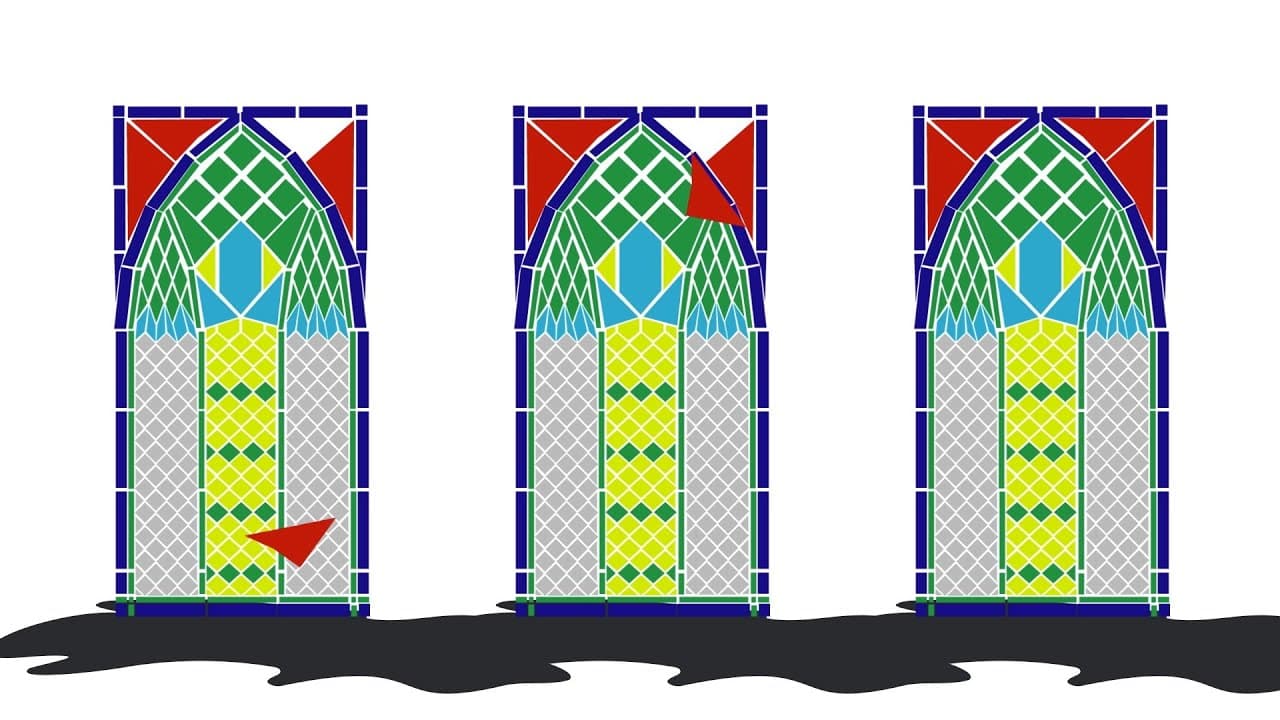
Q: Why are old church windows thicker at the bottom?
Older glass panes were difficult to manufacture with uniform thickness. When installing them, workers placed the thickest part toward the bottom rather than relying on glass to flow there over time.
Q: How does the lead around old windows challenge the idea that glass flows?
The lead holding the panes has a lower viscosity than the glass. If the glass had flowed enough to become thicker at the bottom, the lead should already have ended up as a puddle on the floor.
Q: Why is glass called an amorphous solid?
Glass is cooled so quickly from liquid to solid that its silica molecules do not have time to form a regular crystalline lattice. They remain jumbled, yet their strong chemical bonds still prevent them from sliding past one another at room temperature.
Q: Is pitch a solid or a liquid?
Pitch is a liquid at room temperature, although its extremely high viscosity makes it look solid. Its viscosity is 2.3×10¹¹ times that of water, so it flows extraordinarily slowly.
Q: What happened in the University of Queensland pitch experiment?
Pitch was placed in a funnel in 1927 for what became the world’s longest-running laboratory experiment. In nearly 90 years it produced only nine drips, roughly one per decade, and the last drop mentioned occurred in 2014.
Q: Is Earth’s mantle solid or liquid?
Earth’s mantle is solid despite its high temperature and ability to behave like a fluid over geological timescales. Shear waves propagate through the mantle but cannot pass through liquids, while missing atoms and neighboring atoms filling those gaps allow its crystals to deform extremely slowly.
Summary & Key Takeaways
-
Pitch, a substance that appears solid, is actually a highly viscous liquid at room temperature and exhibits resistance to flow.
-
Glass, despite rumors of flowing over time, is a solid material that is difficult to make with uniform thickness.
-
Earth's mantle, although hot and under extreme pressure, remains solid and behaves like a fluid over geological timescales due to the movement of atoms within crystals.
Read in Other Languages (beta)
Share This Summary 📚
Summarize YouTube Videos and Get Video Transcripts with 1-Click
Try YouTube Summary with ChatGPT & Claude or YouTube Transcript Generator
Explore More Summaries from Veritasium 📚





Summarize YouTube Videos and Get Video Transcripts with 1-Click
Try YouTube Summary with ChatGPT & Claude or YouTube Transcript Generator