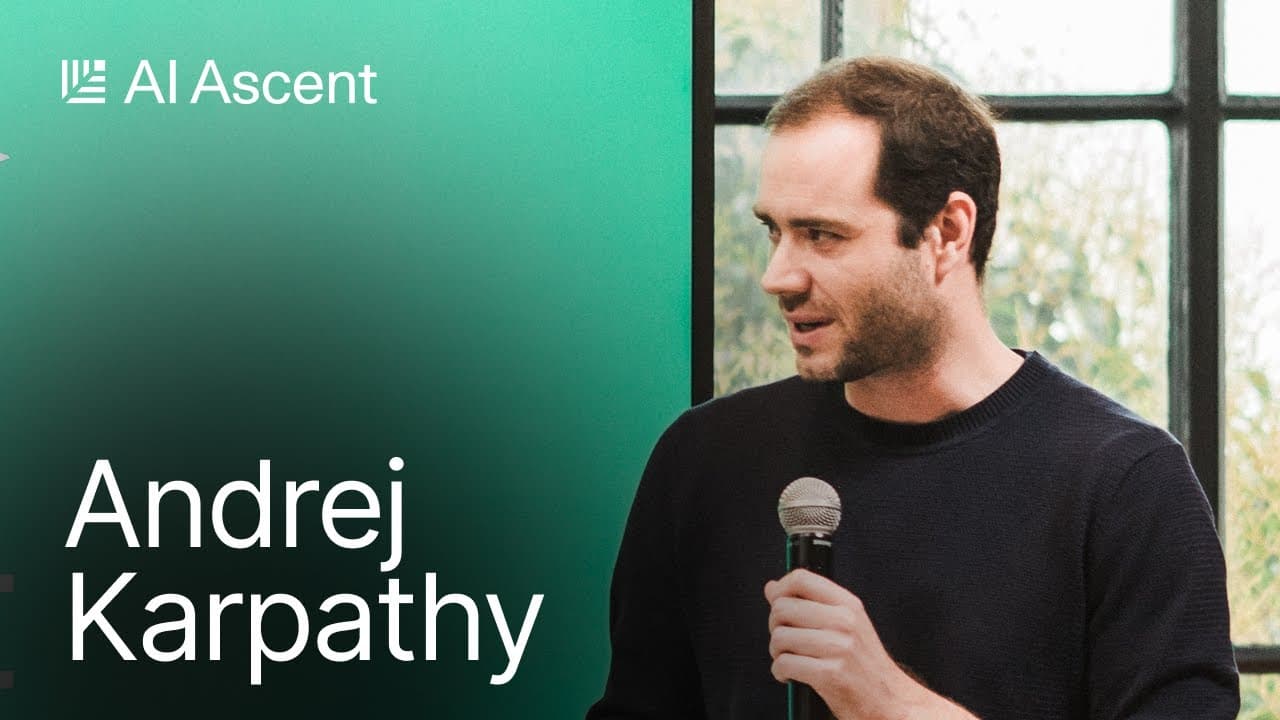
How Does Andrej Karpathy Envision the Future of AI?
TL;DR
Andrej Karpathy believes that the development of Artificial General Intelligence (AGI) is within reach, emphasizing the need for a new 'LLM OS' that integrates various data modalities like text, images, and audio. He advocates for a vibrant and transparent AI ecosystem where independent founders can thrive, while also highlighting the importance of scale, algorithm efficiency, and small, high-performing teams in driving innovation.
Transcript
I'm filed to introduce our next and final speaker Andre karpathy I think karpathy probably needs no introduction most of us have probably watched his YouTube videos at length uh but he's a um he's renowned for his research in deep learning he designed the first deep learning class at Stamford was part of the founding team at open AI led the compute... Read More
Key Insights
- 🖐️ Scale is crucial in AI development, but other factors such as data quality, algorithm efficiency, and computer architecture also play significant roles.
- 🏛️ The AI ecosystem needs more transparency, collaboration, and a focus on building ramps for understanding and utilizing AI models effectively.
- 😤 Elon Musk's unique management style emphasizes small, technical teams, vibrant office culture, direct communication, and a willingness to remove bottlenecks.
- 😌 The future of AI and AGI lies in optimization, expertise, and the development of efficient training techniques.
- 🎙️ More videos with Andrej Karpathy:
Install to Summarize YouTube Videos and Get Transcripts
Explore YouTube Video Summarizer or Get YouTube Transcript Extractor
Questions & Answers
Q: Who are Andrej Karpathy and Stephanie Zhan in this conversation?
Andrej Karpathy is a renowned deep learning researcher who designed the first deep learning course at Stanford, was on the founding team at OpenAI, and led the computer vision team at Tesla before leaving OpenAI. Stephanie Zhan, of Sequoia, hosts the conversation, which takes place near OpenAI's original San Francisco office.
Q: What is the "LLM OS" that Karpathy describes?
Karpathy frames modern AI development as building an operating system where the LLM Transformer is the CPU. Modalities like text, images, and audio act as peripherals that plug in, and it connects to the software 1.0 infrastructure we've already built. The goal is to make it customizable to all the different nooks and crannies of the economy.
Q: What is Karpathy's view of the future of AGI over the next few years?
He says AGI once felt academic and unclear, but now feels within sight, with a lot of space that everyone is trying to fill through optimization. He expects a future of many specialized agents rather than a single one, where high-level tasks are handed to self-contained agents that can be brought up and down.
Q: Where do opportunities exist for other players in the AI ecosystem?
Karpathy addresses the concern that OpenAI dominates and could take out founders overnight. His framing is that the big labs are building the customizable LLM OS platform, which leaves room for other companies to specialize it into the many verticals and niches of the economy.
Q: How should we live our lives differently in anticipation of AGI?
Karpathy is candid that he doesn't fully know. His guidance is to try to build it, influence it, and make sure it's good, so that it turns out well rather than being something that simply happens to us.
Q: What does Karpathy say about Elon Musk's management style?
Karpathy highlights Musk's emphasis on small, highly technical teams, a vibrant office culture, and direct communication with engineers. He also notes Musk's willingness to remove bottlenecks. Karpathy was poached by Elon in 2017 to lead Tesla's autopilot effort, after a run of leaders who each lasted about six months.
Q: Can open source models keep pace with closed source development?
Karpathy acknowledges impressive results from the open source ecosystem, but believes there is still room for improvement in transparency and open collaboration. He frames the ecosystem as needing more openness rather than declaring one side the clear winner.
Summary & Key Takeaways
-
Andre Karpathy discusses his experience working at OpenAI and his belief in the importance of a healthy and vibrant AI ecosystem.
-
He shares his insights on the future of AI and AGI, emphasizing the need for scale, expertise, and efficient training techniques.
-
Karpathy highlights the unique management style of Elon Musk, emphasizing the importance of small, highly technical teams and direct communication with engineers.
Read in Other Languages (beta)
Share This Summary 📚
Summarize YouTube Videos and Get Video Transcripts with 1-Click
Try YouTube Summary with ChatGPT & Claude or YouTube Transcript Generator
Explore More Summaries from Sequoia Capital 📚


Summarize YouTube Videos and Get Video Transcripts with 1-Click
Try YouTube Summary with ChatGPT & Claude or YouTube Transcript Generator