What Is Mark and Sweep Garbage Collection?
TL;DR
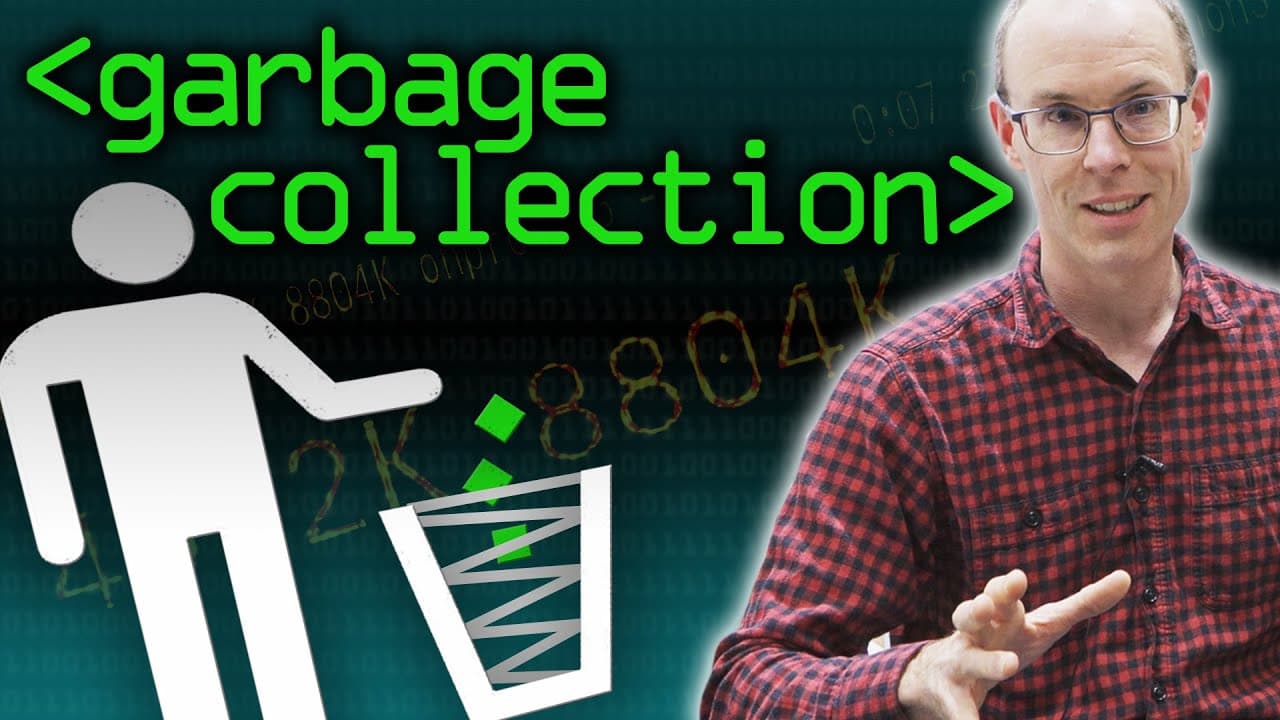
Mark and sweep garbage collection is an automatic memory management technique that identifies and frees memory that is no longer in use. By marking active objects, the algorithm can efficiently reclaim unused memory, preventing leaks and enhancing application performance. This approach simplifies programming by reducing the need for manual memory allocation and deallocation.
Transcript
I thought today we could look at garbage collection which is a form of automatic memory management so the the problem here is when you're programming you never know how much memory your program will use when it's running so if you're running an image processing thing you don't know how big the photo you'll be editing is if you're a web browser you ... Read More
Key Insights
- 💁 Garbage collection is a form of automatic memory management that eliminates the need for manual memory allocation and deallocation.
- 😒 Memory leaks, which occur when memory is not freed after use, can result in a gradual increase in memory usage and system resource depletion.
- 🥶 Garbage collection algorithms, such as reference counting and mark and sweep, effectively identify and free unused memory.
- ❓ Garbage collection improves program reliability, performance, and developer productivity by automating memory management tasks.
- 😒 Memory leaks can still occur in programs using garbage collection if there are references to objects that are no longer in use.
- ❓ Garbage collection algorithms employ various optimizations to minimize the overhead and improve efficiency.
- 🧑🦽 Manual memory management, though more tedious and error-prone, is still used in some programming languages where explicit control is required.
Install to Summarize YouTube Videos and Get Transcripts
Explore YouTube Video Summarizer or Get YouTube Transcript Extractor
Questions & Answers
Q: What is garbage collection and why is it used in programming?
Garbage collection is a technique in programming that automatically manages memory allocation and deallocation. It is used to prevent memory leaks, optimize memory usage, and improve overall program performance.
Q: What are the challenges of manual memory management?
Manual memory management, using techniques like malloc and free, can lead to memory leaks if memory is not deallocated properly. It also requires programmers to accurately track and release memory, which can be challenging and error-prone for larger programs.
Q: How does garbage collection work?
Garbage collection works by automatically tracking memory usage in a program. It identifies objects that are no longer in use and frees up their memory. This process happens periodically or when the system detects a need for memory reallocation.
Q: What are the consequences of memory leaks?
Memory leaks occur when memory is not properly deallocated after use. This can lead to a gradual increase in memory usage, eventually causing the program to run out of memory resources and potentially crash or slow down.
Summary & Key Takeaways
-
Garbage collection is used in programming to automatically manage memory allocation and deallocation, eliminating the need for manual memory management.
-
Traditional memory management techniques, such as malloc and free, require programmers to manually allocate and deallocate memory, which can lead to memory leaks and other errors.
-
Garbage collection solves these issues by automatically tracking and freeing memory that is no longer in use, optimizing memory usage and preventing memory-related problems.
Read in Other Languages (beta)
Share This Summary 📚
Summarize YouTube Videos and Get Video Transcripts with 1-Click
Try YouTube Summary with ChatGPT & Claude or YouTube Transcript Generator
Explore More Summaries from Computerphile 📚



Summarize YouTube Videos and Get Video Transcripts with 1-Click
Try YouTube Summary with ChatGPT & Claude or YouTube Transcript Generator