How Can You Build a Billion-Dollar Solo AI Company? Sam Altman's GPT-5 Solopreneurship Thesis
TL;DR
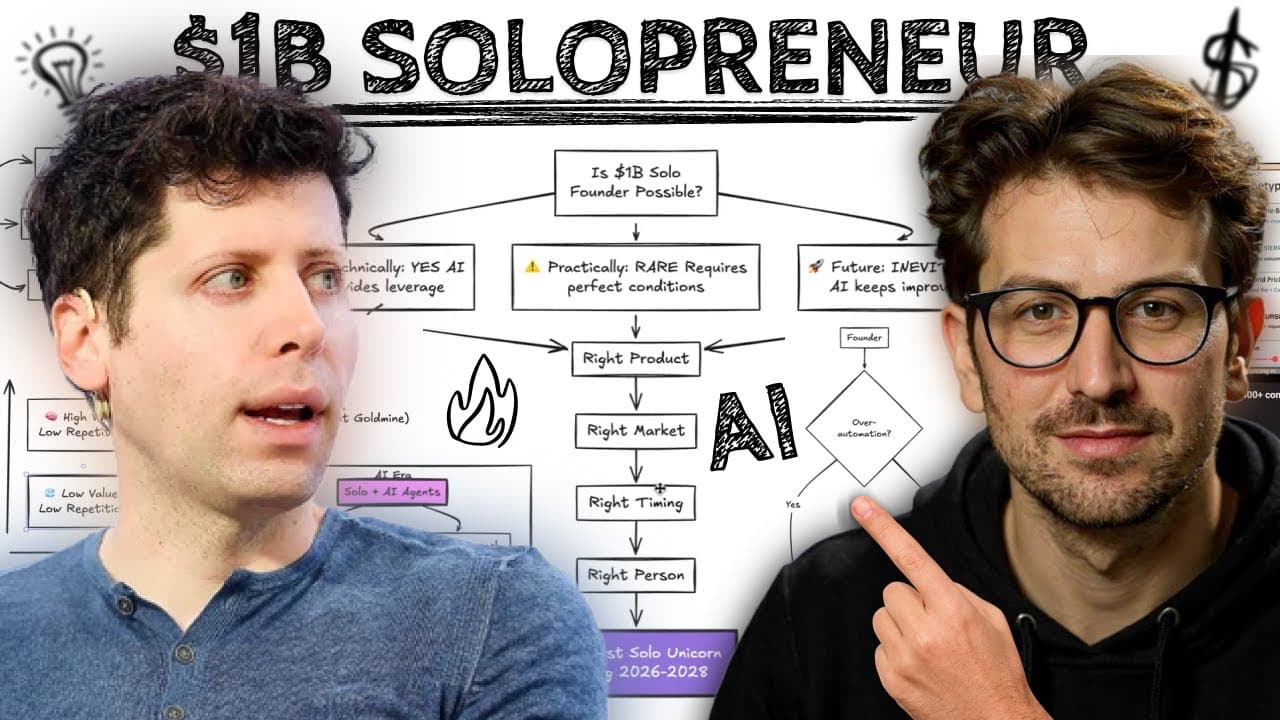
Build a potential billion-dollar solo AI company by growing an audience first, creating a product for demonstrated demand, developing a committed community, and automating recurring work with specialized agents. The proposed structure replaces traditional management layers with a founder directing agents across functions, while retaining people where useful. Idea Browser illustrates the sequence with a three-person team, Cursor-assisted coding, and its Startup Empire community. Read on for the full operating model.
Transcript
Sam Alman says that there's going to be a oneperson soloreneur billiondoll company over the next few years now. Ever since I heard him say this, it's been stuck in my head. Is it actually possible? Can you have one person come up with a billiondoll company? I mean, it's the dream, but is it possible? Um, today's episode is about completely unpackin... Read More
Key Insights
- AI-first companies are structured around a founder managing agents that perform tasks traditionally assigned to employees. Instead of executives supervising engineering, marketing, and sales teams, a small operation can assign those functions to specialized agents and retain humans only where their judgment or management remains useful.
- The new startup path is audience first, followed by product creation, community building, automation, and repetition. Publishing on X, Instagram, or TikTok helps a founder observe demand before creating a product, reducing dependence on the traditional sequence of fundraising, hiring, building, launching, and then seeking customers.
- Audience feedback is a practical form of early product research. The Idea Browser example began with tweets about startup ideas, and audience reactions revealed which content people valued. That response informed a coded product, a private community called Startup Empire, and the gradual automation of recurring work.
- Services are becoming software because AI agents can perform parts of the service itself. A founder can create an agent for social media management or copywriting and charge customers tens or hundreds of dollars per month, opening business categories that extend beyond conventional software tools.
- Existing platforms provide solo founders with access to infrastructure created through billions of dollars in research and development. Integrations with OpenAI and services such as Shopify, Supabase, and Netlify allow founders to assemble products quickly, although they must pay to use the underlying tools.
- Distribution is more accessible through social accounts, creator partnerships, and targeted advertising. Founders can develop followings directly, partner with creators who already have audiences, or use platforms such as Meta, Google, TikTok, and X to reach likely customers with a suitable offer.
- The three core forms of founder leverage are code, audience, and capital. A solo operator does not need to be the strongest developer, but should understand development, select effective products and agents, learn which content formats attract an audience, and accumulate capital over time.
- A one-person billion-dollar company is presented as technically possible but dependent on unusually favorable conditions. The expected progression is that ten-person companies reach billion-dollar valuations first, followed later by a solo company, with the description identifying 2026–2028 as the likely emergence period.
Install to Summarize YouTube Videos and Get Transcripts
Explore YouTube Video Summarizer or Get YouTube Transcript Extractor
Questions & Answers
Q: How can one person build an AI-first company?
The founder can direct specialized agents that perform tasks traditionally handled by engineering, design, marketing, and sales teams. The proposed sequence is to build an audience, create a product for observed demand, strengthen that audience into a community, automate recurring work, and repeat. Humans can remain involved where creative work or agent management benefits from them.
Q: What is the audience-first startup model?
The model begins by publishing content on X, Instagram, or TikTok and observing which ideas and formats people value. The founder then uses AI-assisted coding to build and launch a relevant product, develops a private or in-person community, and automates more work with agents over time.
Q: Why could AI enable a billion-dollar solo company?
AI agents can perform tasks that previously required employees and layers of managers, allowing one founder to coordinate many business functions. Sam Altman's thesis describes a future of one person and 10,000 GPUs, with compute powering agent outcomes. The speaker considers the result technically possible, but not guaranteed.
Q: How does an AI-first company differ from a traditional company?
A traditional company has executives and managers overseeing teams in sales, marketing, engineering, and other functions. An AI-first company instead places a founder above specialized, task-oriented agents. It may still employ people when a creator or agent manager would produce better results.
Q: What steps replace the traditional startup path?
The traditional path is to develop an idea, raise funds, hire people, build a product, launch it, find buyers, and scale. The proposed alternative starts with an audience, uses its response to guide an AI-assisted product, builds a committed community, automates operations with agents, and repeats the cycle.
Q: How did Idea Browser apply the audience-first model?
Idea Browser began when its founder tweeted startup ideas and noticed that people liked them. He then used Cursor primarily to code Idea Browser, created the private Startup Empire community, and automated much of the operation. Its team has three people including the founder, so it is an illustration of the model rather than a one-person company.
Q: What leverage does an AI solopreneur need?
The framework identifies code, audience, and capital as the three core forms of leverage. Code leverage helps the founder select and use products and agents, while audience leverage comes from understanding topics and formats that attract interest. Capital adds operating and growth capacity over time.
Q: What trends support solo AI businesses?
Five trends are identified: services becoming software through agents, distribution through social platforms and creator partnerships, access to established technology platforms, growing trust in small brands, and precise advertising. Together, they help a small operator build, deliver, promote, and sell products without recreating every capability internally.
Summary & Key Takeaways
-
AI-first companies replace the traditional hierarchy of executives and employees with a founder managing specialized agents. Those agents can support engineering, design, marketing, sales, and other recurring functions. This structure allows a much smaller team to pursue outcomes that previously required many employees, although some functions may still benefit from human involvement.
-
The proposed startup path begins with an audience rather than fundraising and hiring. A founder publishes content, studies which topics and formats attract interest, creates a product for that audience, develops a private or in-person community, and gradually automates operations. The Idea Browser example followed this general sequence while retaining three human team members.
-
Five trends support solo AI businesses: services are becoming software, social platforms and creator partnerships provide distribution, existing platforms supply costly infrastructure, customers increasingly trust small brands, and advertising platforms offer precise targeting. Founders can capitalize on these conditions by strengthening code, audience, and capital leverage while using agents to fulfill services.
Read in Other Languages (beta)
Share This Summary 📚
Summarize YouTube Videos and Get Video Transcripts with 1-Click
Try YouTube Summary with ChatGPT & Claude or YouTube Transcript Generator
Explore More Summaries from Greg Isenberg 📚

Summarize YouTube Videos and Get Video Transcripts with 1-Click
Try YouTube Summary with ChatGPT & Claude or YouTube Transcript Generator