How RBI Liquidity and DeepSeek Affect Stocks
TL;DR
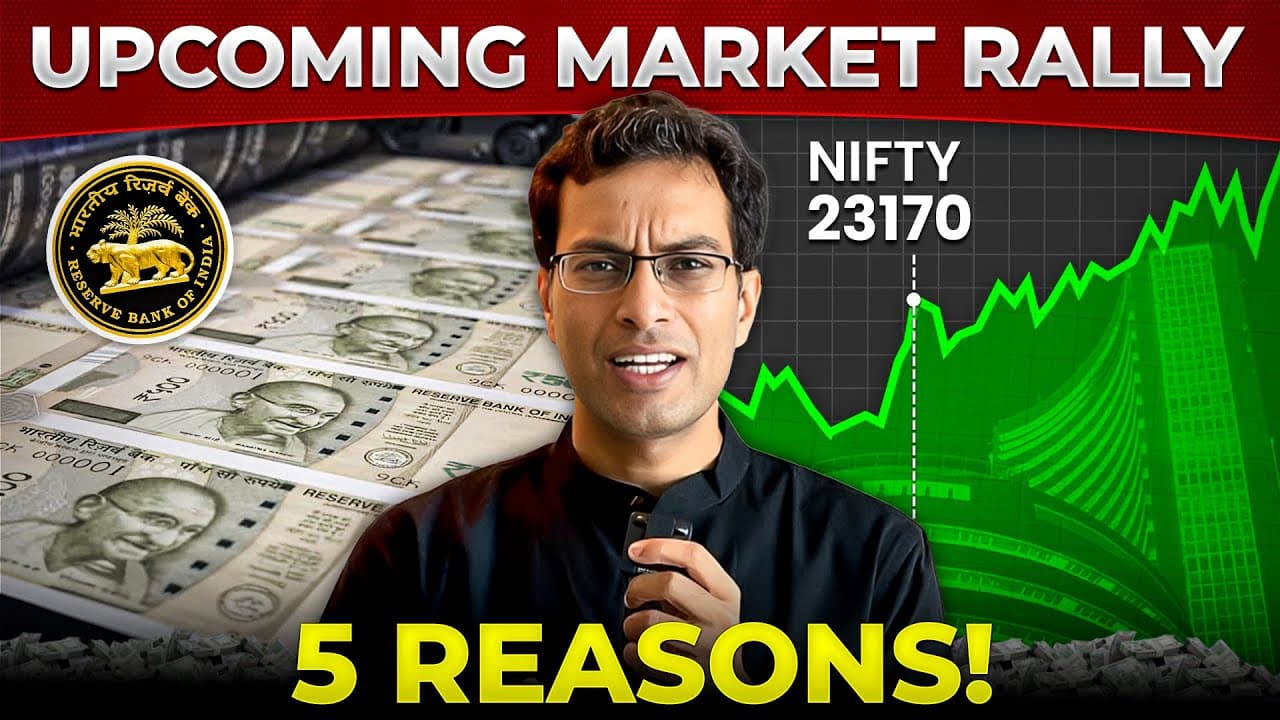
RBI’s planned liquidity infusion could support credit growth, business spending, hiring, company profits, and eventually stock prices, although it may also increase inflation. The analysis also treats DeepSeek-driven weakness in AI stocks as a possible opportunity, noting that Nvidia fell roughly 20% in two days, while stressing that technical signals and commentary should not be treated as investment advice.
Transcript
hi everyone on this video I'm going to do three things number one we are going to speak about the RBI liquidity measures there is a very good chance that going forward RBI is going to keep on injecting more liquidity into the system which means that the stock market is going to rebound from this point I'll help you understand the macroeconomics beh... Read More
Key Insights
- RBI’s liquidity plan includes ₹60,000 crore and an estimated total infusion of ₹1.1 lakh crore into the banking system over the following months. The measure responds to tight liquidity and signals that the central bank is currently placing greater emphasis on supporting growth.
- Liquidity is the amount and flow of money available throughout the economy. The simplified argument is that expanding liquidity tends to raise the prices of stocks, gold, and real estate, while shrinking liquidity can weaken asset prices and reduce economic activity.
- Credit growth fell from 19.9% around April 5 to 11.9% by November in the figures cited. This represents a slowdown in the rate at which lending expanded, not an absolute disappearance of credit or a claim that the total amount of lending declined.
- Deposit growth also slowed during the period discussed. The distinction between growth and the rate of growth is essential, because the claim is that deposits continued changing at a slower pace, not that the banking system suddenly lost all deposits or deposit activity.
- Additional banking liquidity can create a snowball effect by enabling more lending, increasing business spending, supporting hiring, and potentially improving deposit growth. The presenter expects stronger economic activity to translate into better company profits and, eventually, stronger stock prices over the following four or five months.
- Liquidity injections can increase inflation because more money enters the system. The presenter connects the sharp rise in many prices during the preceding two or three years with substantial liquidity introduced in 2020, while emphasizing that the latest measure is not being implemented on the same scale.
- DeepSeek is described as a Chinese-based application generating substantial attention and disruption in the AI sector. Its emergence coincided with a major decline in Nvidia, which corrected by roughly 20% over two days despite being characterized as a multi-trillion-dollar company.
- Kotak Bank shows potentially improving momentum through its 50-day and 150-day moving-average lines. The presenter considers the changing shape of those lines bullish when combined with supportive fundamentals and sentiment, but explicitly says that a technical indicator alone is not sufficient reason to trade.
Install to Summarize YouTube Videos and Get Transcripts
Explore YouTube Video Summarizer or Get YouTube Transcript Extractor
Questions & Answers
Q: How could RBI’s liquidity infusion affect stock prices?
RBI’s planned liquidity infusion could give banks greater access to funds and allow them to lend more freely. More lending may support business borrowing, spending, and hiring, which can strengthen economic activity and company profits. The presenter argues that this snowball effect can eventually improve stock prices, particularly over the following four or five months, although the outcome is presented as an expectation rather than a certainty.
Q: How much liquidity did RBI plan to inject into banks?
The presenter says RBI announced ₹60,000 crore of liquidity and cites an estimated total banking-system infusion of ₹1.1 lakh crore over the following months. RBI also stated that it would monitor liquidity and market conditions and take measures as needed for orderly liquidity management. The announcement is described as a response to tight conditions in the banking system and weak growth momentum.
Q: What does liquidity mean in the stock market?
Liquidity is explained as the amount and flow of money moving through the economy. If the available amount rises from one trillion rupees to two trillion rupees in the presenter’s simplified example, liquidity has doubled. More liquidity can support stocks, gold, real estate, lending, and spending. If liquidity contracts, asset prices and economic activity may face downward pressure.
Q: Why did credit and deposit growth slow in India?
The presenter associates slower credit and deposit growth with a temporary restraint in money and credit flow, along with regulatory actions affecting companies, futures and options, and credit lending. Credit growth is cited as falling from 19.9% around April 5 to 11.9% by November. The key clarification is that their rates of growth slowed, not necessarily that total credit and deposits declined.
Q: Can RBI’s liquidity measures increase inflation?
Additional liquidity can increase inflation because more money is introduced into the economic system. The presenter links the broad rise in prices during the preceding two or three years to the large amount of liquidity injected in 2020. However, the latest RBI action is described as smaller in scale and intended to restart growth while banking-system liquidity remains tight.
Q: Why did DeepSeek affect Nvidia and AI stocks?
DeepSeek is described as a Chinese-based application that created substantial attention and disruption in the AI space. During this period, Nvidia corrected by roughly 20% in two days, which the presenter calls a massive decline for a multi-trillion-dollar company. The discussion frames that fall as a potential buying level, but the supplied transcript does not establish that DeepSeek alone caused the entire correction.
Q: Is Nvidia a good investment after its 20% decline?
The presenter views Nvidia’s roughly 20% correction over two days as a potentially attractive buying point, especially given the company’s earlier substantial growth connected with AI innovation. However, this is explicitly commentary rather than investment advice. Investors are encouraged to develop their own perspective and conduct due diligence instead of assuming that a sharp decline automatically makes the stock suitable for purchase.
Q: What moving-average signal is discussed for Kotak Bank?
The analysis compares Kotak Bank’s 50-day moving average with its 150-day moving average and observes that the lines appear to be changing direction toward a potentially bullish configuration. A previous positive-momentum phase is associated with a roughly 54% to 55% stock-price increase. Still, the presenter says the technical pattern alone is insufficient and should be considered with fundamentals and sentiment.
Summary & Key Takeaways
-
RBI announced measures intended to ease tight banking-system liquidity, including ₹60,000 crore and an estimated total infusion of ₹1.1 lakh crore over the following months. The stated objective is orderly liquidity management while supporting a system in which both credit growth and deposit growth rates have slowed during the preceding period.
-
Additional banking liquidity could allow banks to lend more freely, encouraging businesses to borrow, spend, and hire. The resulting economic activity may support deposit growth, corporate profits, and stock prices through a snowball effect. However, introducing more money can also create inflation, so the measure involves a balance between growth and price pressures.
-
DeepSeek created disruption in the AI market, coinciding with a roughly 20% correction in Nvidia over two days. The presenter views such declines as potential buying opportunities but offers no direct recommendation. Kotak Bank is discussed as another asset with improving fundamental, technical, and sentiment conditions, including a possible bullish moving-average shift.
Read in Other Languages (beta)
Share This Summary 📚
Summarize YouTube Videos and Get Video Transcripts with 1-Click
Try YouTube Summary with ChatGPT & Claude or YouTube Transcript Generator
Explore More Summaries from Akshat Shrivastava 📚




![Why long-term Investing works only FOR THE RICH now? [Instead do MID-TERM investing] thumbnail](/_next/image?url=https%3A%2F%2Fi.ytimg.com%2Fvi%2F3V6i73NCWsc%2Fhqdefault.jpg&w=750&q=75)

Summarize YouTube Videos and Get Video Transcripts with 1-Click
Try YouTube Summary with ChatGPT & Claude or YouTube Transcript Generator