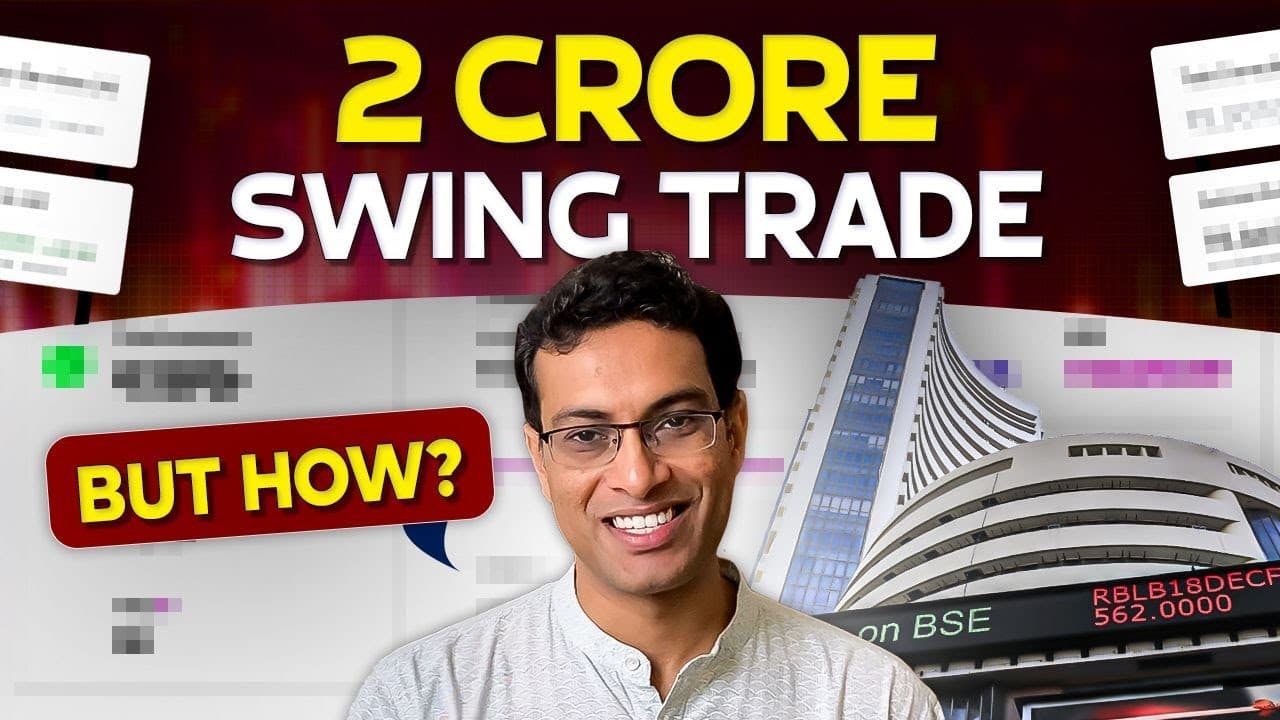
Why Is Akshat Shrivastava Investing About ₹2 Crore in NIFTY Bank for Quick and Safe Returns?
TL;DR
Akshat Shrivastava invested roughly ₹1.75 crore in NIFTY Bank because he saw about 11.5% potential upside versus roughly 4% to 4.5% downside to major support, alongside strong banking growth and attractive relative valuation. He reported being up about 7.5% and expected another 6% to 7% gain, while acknowledging that a broad market correction could hurt the position. Read on to understand his risk-reward framework and investor-oriented response to a decline.
Transcript
hi everyone welcome to today's video so I'm making this video during Market hours so I'll be a little bit quick I had recently or a few months back I took a swing trade of roughly 1.75 CR on Bank Nifty as of today you can see it from my portfolio I am up 7 and a half% I see additional 67% gain on this Bank Nifty as of now so why did I take that Nif... Read More
Key Insights
- Bank Nifty is an index made up of Indian banking stocks with different portfolio weights, including private banks, public-sector banks, and small finance banks. The presenter describes this diversified structure as relatively lower risk than targeting a single banking stock.
- The trade’s technical upside was approximately 11% to 12% from the level shown during the recording. The presenter used the chart’s full target to estimate this potential gain, while emphasizing that the outcome was a possibility rather than a guarantee.
- The first major technical support implied roughly 4% to 4.5% downside from the referenced level. Comparing that downside with approximately 11.5% potential upside formed the basic risk and reward assessment behind the presenter’s Bank Nifty position.
- A trader typically exits when a predetermined stop-loss level is reached. The presenter says that a trader investing ₹5 lakh might close the entire position near a 4.5% loss, while his own investor-oriented approach would allow him to hold through weakness.
- An investor can respond differently from a trader when an index falls. The presenter argues that his longer-term perspective lets him continue holding a diversified banking index instead of automatically exiting at technical support, although this does not eliminate market risk.
- The banking thesis depends on business growth exceeding broader economic growth. The presenter cites an economy growing around 6% to 7% and describes banking profit growth as roughly twice the economy’s rate, supporting his view that the sector offers attractive growth potential.
- The Bank Nifty valuation appeared more attractive to the presenter than the Nifty 50 valuation. He argues that banking businesses had performed well while their prices had not risen correspondingly, creating what he considered an undervalued, lower-risk opportunity.
- The broader market remains a major source of risk for Bank Nifty. The presenter acknowledges that a general market correction would hurt the banking index, while continued channel trading or an upward Nifty 50 breakout could support stronger Bank Nifty performance.
Install to Summarize YouTube Videos and Get Transcripts
Explore YouTube Video Summarizer or Get YouTube Transcript Extractor
Questions & Answers
Q: Why is Akshat Shrivastava investing about ₹2 crore in NIFTY Bank?
Akshat Shrivastava invested roughly ₹1.75 crore because he saw about 11.5% potential upside and only around 4% to 4.5% downside to the first major support. He also viewed banking as a growth industry, considered the index relatively lower risk than an individual stock, and believed Bank Nifty was undervalued compared with Nifty 50.
Q: How do you evaluate a NIFTY Bank swing trade?
Start by using technical analysis to compare the potential gain with the loss to major support. Then assess banking fundamentals, relative valuation, and the direction of the broader Nifty 50 market; in this case, the setup offered roughly 11% to 12% potential upside versus about 4% to 4.5% downside to support.
Q: What is NIFTY Bank and what does it contain?
NIFTY Bank is an index containing Indian banking stocks with different weights. The presenter describes it as a briefcase holding companies such as HDFC Bank, ICICI Bank, Axis Bank, public-sector banks, and small finance banks.
Q: How much upside did the NIFTY Bank setup offer?
The complete technical target indicated approximately 11% to 12% potential upside from the referenced level, with the presenter estimating about 11.5%. He reported that his position was already up about 7.5% and said he saw an additional 6% to 7% gain at that time.
Q: How much downside was there to NIFTY Bank’s major support?
The first major technical support was roughly 4% to 4.5% below the referenced level. The presenter compared that possible decline with approximately 11.5% potential upside to judge whether the trade’s risk and reward were attractive.
Q: How should a trader respond if the NIFTY Bank swing trade fails?
A trader would typically place a stop loss and exit when the predetermined loss level is reached. The presenter says that someone investing ₹5 lakh might close the entire position at around a 4.5% loss.
Q: Why might an investor hold NIFTY Bank through a decline?
The presenter distinguishes his investor approach from short-term trading because he can maintain a longer-term view rather than automatically exiting at technical support. He considers an index relatively lower risk than a single stock because it spreads exposure across multiple banking companies, though a broader market correction can still cause losses.
Q: Why does the presenter expect Indian banks to grow?
He argues that banks should benefit as India’s economy expands, discretionary income rises, and more people use financial products. He describes the economy as growing around 6% to 7% and banking profits as growing at roughly twice that rate, supporting his view that the sector can outgrow the broader economy.
Summary & Key Takeaways
-
The presenter invested roughly ₹1.75 crore in Bank Nifty and reported being up about 7.5% during the recording. His technical analysis indicated approximately 11% to 12% total upside if the chart target was achieved, while the first major support represented a decline of roughly 4% to 4.5%.
-
Bank Nifty is described as an index containing Indian banking stocks with different weights. The presenter considers an index relatively lower risk than an individual stock because it spreads exposure across multiple companies. He also argues that banking can grow strongly as India’s economy, incomes, and use of financial products expand.
-
The thesis combines technical patterns, banking fundamentals, relative valuation, and the broader market trend. The presenter believes Bank Nifty is undervalued compared with Nifty 50 and could rise faster if the broad index advances. He nevertheless acknowledges that Bank Nifty would probably be hurt if the overall market corrected.
Read in Other Languages (beta)
Share This Summary 📚
Summarize YouTube Videos and Get Video Transcripts with 1-Click
Try YouTube Summary with ChatGPT & Claude or YouTube Transcript Generator
Explore More Summaries from Akshat Shrivastava 📚





Summarize YouTube Videos and Get Video Transcripts with 1-Click
Try YouTube Summary with ChatGPT & Claude or YouTube Transcript Generator