How to Build Wealth With Income and Smart Investing
TL;DR
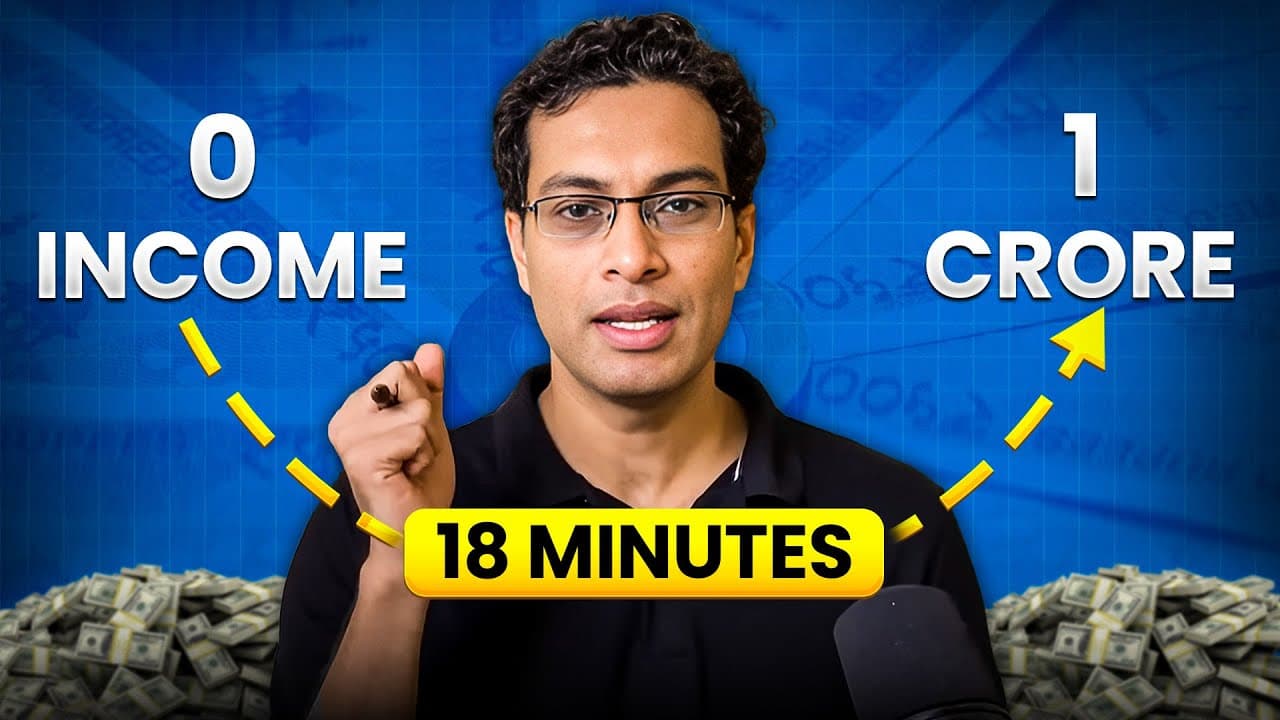
Build wealth by first creating enough active, passive, or semi-passive income to save meaningful capital, then invest that capital in growth-oriented assets. Diversify across asset classes, study market cycles, limit tax-inefficient trading, avoid property with abundant competing supply, and rotate capital toward good assets available at attractive prices.
Transcript
hi everyone so 14 years ago I used to live in this house in pandam nagar New Delhi and every day I used to take a Metro to work in simple words I was living a Frugal life so to say right and I still whenever I'm in Delhi I take a Metro I enjoy Metro rides uh but it was not like a lavish lifestyle that I was living now I live in UAE I travel the wor... Read More
Key Insights
- A strong income source is the foundation of wealth building because investing requires meaningful surplus capital. Income may be active through employment or business, passive through rent, or semi-passive through activities such as operating an Airbnb or producing YouTube content.
- The amount invested can matter more than an exceptional percentage return on a small base. The speaker compares investing ₹1 lakh with a roughly 100% three-year return against saving ₹10 lakh annually and earning 50% over three years, favoring the larger contribution.
- Growth-oriented investing becomes important after income and savings are established. The speaker recommends keeping only limited emergency money in fixed deposits and warns that slow-growth instruments are unlikely to transform wealth, particularly for investors already saving more than 25–30% of salary.
- Low post-tax returns can reduce purchasing power when they fall below inflation. The example given is a 7% fixed-deposit rate that becomes 4.95% after tax, compared with inflation stated as 6%, resulting in annual wealth depreciation in real terms.
- Diversification across asset classes creates opportunities to buy assets during different phases of their cycles. The speaker says equities, real estate, and Bitcoin each experience cycles, so understanding several markets can improve both purchase and exit decisions.
- Trading is generally unsuitable as a core wealth-building method in tax-inefficient markets. The speaker cites a 20% short-term capital gains tax on most asset classes in India and contrasts it with the stated zero capital-gains tax position for a UAE tax resident investing in the US market.
- Township apartments may be weak investments when competing supply can continue expanding. The speaker distinguishes purchasing a home for personal use from treating it as an investment and warns against committing two incomes to long-term EMIs without evaluating scarcity and potential returns.
- Capital rotation is the practice of moving money toward attractive opportunities instead of investing mechanically. The speaker rejects mindless investing for 30–35 years regardless of valuation and illustrates the principle with a ₹1 crore property offered for ₹80 lakh because its owner urgently needs money.
Install to Summarize YouTube Videos and Get Transcripts
Explore YouTube Video Summarizer or Get YouTube Transcript Extractor
Questions & Answers
Q: How should someone start building wealth?
Someone should start by developing a solid source of income that leaves enough money to save and invest. That income can come from employment, a business, rental property, or a semi-passive activity such as Airbnb or YouTube. The central argument is that stock-market or mutual-fund investing cannot easily create substantial wealth when the underlying investable surplus remains too small.
Q: What are active, passive, and semi-passive income sources?
Active income requires direct ongoing work and can come from a job or business. Passive income continues with limited involvement, illustrated by purchasing a flat and collecting rent. Semi-passive income still needs periodic work, with Airbnb operations and YouTube content offered as examples. These sources can be combined, provided they generate enough surplus capital for saving and investment.
Q: Why can saving more matter more than earning higher returns?
A very high return on a small investment may produce less wealth than a moderate return on a much larger contribution. The speaker illustrates this by comparing ₹1 lakh that doubles over three years, roughly a 29–30% compound annual growth rate, with saving ₹10 lakh per year and growing it by 50% over three years. Larger savings are presented as more practical and sustainable.
Q: When should fixed deposits be used in a wealth plan?
Fixed deposits are presented mainly as a place for a limited amount of emergency money, not as the principal engine of wealth growth. The example uses a 7% base return from HDFC Bank that falls to 4.95% after tax. With inflation stated as 6%, the speaker argues that relying heavily on such an instrument can reduce real wealth over time.
Q: How does diversification across asset classes help investors?
Diversification helps because different assets can be at different stages of their cycles. The transcript discusses Indian equities, US equities, real estate, and Bitcoin as markets whose prices do not necessarily move through the same phases simultaneously. Understanding several asset classes can help an investor identify discounted opportunities, avoid concentrating wealth in one market, and recognize when an exit may be appropriate.
Q: Why does the speaker recommend avoiding frequent trading in India?
The speaker considers India tax-inefficient for frequent trading and cites a 20% short-term capital gains tax on most asset classes. Real-estate transactions may also involve stamp duty, direct and indirect taxation, and GST. The proposed general approach is to purchase solid investable assets and hold them, while considering international diversification as personal wealth increases rather than treating trading as the default strategy.
Q: Why might township apartments be poor investments?
Township apartments may face continuing competition because developers can build more similar projects, creating what the speaker characterizes as almost infinite supply. That supply can restrict investment returns even when the property remains suitable as a home. The warning is particularly directed at couples who commit both incomes to EMIs for 20–25 years while assuming the purchased flat will necessarily be a strong investment.
Q: What does rotating capital mean in investing?
Rotating capital means directing money toward sound assets when they are attractively priced instead of continuing the same investment mechanically under every market condition. The transcript uses the example of a bungalow with a market value of ₹1 crore offered for ₹80 lakh because the owner needs money urgently. The principle is to recognize discounts, assess the underlying asset, and act when value appears favorable.
Summary & Key Takeaways
-
The foundation of wealth building is a strong income source, whether active, passive, semi-passive, or a combination of all three. Investing cannot compensate easily for inadequate savings. The speaker argues that saving ₹10 lakh annually and earning moderate growth can be more consequential than investing ₹1 lakh and achieving an unusually high return.
-
After establishing income and savings, money should be directed toward assets capable of meaningful growth. The speaker reserves fixed deposits primarily for limited emergency funds and warns that low post-tax returns may trail inflation. Investors with adequate capital and high savings rates may therefore need to accept risk to pursue long-term wealth growth.
-
Effective investing requires understanding asset cycles, taxes, supply, and valuation. The speaker favors diversification, discourages routine trading in tax-inefficient markets, and questions township properties as investments because additional supply can restrict appreciation. Capital rotation means buying sound assets at discounts instead of following an investment plan mechanically regardless of price or conditions.
Read in Other Languages (beta)
Share This Summary 📚
Summarize YouTube Videos and Get Video Transcripts with 1-Click
Try YouTube Summary with ChatGPT & Claude or YouTube Transcript Generator
Explore More Summaries from Akshat Shrivastava 📚





Summarize YouTube Videos and Get Video Transcripts with 1-Click
Try YouTube Summary with ChatGPT & Claude or YouTube Transcript Generator