Why Deepseek R1 is a Game-Changer in AI Models
TL;DR
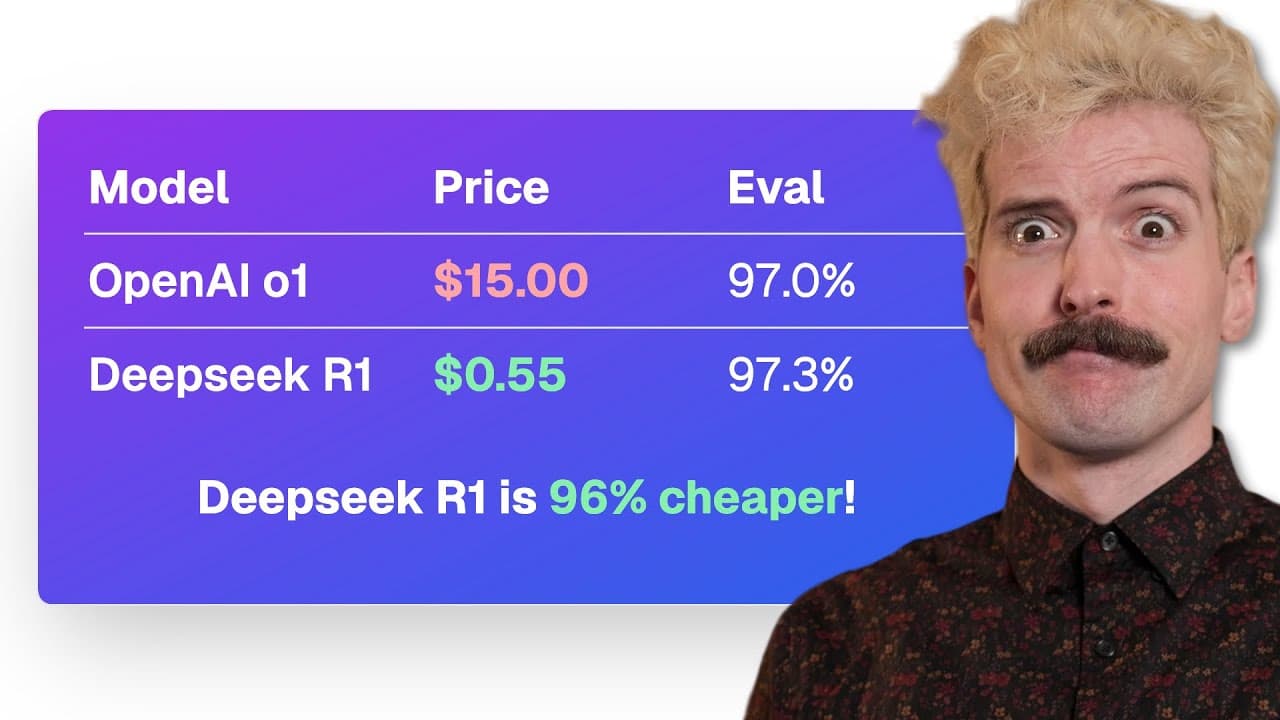
Deepseek R1 surpasses ChatGPT in performance while being significantly more affordable, costing just 55 cents per million tokens. Its open-source nature allows users to view its reasoning process, enhancing transparency and accessibility. Trained on synthetic data, this model signals a critical evolution in AI development, offering a promising alternative to traditional systems despite some speed limitations.
Transcript
open AI should be scared right now there's a new player in the open source bottle space that isn't just close to chat GPT performance it's beating it in a lot of ways and it is comically cheaper too and I mean comically cheaper we're talking a reduction from $15 per million tokens to 55 and $60 per million output tok... Read More
Key Insights
- An open-source model, Deepseek R1, is outperforming ChatGPT in various benchmarks and is significantly cheaper, costing only 55 cents per million input tokens.
- Deepseek R1 allows users to see the reasoning process behind its outputs, offering more transparency compared to closed models like ChatGPT.
- The model is open source and can be run on personal devices, including phones, making high-performance AI more accessible.
- Deepseek R1 is trained on synthetic data, a method supported by research from Google, which suggests synthetic data can meet or exceed the quality of human-generated data.
- The model's open-source nature allows for transparency and potential community-driven improvements, but also raises concerns about embedded biases.
- Despite its advantages, Deepseek R1 can be slower and more resource-intensive due to its detailed reasoning process.
- The rise of open-source models like Deepseek R1 could challenge proprietary AI models by providing high-quality alternatives at a fraction of the cost.
- The use of synthetic data for training AI models could reshape the industry by reducing dependency on traditional data sources, which are becoming less accessible.
Install to Summarize YouTube Videos and Get Transcripts
Explore YouTube Video Summarizer or Get YouTube Transcript Extractor
Questions & Answers
Q: What makes Deepseek R1 stand out from other AI models?
Deepseek R1 stands out due to its open-source nature, allowing users to see and understand the reasoning process behind its outputs. It is also significantly cheaper than other models, costing just 55 cents per million input tokens. Additionally, it can be run on personal devices, including phones, making it more accessible.
Q: How does Deepseek R1 achieve its cost-effectiveness?
Deepseek R1 achieves cost-effectiveness by being open-source and using synthetic data for training. The model's design allows it to outperform other models while being significantly cheaper to operate, with costs as low as 55 cents per million input tokens, compared to $15 for ChatGPT.
Q: What are the potential drawbacks of using Deepseek R1?
Potential drawbacks of using Deepseek R1 include slower response times due to its detailed reasoning process, which can be more resource-intensive. Additionally, while its open-source nature allows for transparency, it also raises concerns about potential biases embedded in the model.
Q: How does synthetic data contribute to Deepseek R1's performance?
Synthetic data contributes to Deepseek R1's performance by providing a large and diverse dataset for training, which can meet or exceed the quality of human-generated data. This approach reduces dependency on traditional data sources and allows for the creation of high-quality models at a lower cost.
Q: What are the implications of Deepseek R1's open-source nature?
The open-source nature of Deepseek R1 implies greater transparency and the potential for community-driven improvements. It allows users to see the model's reasoning process and make modifications, fostering innovation and collaboration. However, it also raises concerns about the potential for embedded biases.
Q: How does Deepseek R1 compare to ChatGPT in terms of performance?
Deepseek R1 outperforms ChatGPT in various benchmarks, offering more accurate and consistent answers. It provides a transparent reasoning process, allowing users to understand how it generates outputs. Additionally, it is significantly cheaper to operate, making it a competitive alternative to ChatGPT.
Q: What role does transparency play in Deepseek R1's design?
Transparency is a key feature of Deepseek R1's design, allowing users to see the reasoning process behind its outputs. This transparency helps users understand the model's decision-making process and identify potential areas for improvement, fostering trust and collaboration within the AI community.
Q: What future developments can be expected in the AI industry due to models like Deepseek R1?
Future developments in the AI industry due to models like Deepseek R1 include increased accessibility to high-performance AI, reduced dependency on proprietary models, and a shift towards using synthetic data for training. These models may lead to more community-driven innovation and challenge existing proprietary AI systems.
Summary & Key Takeaways
-
Deepseek R1 is an open-source AI model that is outperforming existing proprietary models like ChatGPT. It provides a transparent reasoning process, allowing users to understand how it generates outputs. This model is significantly cheaper to operate, making advanced AI more accessible to a wider audience.
-
The model's training on synthetic data represents a shift in AI development. Synthetic data is shown to be effective in creating high-quality models, as supported by research from Google's DeepMind. This approach reduces reliance on traditional data sources, which are becoming less accessible over time.
-
Despite its advantages, Deepseek R1 has some drawbacks, including slower response times due to its detailed reasoning process. However, its open-source nature allows for community-driven improvements, offering a promising alternative to closed AI systems and potentially reshaping the AI landscape.
Read in Other Languages (beta)
Share This Summary 📚
Summarize YouTube Videos and Get Video Transcripts with 1-Click
Try YouTube Summary with ChatGPT & Claude or YouTube Transcript Generator
Explore More Summaries from Theo - t3․gg 📚






Summarize YouTube Videos and Get Video Transcripts with 1-Click
Try YouTube Summary with ChatGPT & Claude or YouTube Transcript Generator