Parsing Explained - Computerphile
TL;DR
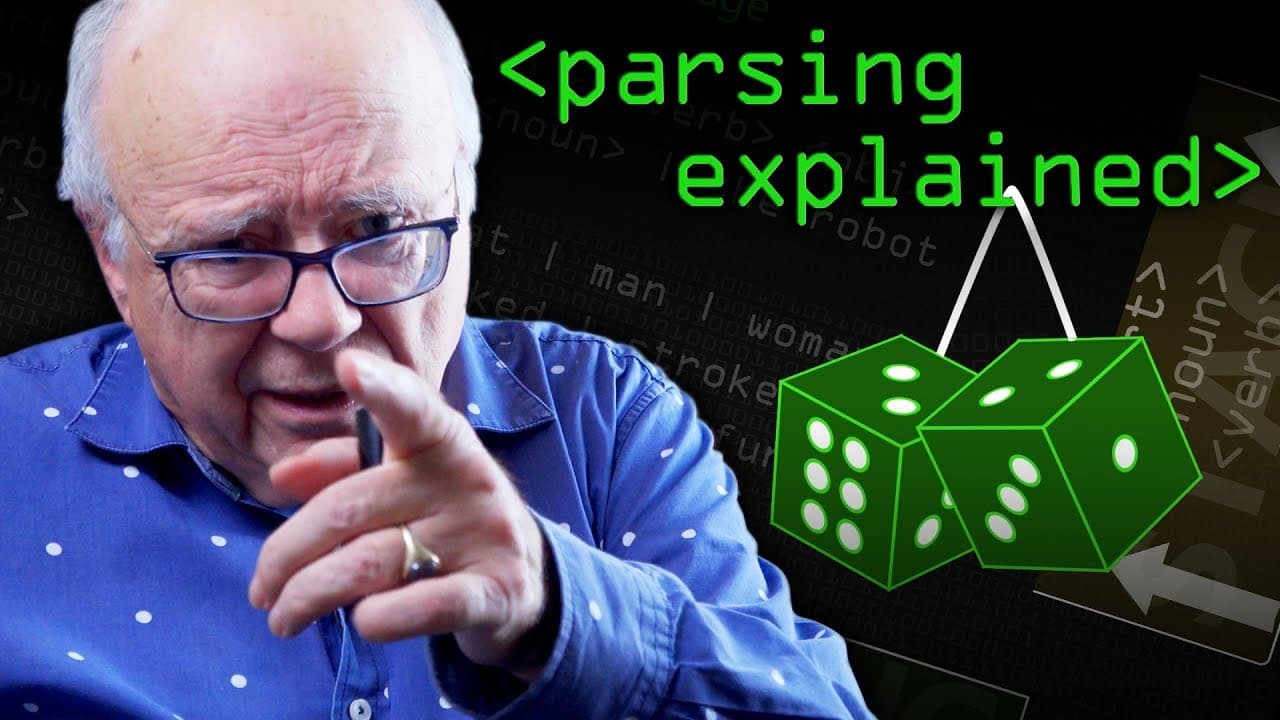
Parsing breaks a sentence into structural components according to a language’s grammar. Using a small English subset capable of generating between two and three hundred valid sentences, the explanation parses “the robot stroked two furry dice” as a subject, verb, and object. It also contrasts top-down parsing from the tree’s root with bottom-up parsing from its leaves, giving readers a concrete foundation for understanding how formal grammar guides parsing.
Transcript
i actually think that if we're going to do parsing it might be easiest not to dive into compilers straight away some of you might want me to do but to actually just take a simple very simple subset of the english language and see how we would pass that and if you look up in a dictionary what does parsing mean it says essentially one of the definiti... Read More
Key Insights
- 🍳 Parsing involves breaking down sentence structures based on grammar rules.
- 🌲 Different parse trees and ambiguities may arise, but they may not always impact understanding or outcomes.
- 🆘 Grammar is a fundamental aspect of language that helps us convey meaning and structure.
- ❓ The top-down and bottom-up approaches are two common methods of parsing.
- 🪡 Ambiguities can occur in languages, but their impact depends on the context and specific communication needs.
- 👨💻 Parsing is also relevant in computer science and programming languages, helping analyze and understand code structures.
- ❓ The importance of grammar in language becomes evident when considering potential inconsistencies and different interpretations.
Install to Summarize YouTube Videos and Get Transcripts
Explore YouTube Video Summarizer or Get YouTube Transcript Extractor
Questions & Answers
Q: What is parsing, and how does it work?
Parsing means breaking a sentence’s structure into component parts under the direction of grammar rules. The parser determines whether each part can be assigned the correct structural role, such as subject, verb, or object.
Q: What grammar is used to explain parsing?
The example uses a deliberately small subset of English involving fairy dice, robots, people, men, women, cats, and dogs. Its grammar can generate between two and three hundred valid English sentences, although it does not capture the full spirit of English.
Q: How is a sentence structured in the example grammar?
A sentence is defined as a subject followed by a verb and then an object. The subject performs the action, the verb identifies the action, and the object identifies what receives that action.
Q: How is “the robot stroked two furry dice” parsed?
The grammar tests whether “the robot stroked two furry dice” can be decoded into the required structural components. “The robot” serves as the subject, “stroked” matches a permitted verb, and the fixed phrase “two furry dice” is defined as a valid object.
Q: What is top-down parsing?
Top-down parsing starts at the root of the parse tree with the rule that a sentence must contain a subject, verb, and object. It then works toward the target string by treating those required components as subtasks that can be pushed onto a stack.
Q: What is bottom-up parsing?
Bottom-up parsing starts with the words, represented as the leaves of the parse tree, and groups them into larger structural components. The goal is to keep working upward until those groups reach the tree’s root and form a valid sentence.
Q: What words can the example grammar generate?
A subject can use an article with a noun such as dog, cat, man, woman, or robot. Articles can include “the” or “a,” while the available verbs include “bit,” “kicked,” and “stroked.”
Q: Why are angle brackets used in the grammar?
The angle brackets mark elements that will become structural parts of a parse tree. The notation was developed when computer scientists writing compilers needed a formal specification of the rules in a language, and it was used in developing a grammar for ALGOL 60.
Summary & Key Takeaways
-
Parsing involves breaking up sentences into their component parts based on grammar rules.
-
The example used involves a subset of the English language involving fairy dice, robots, and people, and can generate between two and three hundred sentences.
-
There may be different parse trees and ambiguities, but in some cases, they may not have a significant impact on understanding or outcomes.
Read in Other Languages (beta)
Share This Summary 📚
Summarize YouTube Videos and Get Video Transcripts with 1-Click
Try YouTube Summary with ChatGPT & Claude or YouTube Transcript Generator
Explore More Summaries from Computerphile 📚

Summarize YouTube Videos and Get Video Transcripts with 1-Click
Try YouTube Summary with ChatGPT & Claude or YouTube Transcript Generator