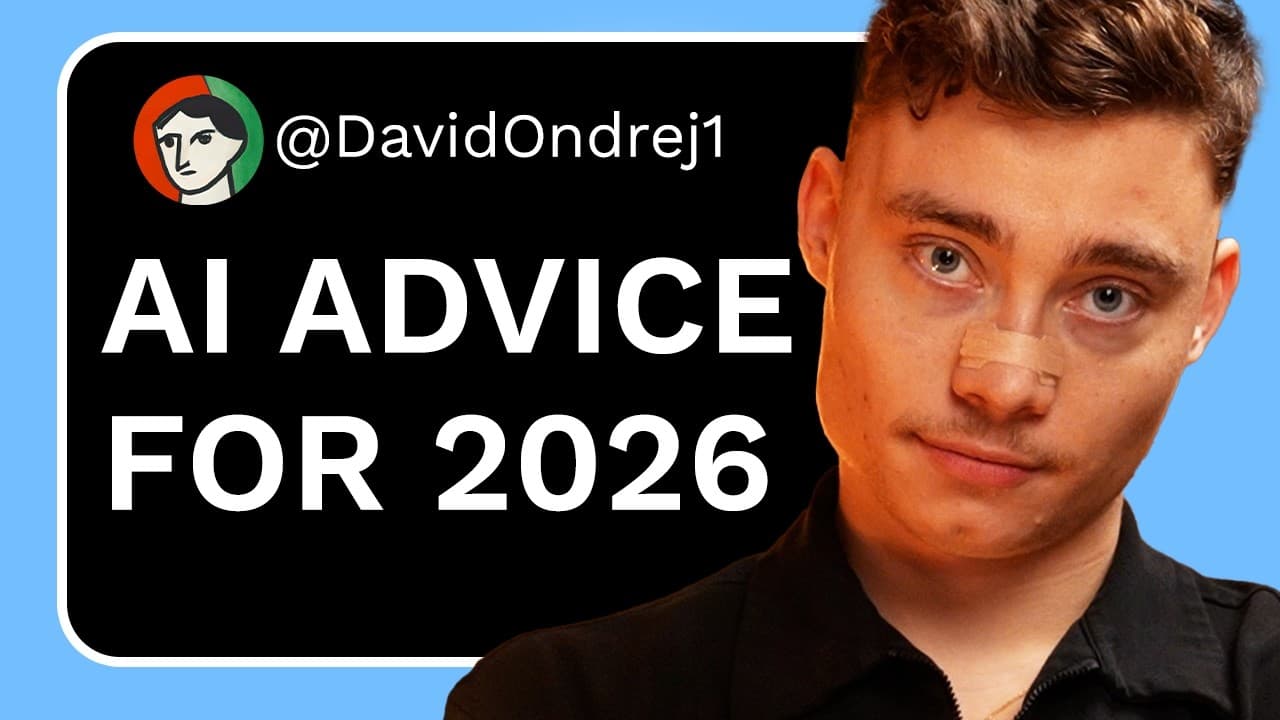
Is AI a Bubble? 28 Months of AI Lessons and 2026 Predictions in 32 Minutes
TL;DR
AI is not a bubble in David Andre’s analysis because it already has practical use cases and companies are generating substantial revenue growth. He distinguishes public-market risks from inflated private startup valuations, while allowing for a possible 10% to 30% pullback. He also examines smaller models, reinforcement learning, compute constraints, open-source AI, jobs, and coding skills. Read on for the evidence and predictions behind his outlook.
Transcript
My name is David Andre and I've spent the last 28 months focused on one thing, AI. In this video, I'm going to give you a detailed analysis of the main trends, patterns, and changes I see in the AI industry as well as a set of predictions for 2026. So, the topic that everyone is talking about is whether AI is a bubble or not. And a good huristic I ... Read More
Key Insights
- AI is not a bubble because it has real-world applications and generates revenue.
- Massive investment in AI is driven by its transformational potential, unlike speculative tech bubbles.
- Open-source AI models are catching up to and sometimes surpassing closed-source models.
- Smaller, specialized AI models are becoming more useful than large, generic ones due to efficiency.
- Compute is the biggest bottleneck in AI, driving significant investment in data centers.
- AI is expected to replace many repetitive jobs, leading to social unrest and protests.
- Learning to code will become increasingly valuable as it enhances the effectiveness of AI tools.
- AI safety concerns have diminished as practical use of AI has clarified its limitations.
Install to Summarize YouTube Videos and Get Transcripts
Explore YouTube Video Summarizer or Get YouTube Transcript Extractor
Questions & Answers
Q: Is AI a bubble?
David Andre argues that AI itself is not a bubble because people already use it daily and major AI companies are producing substantial revenue growth. He contrasts that with the crypto boom of 2021, when many companies and assets lacked meaningful use cases or revenue. However, he sees bubble-like conditions among early-stage startups raising large private rounds without revenue, product-market fit, or proven records.
Q: Could the AI market still experience a crash?
Yes. Andre considers a short- to medium-term stock-market pullback likely and says it could reach 10%, 20%, or even 30%. He distinguishes that possibility from the roughly 80% dot-com-era market crash and says he does not expect a decline of that magnitude.
Q: What is the strongest evidence of an AI investment bubble?
Andre identifies the private startup market as the strongest warning sign. He describes consumer and application-layer startups raising unusually large rounds despite having no revenue, no product-market fit, and unproven track records. He predicts that many privately backed startups will crash and burn.
Q: How is today’s AI cycle different from the 2021 crypto boom?
The two major differences are use cases and revenue. AI is already useful in daily life, while Andre says much of the 2021 crypto activity, especially NFTs and obscure coins, was speculative. He also says AI companies are achieving revenue growth that crypto companies often lacked.
Q: Why was GPT-5 made smaller than GPT-4.5?
Andre says OpenAI intentionally made GPT-5 smaller and more compute-efficient than GPT-4.5. The goal was to make it faster, serve many more users, and improve availability on the free plan. He presents the smaller size as an efficiency decision rather than proof that AI progress has stalled.
Q: Why does reinforcement learning matter for continued AI progress?
Andre describes reinforcement learning, especially when combined with test-time compute, as a largely untapped frontier. He argues that when a task has a measurable benchmark, AI models can train toward achieving and mastering it. He believes these gains weaken the argument that model progress has stopped.
Q: What are reinforcement-learning environments for AI agents?
They are simulated settings where AI agents and models practice a specific task. Andre gives online shopping as a common example: developers can recreate a site like Amazon and train agents to navigate and use it. He notes that startups in San Francisco are working on these environments.
Q: What broader AI trends and predictions does David Andre examine?
Drawing on 28 months focused on AI, Andre analyzes industry trends, patterns, and changes and offers predictions for 2026. The page highlights open-source models, smaller specialized models, compute constraints, repetitive-job displacement, coding skills, and changing AI-safety concerns. His central outlook is that AI remains transformational despite possible market corrections and failures among overfunded startups.
Summary & Key Takeaways
-
AI is not a bubble due to its practical applications and revenue growth, unlike speculative tech bubbles. While short-term market corrections are possible, AI's transformational potential ensures its sustainability. The industry sees significant investment, particularly in compute infrastructure, which remains a bottleneck.
-
Open-source AI models are gaining ground on closed-source ones, and smaller, specialized models are proving more efficient than larger, generic models. This trend is reshaping the AI landscape, with compute as a critical resource driving investment in data centers and infrastructure.
-
AI is poised to replace many repetitive jobs, leading to potential social unrest. However, learning to code will become increasingly valuable, as it allows individuals to leverage AI tools more effectively. The industry's focus has shifted from AI safety concerns to practical applications and growth.
Read in Other Languages (beta)
Share This Summary 📚
Summarize YouTube Videos and Get Video Transcripts with 1-Click
Try YouTube Summary with ChatGPT & Claude or YouTube Transcript Generator
Explore More Summaries from David Ondrej 📚


Summarize YouTube Videos and Get Video Transcripts with 1-Click
Try YouTube Summary with ChatGPT & Claude or YouTube Transcript Generator