What Is Consideration in Contract Law and Why It Matters?
TL;DR
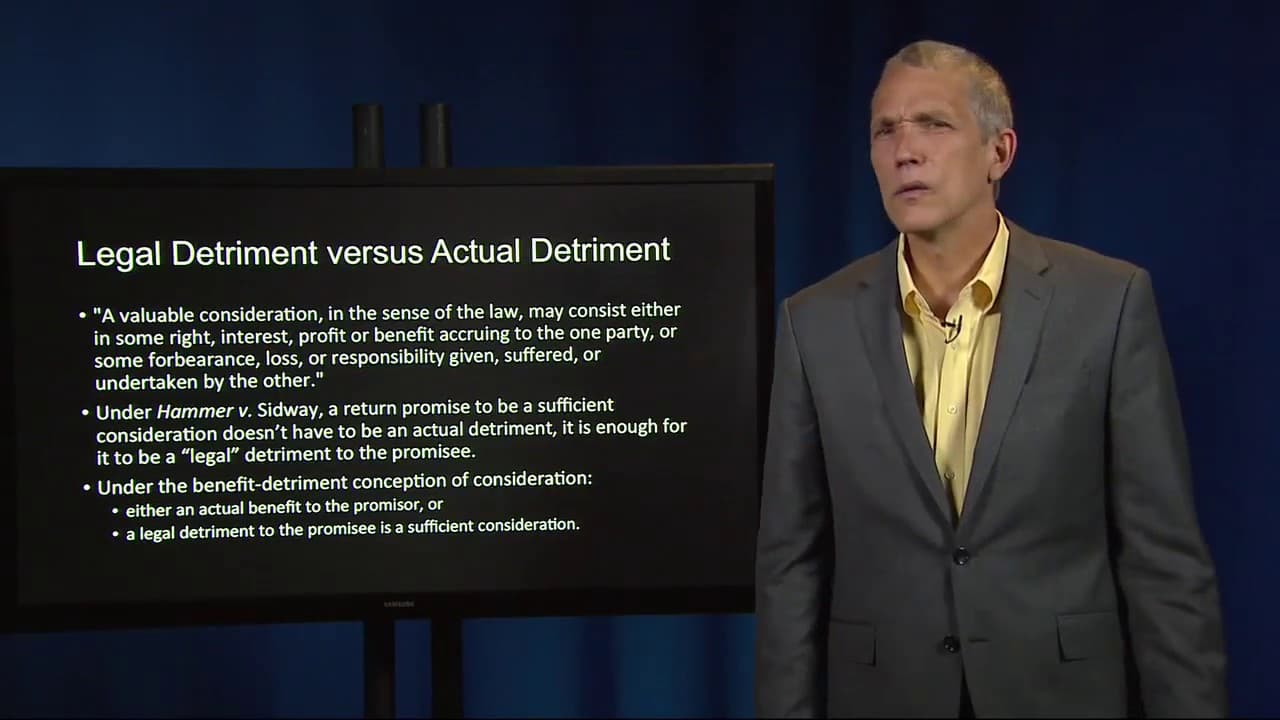
In contract law, consideration refers to something of value exchanged between parties, which can include a promise, benefit, or legal detriment. The Hamer v. Sidway case illustrates that the nephew's forbearance from harmful activities constituted sufficient legal detriment, allowing the court to enforce the uncle's promise to pay $5,000. Modern courts often focus on whether the promise was bargained for rather than just the existence of a benefit or detriment.
Transcript
today we're going to learn about the concept of consideration by exploring the classic chestnut of a case Hamer vs. Sid way which was decided by the New York Court of Appeals in 1891 the facts of this family dispute are memorable william ii story senior promised to pay his nephew william ii story ii $5,000 if the latter would refrain from drinking ... Read More
Key Insights
- 🧑🏫 The Hamer vs. Sidway case is a classic example used to teach the concept of consideration in contract law.
- 🏆 Consideration can be a promise, benefit, or legal detriment, with the legal detriment test being the traditional approach.
- ↩️ The modern approach to consideration focuses on whether the returned promise was bargained for and actually induced the promise or to make their promise.
- 📞 The case highlights the difficulty in determining the benefit or detriment in contracts where the promise or appears to receive no obvious advantage.
Install to Summarize YouTube Videos and Get Transcripts
Explore YouTube Video Summarizer or Get YouTube Transcript Extractor
Questions & Answers
Q: What is the central issue in the Hamer vs. Sidway case?
The central issue in the case is whether forbearance from harmful activities is sufficient consideration for a promise.
Q: What is the definition of consideration in contract law?
Consideration refers to what is given in exchange for someone else's promise. It can be a promise, benefit, or legal detriment to the promisee.
Q: Why did the court in the Hamer vs. Sidway case reject the argument that the nephew's forbearance did not constitute sufficient consideration?
The court found that the nephew's forbearance from harmful activities imposed a legal detriment on him, which qualified as sufficient consideration for the uncle's promise.
Q: How do modern courts approach the concept of consideration in contracts?
Modern courts tend to require that the promise or's returned promise was bargained for and actually induced the promise or to make their promise, rather than solely focusing on benefits or legal detriments.
Summary & Key Takeaways
-
The case involves a family dispute where the nephew promised to refrain from certain activities in exchange for $5,000 from his uncle.
-
The nephew requested the money after fulfilling his promise, but the executor of the uncle's estate claimed the agreement lacked sufficient consideration.
-
The court ruled that the nephew's forbearance constituted a legal detriment and met the requirement of consideration.
Read in Other Languages (beta)
Share This Summary 📚
Summarize YouTube Videos and Get Video Transcripts with 1-Click
Try YouTube Summary with ChatGPT & Claude or YouTube Transcript Generator
Explore More Summaries from YaleCourses 📚





Summarize YouTube Videos and Get Video Transcripts with 1-Click
Try YouTube Summary with ChatGPT & Claude or YouTube Transcript Generator