How Does the $500K+ Liquidity Trap Strategy Use Candle Range Theory for the Easiest Sniper Entry Method?
TL;DR
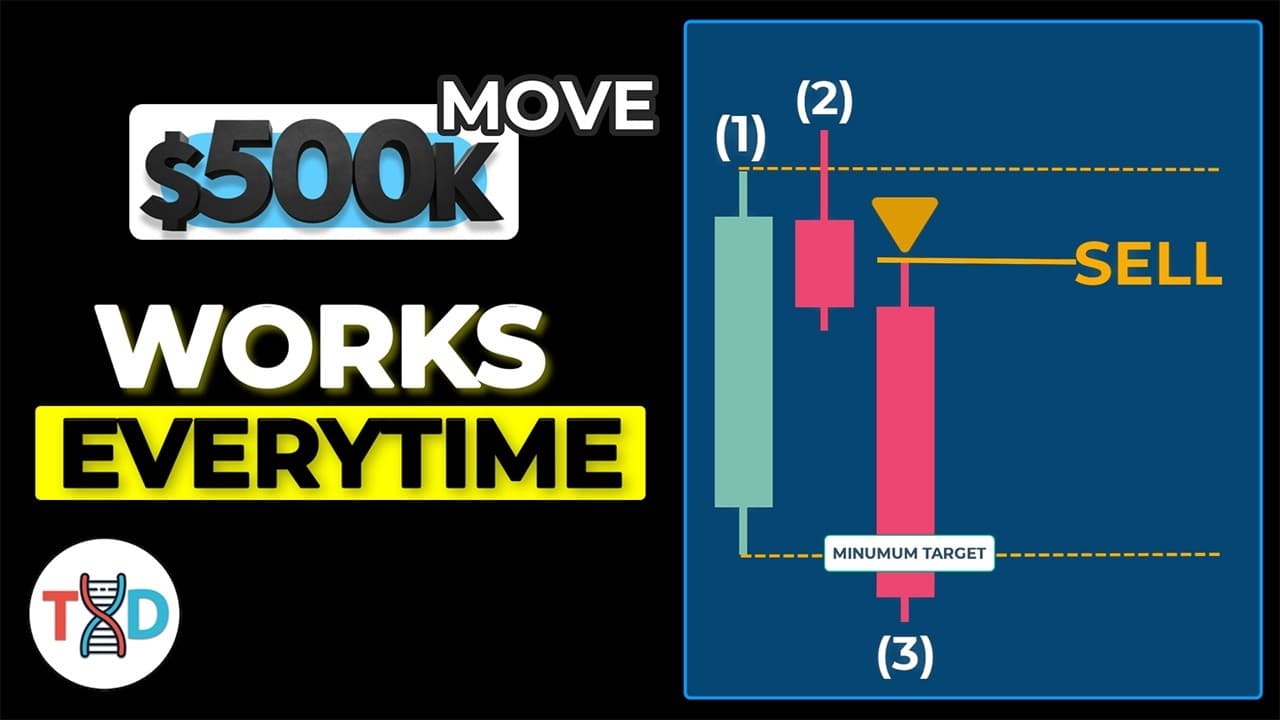
Candle Range Theory finds short setups by treating one candle’s high and low as a tradable range, then waiting for price to sweep the high and close back inside it. The three-candle model uses candle one to define the CRH and CRL, candle two to confirm rejection, and candle three to enter at a bearish fair value gap targeting the CRL. Read on for the entry confirmations, invalidation rule, and flexible AMD structure.
Transcript
Hey traders, welcome back to Trader DNA. What if I told you one single candle on your chart can reveal the entire battlefield between buyers and sellers and give you high probability entries over and over again? Most traders ignore this. But today, you won't. When most traders analyze market structure, they mark the obvious highs and lows to define... Read More
Key Insights
- Candle Range Theory holds that every single candle contains its own isolated range and internal structure. Viewing a daily candle on the 1 hour time frame reveals that the daily high and daily low wick points become swing highs and swing lows, forming a complete mini market inside one candle.
- The wicks of a candle act as isolated liquidity levels rather than random price noise. The top wick and bottom wick function as independent targets and magnets for future price, which is why most candles on any chart will attack either the previous candle's high or its low.
- The first candle in the framework has one job: to define the tradable range. Its high becomes the candle range high (CRH) and its low becomes the candle range low (CRL), and that range becomes the foundation and map for everything that follows in the setup.
- The second candle is the filter that decides whether a setup exists at all. It must push aggressively above the first candle's range high, grab buy side liquidity, trigger breakout traders, then fail and get dragged back down to close below the candle range high.
- A strong close above the candle range high invalidates the entire setup. That price action is acceptance and continuation behavior rather than a liquidity sweep, so probability shifts toward price continuing higher instead of reversing toward the candle range low.
- The bearish execution sequence requires three confirmations in order: a sweep of buy side liquidity, a change of character where price breaks below the bullish leg that created the sweep, and a bearish fair value gap forming inside that bearish leg to serve as the entry zone.
- Entering at a bearish fair value gap gives more precision than entering on a breakout of the second candle's low. Breakout trading chases momentum and is inherently riskier, while using internal range liquidity as the entry reference offers a cleaner and more favorable entry price.
- The number of candles in a Candle Range Theory setup is not fixed at three. What matters is that structure forms the AMD pattern of accumulation, manipulation, and distribution, the three phases of the smart money concepts model known as the power of three, with entry occurring in distribution.
Install to Summarize YouTube Videos and Get Transcripts
Explore YouTube Video Summarizer or Get YouTube Transcript Extractor
Questions & Answers
Q: What is Candle Range Theory in trading?
Candle Range Theory treats every candle as an isolated range with its own internal market structure. When a daily candle is viewed on the 1-hour time frame, its wick extremes become lower-time-frame swing highs and lows that can serve as liquidity levels and price targets.
Q: How does the three-candle Candle Range Theory setup work?
Candle one defines the range, with its high becoming the candle range high (CRH) and its low becoming the candle range low (CRL). Candle two trades above the CRH to sweep buy-side liquidity but closes back below it. Candle three provides the short entry, with the CRL as the target.
Q: How do you enter a Candle Range Theory short trade?
First, wait for price to sweep buy-side liquidity above the previous high. Next, confirm a change of character as price breaks below the bullish leg that created the sweep, then use a bearish fair value gap within the bearish leg as the entry zone. The short targets the original candle range low.
Q: What invalidates a Candle Range Theory short setup?
A strong close above the candle range high invalidates the setup. That close represents acceptance and continuation rather than a failed liquidity sweep, shifting the expected move away from a reversal toward the candle range low.
Q: What is a liquidity sweep in this strategy?
A liquidity sweep occurs when price trades above the first candle’s high, takes buy-side liquidity, and triggers breakout traders before returning inside the range. For the short setup, the sweeping candle must fail to close above the candle range high.
Q: Why do candle wicks matter in Candle Range Theory?
The top and bottom wicks mark the highest and lowest prices reached during the candle’s period. Candle Range Theory treats these extremes as isolated liquidity levels, independent targets, and magnets for future price rather than random chart noise.
Q: Can any candle define a tradable range?
Technically, any candle can define a range on a daily, 4-hour, 1-hour, or other time frame. However, the transcript notes that not every candle is ideal, so traders should apply selection criteria to seek higher-probability setups.
Q: Does a Candle Range Theory setup always require exactly three candles?
No. The three-candle framework is a teaching simplification; the setup may take any number of candles if it still forms accumulation, manipulation, and distribution (AMD). Accumulation compresses price, manipulation sweeps liquidity, and distribution is where the entry occurs.
Summary & Key Takeaways
-
Candle Range Theory states that every single candle holds its own internal range rather than only overall market structure defining highs and lows. Viewing a daily candle on the 1 hour time frame shows the wick points becoming swing highs and swing lows, so one candle contains a complete mini market with its own isolated structure.
-
The three candle framework assigns each candle a specific mission. Candle one defines the range with the candle range high at the top and the candle range low at the bottom. Candle two must sweep the high and fail to close above it. Candle three is where the short entry is executed toward the candle range low.
-
Execution on lower time frames follows three phases: a sweep of buy side liquidity above the previous high, a change of character where price breaks below the bullish leg that created the sweep, and a bearish fair value gap forming during that bearish leg which becomes the PD array used for entry.
-
The three candle model is a teaching simplification, not a fixed rule. In real conditions any number of candles can complete a setup as long as the structure forms an AMD pattern: accumulation where a cluster of candles compresses without expansion, manipulation where liquidity is swept, and distribution where the entry happens.
Read in Other Languages (beta)
Share This Summary 📚
Summarize YouTube Videos and Get Video Transcripts with 1-Click
Try YouTube Summary with ChatGPT & Claude or YouTube Transcript Generator
Explore More Summaries from Trader DNA 📚

Summarize YouTube Videos and Get Video Transcripts with 1-Click
Try YouTube Summary with ChatGPT & Claude or YouTube Transcript Generator