Contract Law 45 III Austin Instrument v Loral
TL;DR
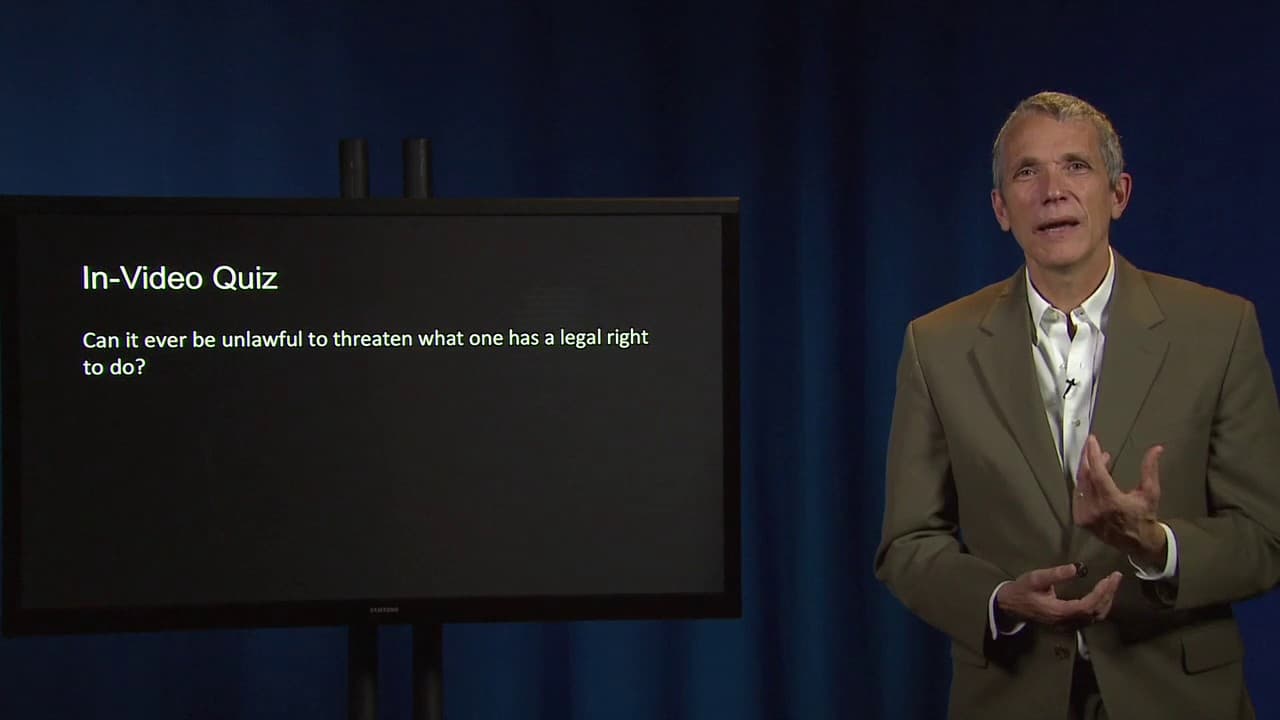
Contracts made under duress, whether physical or economic, can be voidable. The case of Austin v. Laurel explores the concept of economic duress in contract law.
Transcript
today we will examine the duress defense if someone holds a gun to your head and demands that you sign a contract that contract as you might suspect becomes voidable at your option threats of your money or your life do not produce valid evidence of welfare enhancing trade but not all forms of dress are of this kind of physical threat what if someon... Read More
Key Insights
- 💼 Contracts made under economic duress can be voidable, as demonstrated in the case of Austin v. Laurel.
- 😑 The threat of breach must involve a pre-existing duty or obligation, distinguishing it from other hypothetical scenarios.
- ❓ Economic duress is a substitute for failure of damages in contractual actions when legal damages are inadequate.
- ⌛ The court's decision may be influenced by prevailing military or economic crises during the time of the case.
- 🚱 Duress can be physical or non-physical, with non-physical duress rendering a contract voidable.
Install to Summarize YouTube Videos and Get Transcripts
Explore YouTube Video Summarizer or Get YouTube Transcript Extractor
Questions & Answers
Q: What is economic duress, and how does it differ from physical duress?
Economic duress occurs when one party threatens to breach a contract unless the other party agrees to modify its terms. Physical duress involves direct physical threats.
Q: Why was the court's decision influenced by the Vietnam War?
The prevailing military exigencies during the Vietnam War, where soldiers' lives were at stake, likely influenced the court's decision to protect the government's deadline for radar sets.
Q: What are the three conditions that must be met for economic duress to exist?
The three conditions for economic duress are: 1) one party threatens to breach a contract, 2) the threatened party cannot find an alternative source to cover their obligation, and 3) the ordinary remedy for breach of contract is inadequate.
Q: Did the court consider the pre-existing duty doctrine or UCC section 2-209 in this case?
No, the court did not mention these doctrines. It focused solely on the concept of economic duress in determining the contract's voidability.
Summary & Key Takeaways
-
The case of Austin v. Laurel involves a contract dispute between buyer Laurel and seller Austin over a price increase for radar parts.
-
Austin threatened to cease delivery unless Laurel agreed to the increase, and Laurel, unable to find alternative suppliers, knuckled under and agreed.
-
The court found that economic duress existed and concluded that the contract modification made under duress was voidable.
Read in Other Languages (beta)
Share This Summary 📚
Summarize YouTube Videos and Get Video Transcripts with 1-Click
Try YouTube Summary with ChatGPT & Claude or YouTube Transcript Generator
Explore More Summaries from YaleCourses 📚

Summarize YouTube Videos and Get Video Transcripts with 1-Click
Try YouTube Summary with ChatGPT & Claude or YouTube Transcript Generator