How to Divide Amounts Using Ratios
TL;DR
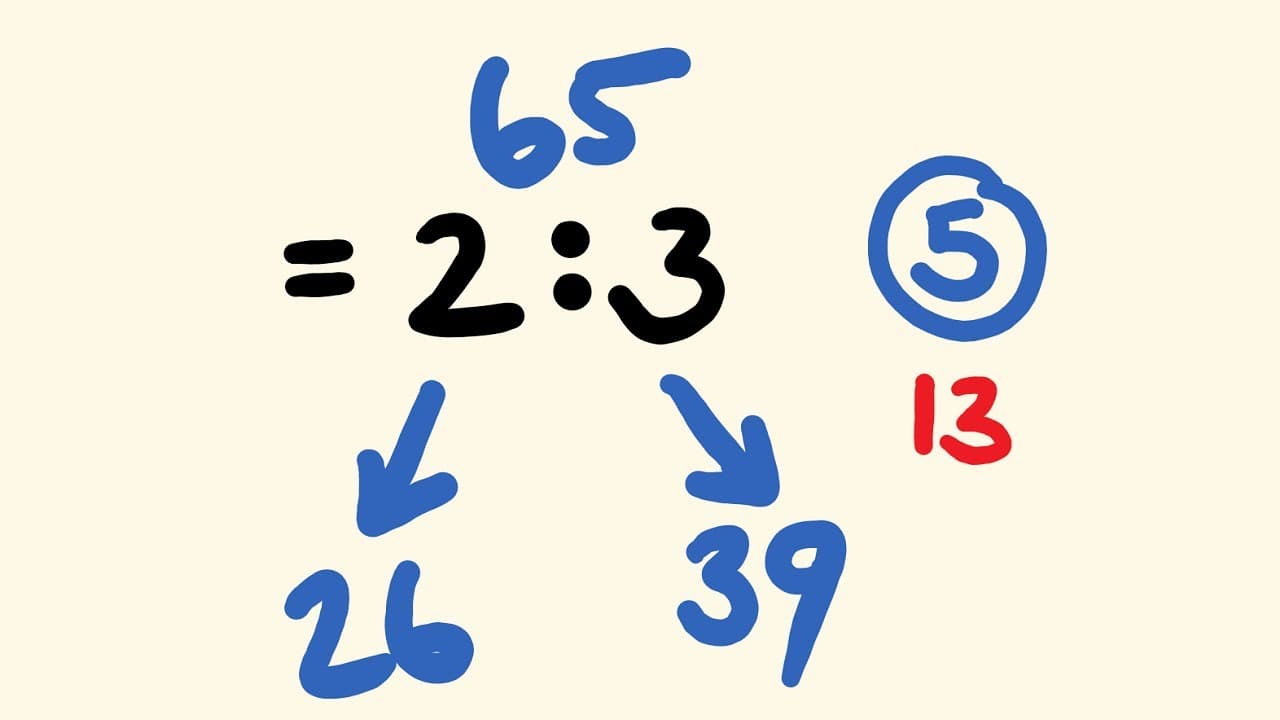
Dividing an amount into a specific ratio involves calculating the total number of parts and then distributing the amount accordingly. This method applies to various scenarios, including money, materials like concrete, and angles in geometry. By understanding the parts and their relationship to the total, you can effectively allocate resources in the desired proportions.
Transcript
good day welcome to the tech math Channel what we're going to be having a look at in this video is how to divide into a given ratio it's a pretty simple thing to do but I found it's something that a lot of people get stuck on in math so uh let's launch into this so I'm just going to go with an example say for example we had $100,000 that it was som... Read More
Key Insights
- 🥳 Dividing an amount into a given ratio involves determining the total number of parts in the ratio and distributing the amount accordingly.
- 🤑 The process applies not only to money but also to other quantities like concrete or angles in geometry.
- 🥳 Understanding the parts-to-total ratio helps calculate the value of each part in the given ratio.
- 🥳 Dividing concrete or other materials into a given ratio requires dividing the total volume by the sum of the parts and multiplying each part by the result.
Install to Summarize YouTube Videos and Get Transcripts
Explore YouTube Video Summarizer or Get YouTube Transcript Extractor
Questions & Answers
Q: How do you divide an amount into a given ratio?
To divide an amount into a given ratio, first determine the total number of parts in the ratio. Then, divide the amount by that number and distribute the parts accordingly.
Q: Can you provide an example of dividing money into a given ratio?
Sure! For example, if we have $100,000 to be divided into a ratio of 3:7, we first determine the total number of parts, which is 10. Then, divide $100,000 by 10 to get $10,000 per part. Multiply $10,000 by 3 to get $30,000 for one person and by 7 to get $70,000 for the other person.
Q: How is concrete divided into a given ratio?
In the example given, concrete is made up of three parts: one part cement, two parts sand, and four parts stone. To determine the amounts needed, divide the total volume of concrete by the sum of the parts (7 in this case). Multiply each part by the result to find the required volume for cement, sand, and stone.
Q: What is the process for dividing angles into a given ratio?
The example shows that the sizes of three angles in a triangle have a ratio of 1:2:3. Start by determining the total number of parts in the ratio (6 in this case). Divide the total degrees in a triangle (180°) by 6 to find that each part represents 30°. Multiply 30° by the number of parts for each angle to find their sizes.
Summary & Key Takeaways
-
The video explains how to divide an amount into a given ratio using examples with money, concrete, and angles.
-
The process involves determining the total number of parts in the ratio, dividing the amount by that number, and distributing the parts accordingly.
-
The tutorial provides step-by-step explanations for dividing money, concrete, and angles into given ratios.
Read in Other Languages (beta)
Share This Summary 📚
Summarize YouTube Videos and Get Video Transcripts with 1-Click
Try YouTube Summary with ChatGPT & Claude or YouTube Transcript Generator
Explore More Summaries from tecmath 📚



Summarize YouTube Videos and Get Video Transcripts with 1-Click
Try YouTube Summary with ChatGPT & Claude or YouTube Transcript Generator