What Are 7 Wild Business Ideas for the Ocean’s $3 Trillion Frontier?
TL;DR
The ocean is a promising startup frontier because it already represents roughly $3 trillion in annual spending while relying on comparatively stagnant technology. The discussion identifies opportunities in autonomous surveying, seagrass restoration, defense drones, underwater cable networks, lab-grown seafood, treasure profit sharing, and marine geo-engineering. Read on to see how these seven ideas span the biosphere, commercial prosperity, and maritime safety.
Transcript
That episode was a whirlwind. Yeah, we just recorded with our buddy Will O'Brien. This episode was like my favorite conversations living in San Francisco where you run into a weirdo who knows a lot about something you know very little about and like 45 minutes your mind gets blown like five times and you just get smarter. So, this is a get smarter ... Read More
Key Insights
- The ocean economy already represents roughly $3 trillion in annual spending, so founders do not need to wait for a hypothetical future market. The opportunity comes from modernizing large, established sectors whose underlying ships, unmanned systems, and software have experienced comparatively limited innovation.
- The ocean covers about 70% of the planet, yet only around 25% has been explored according to the discussion. This gap makes surveying, environmental mapping, scientific observation, and scalable data collection central problems for companies building new ocean technologies.
- The ocean directly supports human livelihoods and nutrition at enormous scale. Roughly three billion people rely on it as their primary food source, while about one billion depend on it as their primary source of income through activities such as fisheries, shipping, infrastructure, and related industries.
- The ocean economy consists of three broad layers: biosphere management, commercial prosperity, and maritime safety. This framework connects fisheries and restoration with energy, infrastructure, logistics, defense, border security, and protection of critical assets, revealing opportunities beyond conventional fishing or shipping businesses.
- Ocean technology remains comparatively stagnant despite the market’s size and importance. The discussion characterizes many established providers as large incumbents using old software and familiar hardware, which may give startups room to improve autonomy, data gathering, operational systems, and specialized equipment.
- Saildrone addresses ocean data collection at scale through autonomous sailboats. Its vessels illustrate how unmanned systems can gather information across the ocean without relying entirely on conventional crewed operations, making ocean surveying a concrete example of technology being applied to an underserved physical environment.
- Underwater infrastructure is a distinct startup frontier within the broader ocean economy. The conversation identifies underwater cable networks alongside defense drones, surveying, restoration, and energy-related infrastructure, showing that valuable opportunities exist both beneath the surface and across maritime operations.
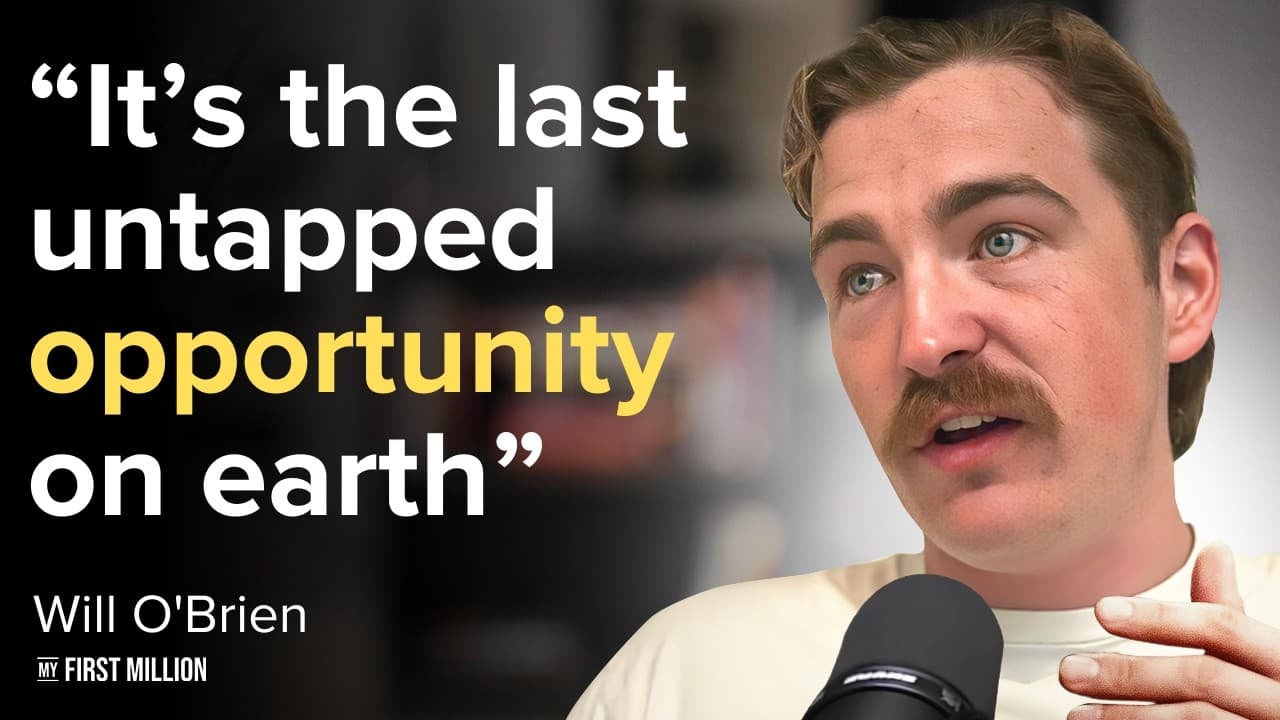
- Unconventional curiosity can help founders identify markets ignored by mainstream technology culture. Will O’Brien’s thesis begins by asking where everyone else is looking, then examining what remains underrated, a mindset the hosts connect with technology windows, conspiracy theories, philosophy, and personal experience.
Install to Summarize YouTube Videos and Get Transcripts
Explore YouTube Video Summarizer or Get YouTube Transcript Extractor
Questions & Answers
Q: Why is the ocean considered the next startup frontier?
The ocean already represents roughly $3 trillion in annual spending, but much of its underlying technology remains comparatively stagnant. Established sectors such as transportation, fisheries, defense, energy, biodiversity management, and data infrastructure offer openings for startups that can modernize software, equipment, autonomy, and data collection.
Q: What are the seven ocean business ideas discussed?
The seven ideas are ocean surveying, seagrass restoration, defense drones, underwater cable networks, lab-grown seafood, treasure profit sharing, and marine geo-engineering. They cover data collection, ecosystem restoration, security, communications infrastructure, food production, financing, and environmental intervention.
Q: How large is the ocean economy?
The discussion describes the ocean economy as roughly $3 trillion in annual spending. It also says the ocean covers about 70% of the planet, provides the primary food source for three billion people, and supplies the primary income source for one billion people.
Q: What sectors make up the ocean economy?
The discussion organizes the ocean economy into biosphere management, commercial prosperity, and maritime safety. These categories include fisheries, restoration, environmental mapping, science, energy, infrastructure, oil and gas, data networks, logistics, shipping, defense, border security, and critical-infrastructure protection.
Q: How can startups improve ocean surveying?
Startups can use autonomous vessels to collect ocean data at scale without relying entirely on conventional crewed operations. Saildrone is presented as an example that uses autonomous sailboats, and the opportunity is substantial because the discussion says only around 25% of the ocean has been explored.
Q: Why might established ocean companies be vulnerable to startups?
The discussion portrays many ocean industries as dominated by large incumbents using familiar hardware and ancient software. Startups may find opportunities by improving autonomous systems, operational software, specialized equipment, and scalable data gathering across established markets.
Q: Why does the ocean matter for food and employment?
Roughly three billion people rely on the ocean as their primary food source, while about one billion depend on it as their primary source of income. Fisheries, shipping, infrastructure, energy, defense, and related maritime industries connect the ocean directly to nutrition and livelihoods.
Q: What founder mindset can reveal overlooked ocean opportunities?
Will O’Brien suggests asking where most founders and investors are looking, then examining what remains underrated. While technology culture directs intense attention toward space, the ocean combines a massive existing economy with comparatively limited innovation, making unconventional curiosity useful for identifying opportunities.
Summary & Key Takeaways
-
Will O’Brien argues that entrepreneurs searching for overlooked markets should examine the ocean rather than follow the intense attention directed toward space. The ocean already supports roughly $3 trillion in annual spending, covers about 70% of Earth, and remains technologically underserved across transportation, fisheries, defense, energy, science, and biodiversity management.
-
The ocean economy can be understood through three broad categories. The biosphere includes fisheries, ecosystem restoration, environmental mapping, and science. Commercial prosperity includes energy, infrastructure, oil and gas, data networks, logistics, and shipping. Safety includes defense, border security, infrastructure protection, and the deployment of vessels in strategically important waters.
-
The discussion surveys business opportunities in ocean mapping, seagrass restoration, autonomous defense systems, underwater cable networks, lab-grown seafood, treasure profit sharing, and marine geo-engineering. It also connects entrepreneurship to technology windows, unconventional thinking, admired people, conspiracy theories, and lessons Will O’Brien drew from spending a summer with monks in Nepal.
Read in Other Languages (beta)
Share This Summary 📚
Summarize YouTube Videos and Get Video Transcripts with 1-Click
Try YouTube Summary with ChatGPT & Claude or YouTube Transcript Generator
Explore More Summaries from My First Million 📚






Summarize YouTube Videos and Get Video Transcripts with 1-Click
Try YouTube Summary with ChatGPT & Claude or YouTube Transcript Generator