How to Use Literals and Variables in Java
TL;DR
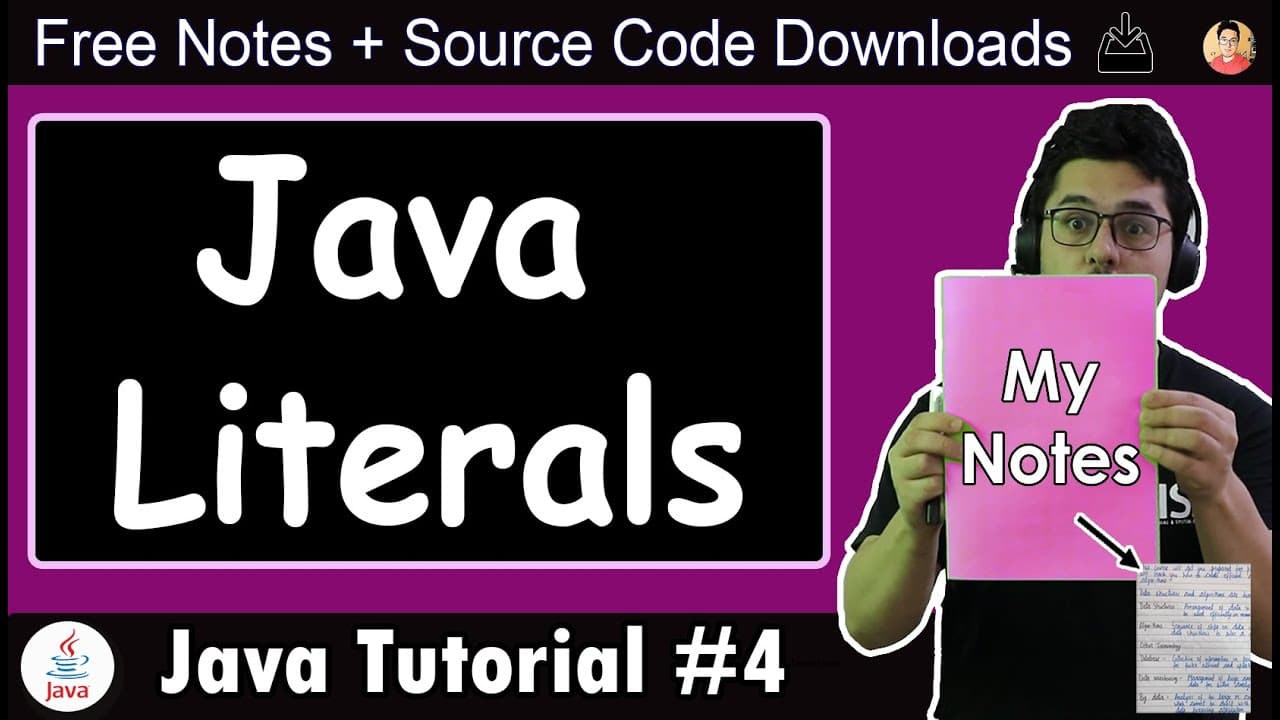
A literal is a constant value assigned to a variable, such as 34 in byte age = 34. Choose a primitive data type by first identifying whether the value is integral, decimal, character, or boolean, then considering its expected minimum and maximum. Java decimal literals are double by default, so a float value needs an F or f suffix.
Transcript
In today's video we will talk about the literals of Java What are literals and how you can make a floating point literal, a character literal and along with that a long literal I have added some more things in the notes here I will show you that which will make your Java programming journey very easy So there is a double power here One is that I ha... Read More
Key Insights
- A Java literal is a constant value that can be assigned directly to a variable. In the declaration byte age = 34, the number 34 is the literal, while age is the variable that receives and stores that value.
- Java has eight primitive data types: byte, short, int, long, float, double, char, and boolean. The tutorial groups them into integral values, floating-point decimal values, characters, and boolean values before explaining how literals correspond to these categories.
- Data type selection begins by identifying the kind of data being stored. A programmer first determines whether a value is an integer, decimal number, character, or boolean, then evaluates the minimum and maximum values that the variable may need to hold.
- A byte can be used for an age when the expected value will remain within the required limits. The tutorial reasons that an age will not exceed 110 and notes that this remains below 127, making byte a safe choice for that example.
- An integer literal can be written directly as a whole number. The declaration int age2 = 56 uses 56 as an integer literal, while byte age = 34 demonstrates that an integer literal may also be assigned to another suitable integral primitive type.
- A character literal is written inside single quotation marks in Java. The example char ch = 'a' follows this language rule, with 'a' serving as the constant character value assigned to the variable named ch.
- A decimal literal is treated as a double by default. Consequently, writing float f1 = 5.6 without an added marker does not express the intended float literal, so the value is written as 5.6F or 5.6f.
- A double literal can be written without a suffix because decimal literals default to double. The example double d1 = 4.66 is therefore valid, while either D or d can also be appended and compiled as a double value.
Install to Summarize YouTube Videos and Get Transcripts
Explore YouTube Video Summarizer or Get YouTube Transcript Extractor
Questions & Answers
Q: What is a literal in Java?
A literal in Java is a constant value that can be assigned to a variable. For example, in byte age = 34, age is the variable and 34 is the integer literal stored in it. Literals can represent several kinds of primitive data, including integral numbers, decimal numbers, characters, and boolean values such as true or false.
Q: How do you choose a primitive data type in Java?
Choose a primitive data type by first identifying the type of information you want to store, such as an integer, decimal number, character, or boolean value. Next, analyze the minimum and maximum values the variable may hold. The tutorial uses age as an example and selects byte because the expected value stays within the required limit.
Q: What primitive data types are discussed in Java?
The tutorial identifies eight primitive data types in Java: byte, short, int, long, float, double, char, and boolean. It organizes byte, short, int, and long as integral types, while float and double represent floating-point decimal values. Char represents a character, and boolean represents a true-or-false value whose default value is stated as false.
Q: How do you write a character literal in Java?
A character literal is written using single quotation marks. The example char ch = 'a' assigns the character literal 'a' to the char variable named ch. The single quotation marks are required by the Java rule described in the tutorial. The literal is the constant value on the right side, while ch is the variable receiving it.
Q: Why does a Java float literal need an F suffix?
A Java decimal literal is treated as double by default, so the value 5.6 is initially understood as a double literal. When assigning that value to a float variable, the tutorial adds F or f, as in float f1 = 5.6F. The suffix explicitly indicates that the decimal value should be treated as a float literal.
Q: How do you write a double literal in Java?
A double literal can be written as a decimal number without adding a suffix because Java treats decimal literals as double by default. The tutorial demonstrates this with double d1 = 4.66. A capital D or lowercase d may also be appended to the value, and both versions can compile as double literals according to the explanation.
Q: How are integer literals assigned to Java variables?
An integer literal is placed on the right side of a variable declaration and assignment. In byte age = 34, the literal 34 is stored in age, and printing age produces 34. The tutorial also shows int age2 = 56, where 56 is another integer literal assigned to an int variable named age2.
Q: How should a new Java example be run in IntelliJ IDEA?
The tutorial recommends right-clicking the newly created Java file and choosing the run action when running it for the first time. After the file appears as the selected run target, it can be run again from the available run control. This procedure helps prevent the previously selected Java file from running instead of the new literals example.
Summary & Key Takeaways
-
Java has eight primitive data types: byte, short, int, long, float, double, char, and boolean. These can be grouped into integral, floating-point, character, and boolean categories. Selecting among them starts with identifying the kind of information being stored, such as an integer, decimal number, character, or true-or-false value.
-
A literal is a constant value that can be assigned to a variable. In byte age = 34, the value 34 is an integer literal. A character literal follows Java's rule of using single quotation marks, as shown by assigning 'a' to a char variable. Printing age produces the stored value 34.
-
Decimal values are treated as double literals by default. Therefore, assigning 5.6 to a float variable requires an F or f suffix, such as 5.6F. A double value such as 4.66 can be written without a suffix, although D or d may be added. IntelliJ IDEA can then compile and run these examples.
Read in Other Languages (beta)
Share This Summary 📚
Summarize YouTube Videos and Get Video Transcripts with 1-Click
Try YouTube Summary with ChatGPT & Claude or YouTube Transcript Generator
Explore More Summaries from CodeWithHarry 📚





Summarize YouTube Videos and Get Video Transcripts with 1-Click
Try YouTube Summary with ChatGPT & Claude or YouTube Transcript Generator