How to Turn AI Products Into Paying Customers
TL;DR
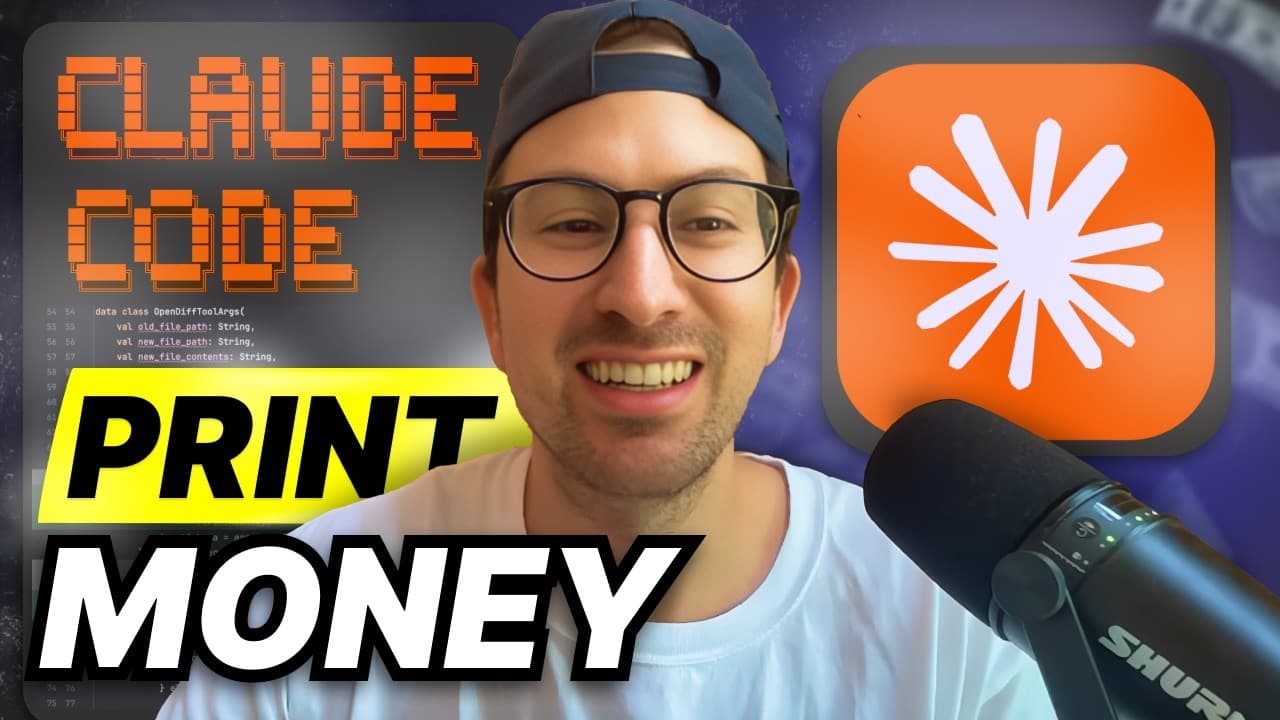
A founder’s primary job is to promote the business and acquire customers, not merely build products or optimize AI automations. The recommended revenue system moves prospects through four phases: traffic, a holding pattern, a selling event, and conversion, while Claude and Claude Code support research, campaign planning, and rapid production of marketing assets.
Transcript
So, you vibecoded a project, but then when you launch it, it's just crickets. No customers, no revenue, no passive income, [music] nothing. Well, today's episode, we bring in Jonathan aka Mr. Jice Cream Courtney, who teaches us, hey, how do you actually use AI to generate revenue to your vibe coded project? He starts the episode off with the founda... Read More
Key Insights
- A CEO’s primary responsibility is promoting the business, acquiring users, generating revenue, and making deals. Product creation remains important, but a founder who builds without consistently attracting attention can end up with a technically impressive business that nobody knows exists or buys from.
- AI tools are procrastination machines when founders use them to perfect systems and automations that have no customers. Technical sophistication does not automatically create demand, so founders should evaluate AI work by whether it supports promotion, user acquisition, sales, or revenue growth.
- The Promoter Blueprint is a four-phase revenue system consisting of traffic, a holding pattern, a selling event, and conversion. These phases provide a practical structure for moving people from initial awareness toward a purchase, then repeating the process as an ongoing promotional loop.
- Traffic comes from two broad categories: organic promotion and paid promotion. Organic sources include podcast appearances, events, networking, social media posts, and free content, while paid sources include advertising on platforms such as Meta, TikTok, and YouTube.
- A holding pattern is a channel that keeps prospective customers engaged without immediately demanding a purchase. Newsletters, podcasts, YouTube content, and recurring social posts provide continuing value, maintain attention, and gradually familiarize an audience with the founder and the business.
- Successful AI entrepreneurs visibly promote their products through podcasts, social posts, and other public content. The fact that audiences recognize prominent founders is presented as evidence that strong products are supported by sustained promotion rather than discovered automatically after being built.
- Claude projects and Claude Code form a workflow for moving from research and strategic thinking to a shipped marketing asset. The demonstrated process applies AI to execution within the Promoter Blueprint, including the development of a $450K webinar campaign and rapid production of campaign materials.
- The purpose of AI in a business is to support the founder’s revenue responsibilities. Courtney recommends using these tools for customer acquisition and marketing execution while embracing the founder’s public role as promoter, rather than treating mastery of AI tools as the business objective itself.
Install to Summarize YouTube Videos and Get Transcripts
Explore YouTube Video Summarizer or Get YouTube Transcript Extractor
Questions & Answers
Q: What is the primary job of a startup CEO?
A startup CEO’s primary job is to promote the business, attract users, generate revenue, and make deals. Building the product may also be part of the founder’s work, but creation alone does not produce customers. The founder should organize tools, systems, and supporting work around getting the offer in front of people and persuading them to buy.
Q: Why can AI tools become procrastination machines for founders?
AI tools become procrastination machines when founders spend days creating complex systems, automations, or product features without connecting that work to customers or revenue. The activity feels productive because something is being built, but it may not improve the business. A practical test is whether the work helps acquire users, increase revenue, promote the offer, or complete deals.
Q: What are the four phases of the Promoter Blueprint?
The Promoter Blueprint consists of traffic, a holding pattern, a selling event, and conversion. Traffic introduces people to the business. The holding pattern keeps them engaged and builds familiarity. The selling event presents the offer, and conversion turns interested prospects into buyers. The process then loops so promotion and customer acquisition continue rather than occurring only once.
Q: How can a founder generate traffic for a product?
A founder can generate traffic through either organic or paid channels. Organic approaches include appearing on podcasts, running events, networking, publishing social media posts, and creating free content. Paid approaches include advertising on Meta, TikTok, or YouTube. Both categories serve the same initial purpose: bringing relevant people into the business’s promotional and sales process.
Q: What is a holding pattern in a marketing funnel?
A holding pattern is a channel that keeps prospective customers within the founder’s world while providing ongoing value. Examples include an email newsletter, a podcast, YouTube content, and recurring posts on X. Rather than sending new traffic directly to a purchase request, the holding pattern maintains attention and gradually warms people before a later selling event.
Q: How should founders use Claude for marketing work?
Founders can use Claude projects to organize research and develop campaign thinking, then move into Claude Code to build the required marketing assets. The workflow connects strategic preparation with production, allowing the founder to execute each phase of the Promoter Blueprint more quickly. The demonstrated use case includes creating materials for a $450K webinar campaign.
Q: Why is building a strong product not enough to make sales?
A strong product cannot generate sales if prospective customers do not know it exists. Courtney compares this problem to creating an excellent restaurant with automated equipment, perfect food, and easy booking, but never telling anyone about it. Product quality and operational efficiency matter, yet the business still requires deliberate promotion to attract attention, users, and revenue.
Q: How should a founder balance product building and promotion?
A founder should treat promotion as a central CEO responsibility and make product building support that responsibility. The goal is not to stop creating useful products or systems, but to ensure that technical work does not displace customer acquisition. AI should accelerate research, campaign planning, and asset production while the founder continues publishing, networking, selling, and making the business visible.
Summary & Key Takeaways
-
Founders can mistake technical progress for business progress, especially when AI makes building products and automations enjoyable. Jonathan Courtney argues that a CEO must prioritize promotion, users, revenue, and deals. A sophisticated product can still fail if nobody knows it exists, just as an excellent restaurant cannot survive without customers.
-
The Promoter Blueprint organizes revenue generation into four phases: traffic, holding pattern, selling event, and conversion. Traffic comes from either organic promotion or paid advertising. Instead of immediately asking visitors to buy, the business places them in channels such as newsletters, podcasts, YouTube content, or social posts that build familiarity over time.
-
Claude and Claude Code support the blueprint by turning research and campaign thinking into finished marketing assets quickly. Courtney demonstrates a workflow that moves from Claude projects into Claude Code and discusses building a $450K webinar campaign. The broader recommendation is to pursue abundant promotional output while keeping AI aligned with revenue-producing work.
Read in Other Languages (beta)
Share This Summary 📚
Summarize YouTube Videos and Get Video Transcripts with 1-Click
Try YouTube Summary with ChatGPT & Claude or YouTube Transcript Generator
Explore More Summaries from Greg Isenberg 📚
Summarize YouTube Videos and Get Video Transcripts with 1-Click
Try YouTube Summary with ChatGPT & Claude or YouTube Transcript Generator