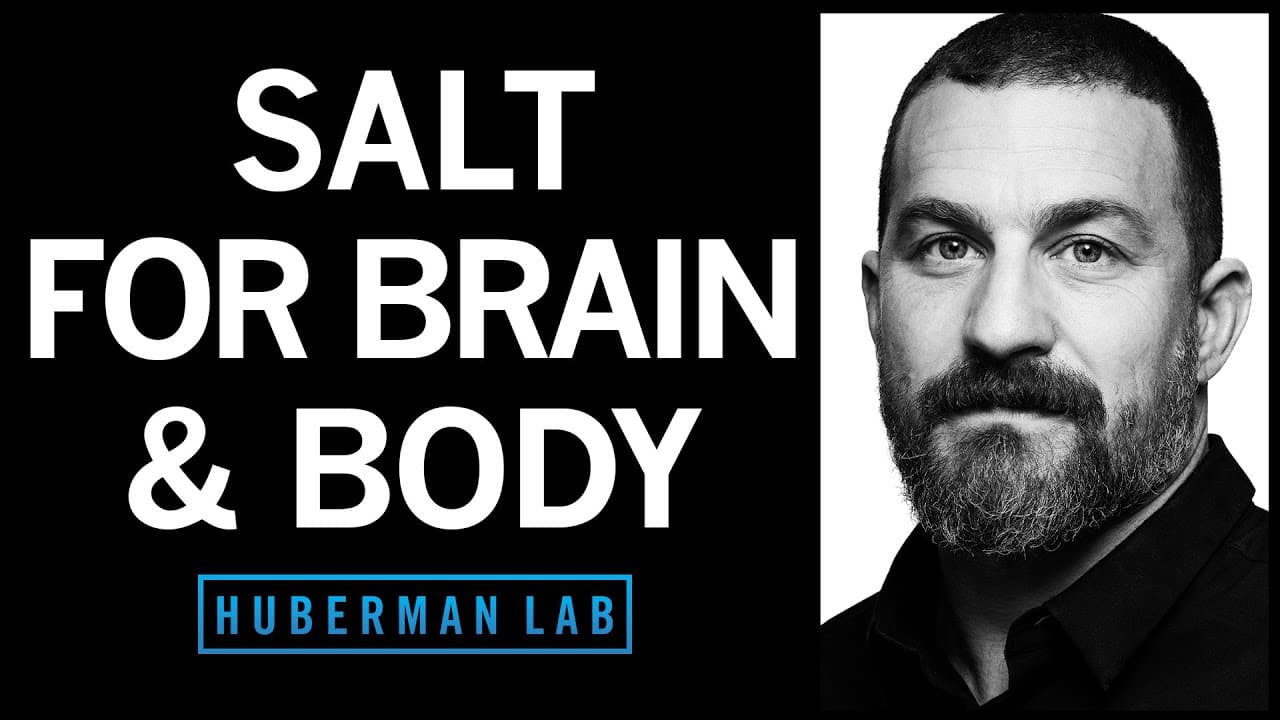
What Role Does Salt Play in Mental and Physical Performance?
TL;DR
Salt, or sodium, is essential for regulating blood pressure, fluid balance, and appetite. The brain detects salt levels through the OVLT, which influences hydration and the release of hormones like vasopressin. Both too much and too little salt can impact health, making individualized intake recommendations important.
Transcript
- Welcome to the Huberman Lab Podcast, where we discuss science and science-based tools for everyday life. [authoritative music] I'm Andrew Huberman, and I'm a professor of neurobiology and ophthalmology at Stanford School of Medicine. Today, we are going to discuss salt, also referred to as sodium. Now, most of us think of salt as something that w... Read More
Key Insights
- 🖐️ The brain's OVLT plays a crucial role in regulating salt appetite and thirst.
- 🧑⚕️ Salt intake affects various aspects of health, including blood pressure, cardiovascular health, and brain function.
- 🧡 High-salt diets can increase the risk of cardiovascular events and other health issues, although the ideal range is still a subject of debate.
- 🥺 Sodium and water balance are interdependent, and imbalances can lead to health complications.
Install to Summarize YouTube Videos and Get Transcripts
Explore YouTube Video Summarizer or Get YouTube Transcript Extractor
Questions & Answers
Q: How does the brain regulate appetite for salt?
The brain regulates salt appetite through the OVLT, which detects changes in salt concentration in the blood. This information is then relayed to other brain areas, triggering the release of hormones, such as vasopressin, that influence thirst and fluid balance.
Q: Can a high-salt diet be harmful to the brain?
Yes, research has shown that excessive salt intake can negatively affect brain health, leading to neurological impairments. However, the impact of salt on the brain is complex and influenced by other dietary factors and individual health conditions.
Q: Is there an ideal salt intake for everyone?
The optimal salt intake varies depending on individual needs and health conditions. Factors like blood pressure, fluid balance, and overall cardiovascular health should be considered when determining salt intake. It is crucial to consult with a healthcare professional to determine the appropriate level for you.
Q: How does salt affect fluid balance in the body?
Sodium plays a vital role in regulating fluid balance. It can cause water retention when concentrated, and vice versa. However, the relationship between sodium and water balance is contextual, and various factors need to be considered when determining the optimal balance for an individual.
Key Insights:
- The brain's OVLT plays a crucial role in regulating salt appetite and thirst.
- Salt intake affects various aspects of health, including blood pressure, cardiovascular health, and brain function.
- High-salt diets can increase the risk of cardiovascular events and other health issues, although the ideal range is still a subject of debate.
- Sodium and water balance are interdependent, and imbalances can lead to health complications.
- Individual factors, such as blood pressure and overall health, should be considered when determining the appropriate salt intake.
Summary & Key Takeaways
-
Salt, also known as sodium, is involved in regulating blood pressure, fluid balance, appetite, and various physiological functions.
-
The brain detects salt levels through the OVLT, a region that influences thirst and the release of hormones like vasopressin.
-
Thirst can be categorized into osmotic thirst (related to salt concentration) and hypovolemic thirst (due to changes in blood pressure).
-
Sodium and water work together to regulate fluid balance, and imbalances can have significant health implications.
-
Studies suggest that both low and high salt intakes can be detrimental, and the optimal range varies depending on individual factors.
Read in Other Languages (beta)
Share This Summary 📚
Summarize YouTube Videos and Get Video Transcripts with 1-Click
Try YouTube Summary with ChatGPT & Claude or YouTube Transcript Generator
Explore More Summaries from Andrew Huberman 📚



Summarize YouTube Videos and Get Video Transcripts with 1-Click
Try YouTube Summary with ChatGPT & Claude or YouTube Transcript Generator