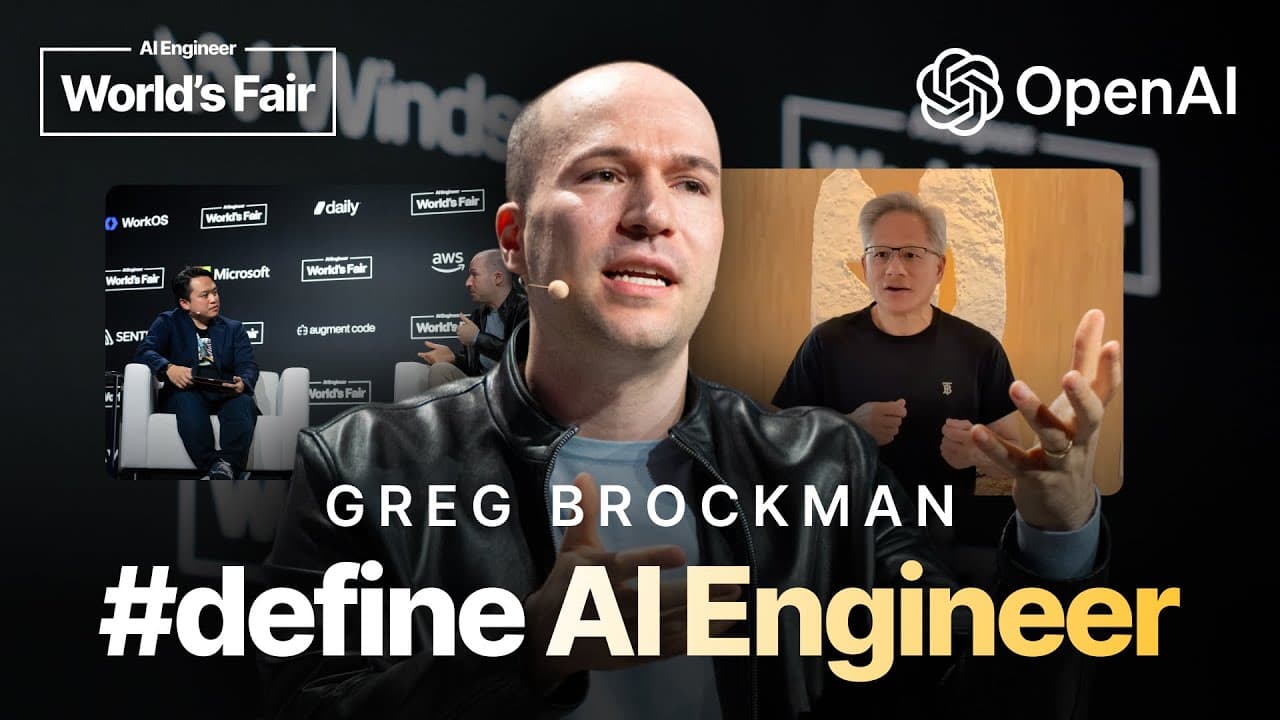
How Greg Brockman Became an AI Leader
TL;DR
Greg Brockman shares his journey from theater and chemistry to becoming a pivotal figure in AI and tech. He emphasizes the importance of independent study, the impact of deep learning, and the synergy between engineering and research. His experience at Stripe and OpenAI highlights the potential of AI to transform industries and the ongoing challenges in scaling AI infrastructure.
Transcript
[Applause] well hello hello is uh mic working for you check check check one two three all right first hard technology problem of the day down yeah yeah well the Wi-Fi is the other one um everyone here knows um so Greg welcome to AI Engineer thank you so much for taking the time thank you for having me um we're going to go a little bit chronological... Read More
Key Insights
- Greg Brockman transitioned from theater and chemistry to coding, inspired by the ability to create tangible results through programming.
- He joined Stripe after being identified by mutual connections at Harvard and MIT, drawn by the company's innovative culture.
- Independent study played a crucial role in Brockman's development, allowing him to accelerate his learning and explore subjects deeply.
- Deep learning's breakthrough in 2012 with AlexNet convinced Brockman of its potential, leading him to focus on AI and machine learning.
- OpenAI values the partnership between engineering and research, emphasizing technical humility and collaboration for innovation.
- Scaling AI infrastructure presents challenges, requiring a balance of compute, data, and algorithms to optimize performance.
- Vibe coding and Codex are transforming software engineering by enabling more efficient and creative coding practices.
- The future of AI development involves domain-specific agents and diverse models, requiring ongoing innovation and adaptation.
Install to Summarize YouTube Videos and Get Transcripts
Explore YouTube Video Summarizer or Get YouTube Transcript Extractor
Questions & Answers
Q: How did Greg Brockman start his coding journey?
Greg Brockman began coding after realizing the potential to create tangible results through programming. Initially interested in mathematics, he shifted focus when a friend suggested he create a website instead of self-publishing a chemistry textbook. This led him to learn web development through resources like W3 Schools, sparking his passion for coding.
Q: What role did independent study play in Brockman's development?
Independent study was pivotal in Brockman's development, allowing him to accelerate his learning and explore subjects deeply. In middle school, he advanced through math courses rapidly, later applying this self-directed approach to programming and machine learning. This method enabled him to break traditional educational constraints and pursue his interests intensely.
Q: Why did Brockman join Stripe, and what was his experience there?
Brockman joined Stripe after being identified by mutual connections at Harvard and MIT. He was drawn by the company's innovative culture and the opportunity to work with like-minded individuals. At Stripe, he experienced the challenges of a startup, contributing to its growth from a small team to a significant player in the tech industry, emphasizing customer obsession and rapid problem-solving.
Q: How did deep learning influence Brockman's career path?
Deep learning's breakthrough in 2012 with AlexNet convinced Brockman of its transformative potential. Observing its success in various fields, he recognized it as the technology Alan Turing envisioned for AI. This realization led him to focus on AI and machine learning, eventually contributing to OpenAI's mission of developing AGI and advancing AI research and applications.
Q: What is the relationship between engineering and research at OpenAI?
At OpenAI, engineering and research are valued equally, with an emphasis on technical humility and collaboration. Brockman notes the importance of understanding different perspectives and the need for engineers to adapt to the unique challenges of AI research. This partnership is crucial for innovation, allowing OpenAI to tackle complex problems and develop cutting-edge AI technologies.
Q: What challenges does OpenAI face in scaling AI infrastructure?
Scaling AI infrastructure at OpenAI involves balancing compute, data, and algorithms to optimize performance. Challenges include managing diverse workloads, ensuring reliability, and adapting to rapidly evolving research. Brockman highlights the importance of building robust systems and leveraging innovations like Codex to enhance productivity and efficiency in AI development.
Q: How is Codex changing the way software is developed?
Codex is transforming software development by enabling more efficient and creative coding practices. It allows developers to focus on higher-level problem-solving while automating routine tasks. Brockman notes that structuring codebases to match the strengths of AI models can enhance productivity, suggesting a shift towards modular, well-documented code that facilitates AI assistance.
Q: What does the future of AI development look like according to Brockman?
Brockman envisions a future where domain-specific agents and diverse models play a significant role in AI development. As AI becomes more capable, he anticipates a shift towards more specialized applications, requiring ongoing innovation and adaptation. The goal is to achieve greater economic output and societal benefits, with AI driving significant advancements across various industries.
Summary & Key Takeaways
-
Greg Brockman's journey from theater and chemistry to AI leadership highlights the power of independent study and deep learning. He joined Stripe, drawn by the innovative culture, and later focused on AI at OpenAI. His experiences underscore the importance of engineering-research synergy and the challenges of scaling AI infrastructure.
-
Independent study allowed Brockman to accelerate his learning, leading to a career in AI. He believes in the transformative potential of AI, as evidenced by deep learning breakthroughs and his work at OpenAI. The partnership between engineering and research is crucial for innovation.
-
Brockman discusses the challenges of scaling AI infrastructure and the future of software engineering with Codex and vibe coding. He envisions a future with domain-specific agents and diverse models, requiring ongoing adaptation and innovation in AI development.
Read in Other Languages (beta)
Share This Summary 📚
Summarize YouTube Videos and Get Video Transcripts with 1-Click
Try YouTube Summary with ChatGPT & Claude or YouTube Transcript Generator
Explore More Summaries from AI Engineer 📚



Summarize YouTube Videos and Get Video Transcripts with 1-Click
Try YouTube Summary with ChatGPT & Claude or YouTube Transcript Generator