How to Extract and Taste DNA from Strawberries
TL;DR
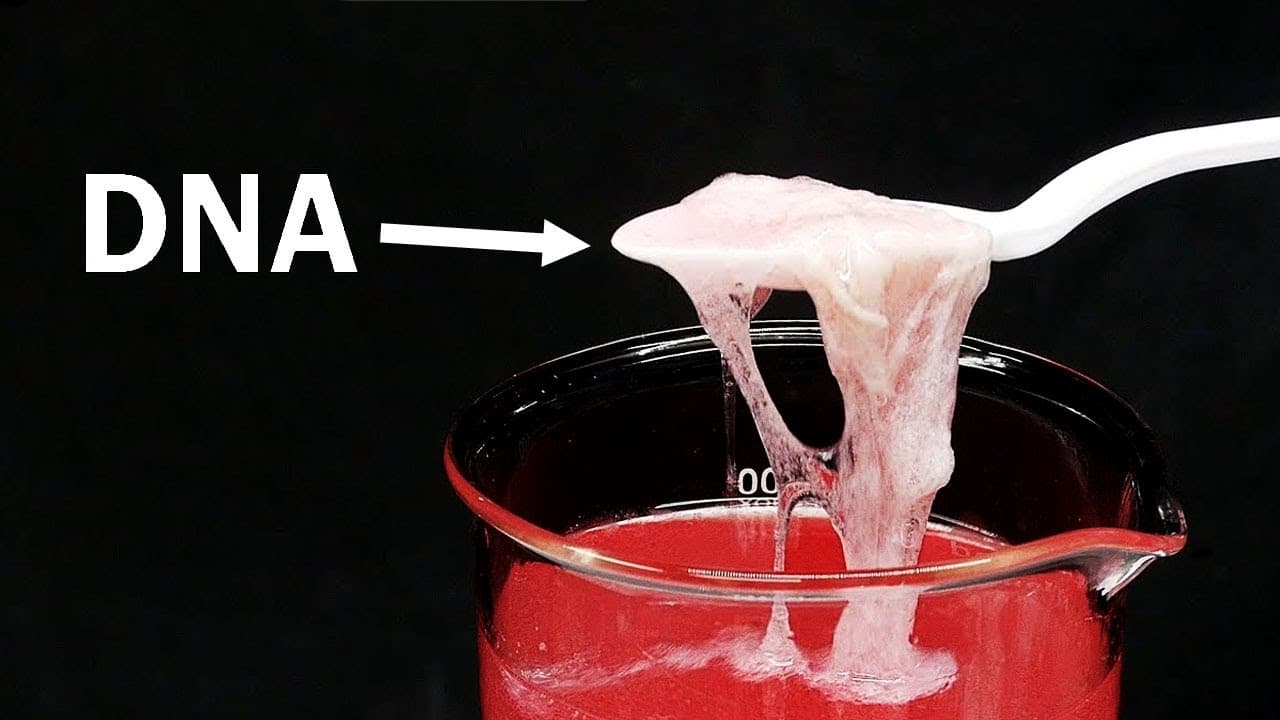
You can extract DNA from strawberries by crushing the fruit, mixing it with a soapy salt solution, and then filtering the mixture. Finally, adding cold isopropyl alcohol precipitates the DNA, which appears as a white, stringy substance. The taste of the isolated DNA is salty and slimy, making it an unpalatable experience.
Transcript
Deoxyribonucleic acid or DNA for short is the molecule that carries the genetic information in all living organisms In terms of structure, DNA's a polymer that's made of four sub-units known simply as A (adenine), C (cytosine), T (thymine), and G (guanine) Each of these sub-units has three main components: a unique nitrogenous base, a phosphate gro... Read More
Key Insights
- 🥹 DNA is a polymer made up of four sub-units and is structured as a double helix held together by hydrogen bonding.
- 💁 The order of sub-units in DNA is crucial for storing and transmitting genetic information.
- 🎒 Chromosomes, which contain DNA, vary in number among organisms and are tightly packed with proteins.
- 🍓 DNA can be extracted from various organisms, with strawberries being a relatively easy source.
- 🍳 The extraction process involves breaking down cell barriers and precipitating DNA using alcohol and salt.
- 🧬 DNA extraction can be a messy process, requiring patience and multiple filtration steps.
- 👅 The taste of isolated DNA is salty and slimy, with a texture that is unpleasant to consume.
Install to Summarize YouTube Videos and Get Transcripts
Explore YouTube Video Summarizer or Get YouTube Transcript Extractor
Questions & Answers
Q: How is DNA structured, and what are its main components?
DNA is a polymer made up of four sub-units (A, C, T, G), with each sub-unit consisting of a unique nitrogenous base, a phosphate group, and a sugar. These components connect through their phosphate groups to form long polymer chains.
Q: How does DNA store and transmit genetic information?
The order of the sub-units in DNA is crucial for storing genetic information. Adenine (A) pairs with Thymine (T), and Cytosine (C) pairs with Guanine (G) through hydrogen bonding. This double-stranded structure allows one strand to act as a backup and facilitates repairs and information reading by the cell.
Q: How is DNA packed in a cell, and what is a chromosome?
DNA is associated with proteins that compact it into a highly condensed form. Chromosomes are the smallest visible structures containing DNA under a microscope and vary in number among organisms. Humans have 23 pairs of chromosomes.
Q: How is DNA extracted from strawberries?
The process involves breaking down the cell wall and membranes of strawberry cells using soapy salt solution. Squishing the strawberries releases the DNA, which is then isolated using alcohol and salt to precipitate it out.
Summary & Key Takeaways
-
DNA is a molecule that carries genetic information in all living organisms, structured as a polymer made up of four sub-units.
-
The order of these sub-units is crucial for storing genetic information, and DNA is made up of two strands held together by hydrogen bonding.
-
DNA is tightly packed with proteins, forming chromosomes, and can be isolated from various organisms, with strawberries being a relatively easy source.
Read in Other Languages (beta)
Share This Summary 📚
Summarize YouTube Videos and Get Video Transcripts with 1-Click
Try YouTube Summary with ChatGPT & Claude or YouTube Transcript Generator
Explore More Summaries from NileRed 📚
Summarize YouTube Videos and Get Video Transcripts with 1-Click
Try YouTube Summary with ChatGPT & Claude or YouTube Transcript Generator