How Does Tesla's FSD Perform in Real-World Conditions?
TL;DR
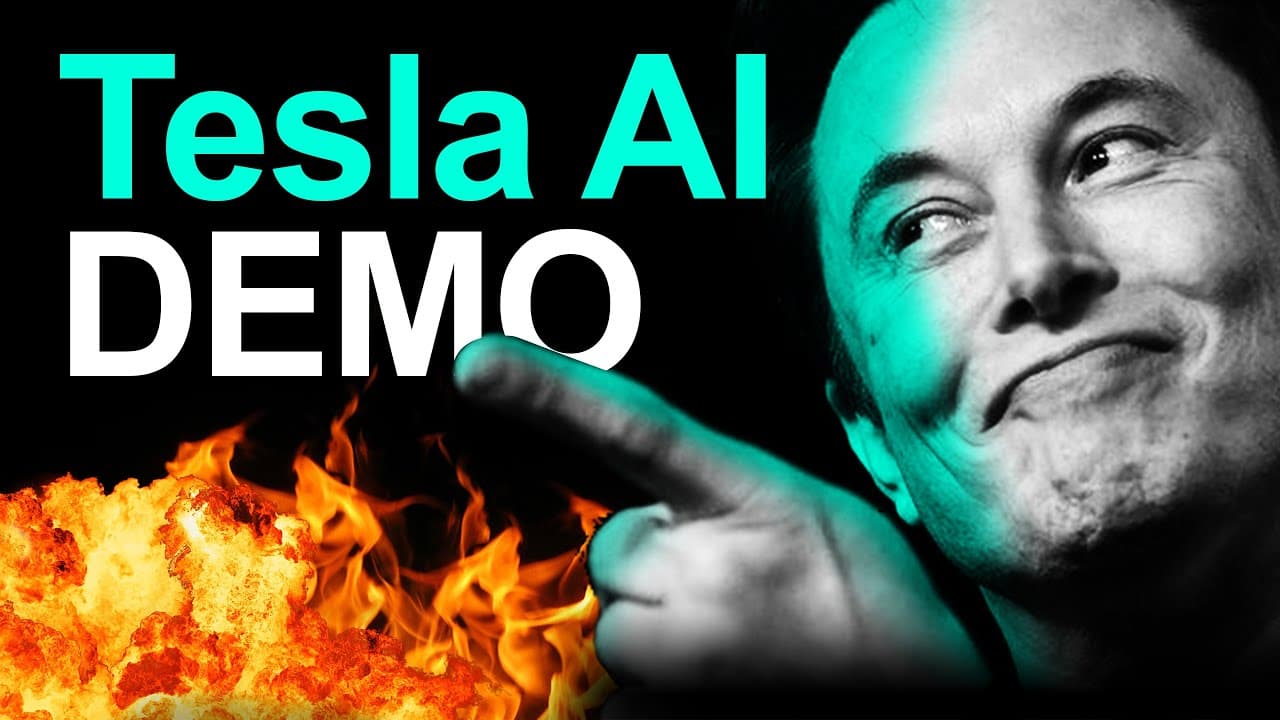
Tesla's Full Self-Driving (FSD) system successfully navigates complex real-world scenarios like traffic, construction, and roundabouts, relying solely on neural network training rather than explicit coding. The car makes human-like driving decisions, such as stopping at red lights and yielding to pedestrians, showcasing advanced AI capabilities in autonomous driving.
Transcript
all right I think we are now live great um and I think it's it's maybe better to go horizontal uh we'll see you see more horizontal than vertical um all right hey guys so let's see and you can sort of read some of the comments there um all right we're gonna let's see so here we are um we're just uh leaving Tesla headquarters and uh we just dropped ... Read More
Key Insights
- 👨💻 The Tesla's autonomous driving capabilities are driven by neural nets and video training data, rather than explicit coding for scenarios.
- 🙂 The system shows advanced decision-making, like stopping at red lights and giving way to pedestrians, based on human-like driving behavior.
- 🤩 Training data curation and model updates play a key role in ensuring safe and effective self-driving performance.
- 🧑🦽 The Tesla can adapt to various weather conditions and challenging scenarios, like intersections and merges, without manual intervention.
- ✊ The AI-powered system can handle complex driving tasks, such as negotiating roundabouts and responding to traffic signals, autonomously.
- ✈️ The Tesla's smooth acceleration, braking, and lane changes are a result of intuitive decision-making based on training data and real-time conditions.
- 🅿️ The self-driving system's ability to automatic parking and navigate parking lots demonstrates its comprehensive capabilities beyond regular road driving.
- 🎙️ More videos with Elon Musk:
Install to Summarize YouTube Videos and Get Transcripts
Explore YouTube Video Summarizer or Get YouTube Transcript Extractor
Questions & Answers
Q: How does the AI-driven Tesla handle scenarios like roundabouts and construction zones?
The Tesla navigates roundabouts and construction zones smoothly, despite no explicit coding for such scenarios. It relies solely on video training data for guidance.
Q: Is the Tesla equipped to handle unexpected situations like pedestrians crossing the road?
The AI system in the Tesla is cautious and considerate of pedestrians, displaying polite behavior and safe driving practices around them.
Q: How does the Tesla know when to accelerate, decelerate, and change lanes?
The Tesla's AI system determines speeds, distances, and lane changes based on video training data, adapting to traffic conditions in real-time.
Q: What is the significance of the AI-based self-driving system not needing a map?
The Tesla's self-driving system can navigate to GPS points without a map, showcasing its ability to rely solely on video training for driving directions.
Summary & Key Takeaways
-
AI-driven Tesla conducts a live test drive showcasing neural net-based autonomous driving.
-
The Tesla smoothly navigates through traffic, construction, roundabouts, and intersections without manual input.
-
The self-driving system is entirely based on video training with no explicit coding for scenarios like stop signs and lane changes.
Read in Other Languages (beta)
Share This Summary 📚
Summarize YouTube Videos and Get Video Transcripts with 1-Click
Try YouTube Summary with ChatGPT & Claude or YouTube Transcript Generator
Explore More Summaries from Solving The Money Problem 📚
Summarize YouTube Videos and Get Video Transcripts with 1-Click
Try YouTube Summary with ChatGPT & Claude or YouTube Transcript Generator