Why Are Snowflakes Unique in Their Shapes?
TL;DR
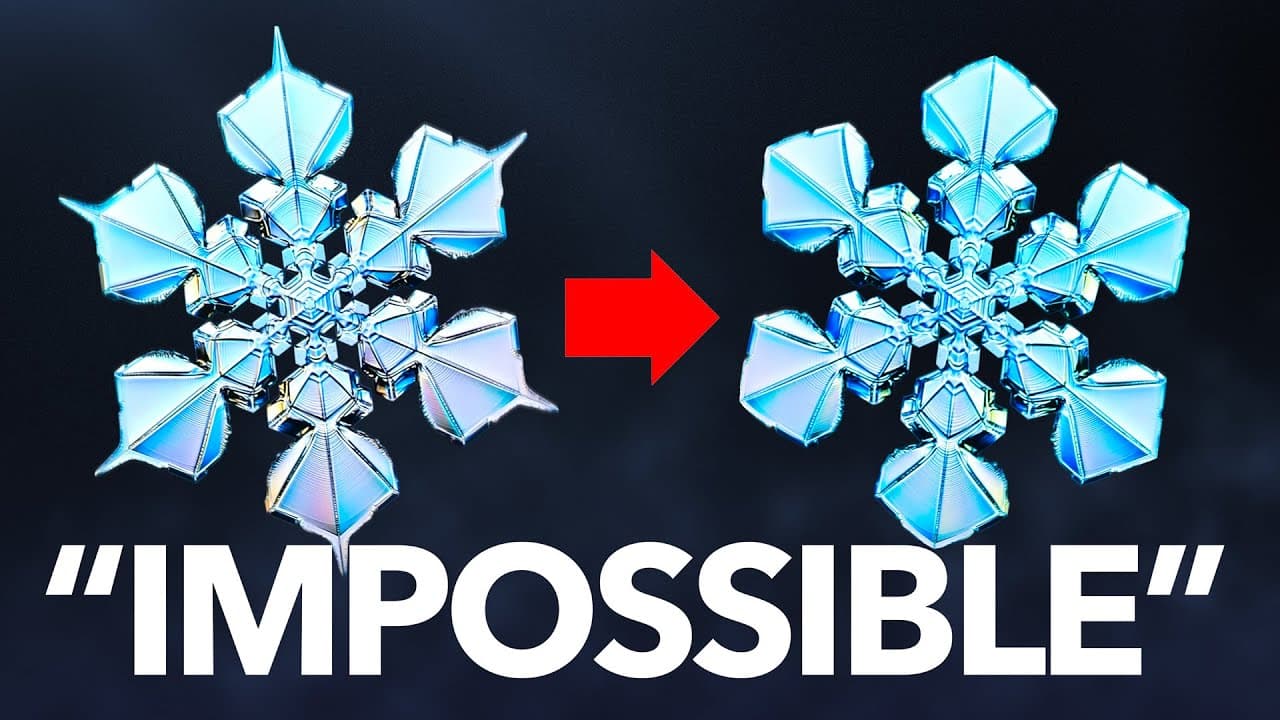
Snowflakes are unique due to the intricate molecular processes of ice formation. They develop their distinct shapes based on varying temperature and humidity levels during growth, resulting in diverse structures like plates and columns. This complexity arises because each snowflake experiences different conditions, explaining why no two snowflakes appear alike.
Transcript
- [Ken] Now, I'm gonna turn on 2000 volts. - [Derek] What? And this is the first step in creating snowflakes in the lab. This is totally wild. What?
- Crazy, huh? The tips of those needles are like a hundred nanometers in diameter. - [Derek] That is so wild. Dr. Ken Libbrecht is the snowflake guy. - I was the snowflake consultant for the movie, "Fr... Read More
Key Insights
- 🥶 The growth of snowflakes occurs through a process of water vapor freezing into hexagonal ice crystals.
- 🦸 The temperature and level of super saturation determine the shape and structure of snowflakes.
- 💦 The unique shape of a snowflake is a result of the complex interplay between temperature variations and water molecule diffusion.
- 💁 Different types of snowflakes form under specific temperature conditions, resulting in a diverse array of shapes and structures.
- ☠️ The nucleation barriers and growth rates of different facets contribute to the distinct shapes and symmetry of snowflakes.
- ❄️ While no two snowflakes are identical, it is difficult to prove this definitively due to the immense complexity and variability in snowflake formation.
- ❄️ Ken Libbrecht's experiments and research have shed light on the molecular physics behind snowflake formation, offering potential explanations for the diversity and complexity of snowflake shapes.
Install to Summarize YouTube Videos and Get Transcripts
Explore YouTube Video Summarizer or Get YouTube Transcript Extractor
Questions & Answers
Q: How do snowflakes form their intricate and symmetrical shapes?
Snowflakes form when individual water molecules freeze into hexagonal crystals. The structure results from the polar nature of water molecules and the hydrogen bonds they form.
Q: Are all snowflakes truly unique?
While it is commonly believed that no two snowflakes are alike, this is technically impossible to prove. Nevertheless, due to the vast number of variables and the diversity of conditions in which snowflakes form, it is highly unlikely for two snowflakes to be identical.
Q: How do temperature and humidity affect snowflake formation?
Temperature and humidity are crucial factors in determining the type of snowflake that forms. Different combinations of temperature and humidity create varying conditions, leading to the growth of plates, columns, or other snowflake shapes.
Q: Why do snowflakes have six-fold radial symmetry?
The six-fold radial symmetry of snowflakes arises from the hexagonal structure of water molecules. Each side of a snowflake grows in the same conditions, resulting in a mirrored pattern.
Summary & Key Takeaways
-
Dr. Ken Libbrecht, a snowflake expert, shares his knowledge and passion for studying snowflakes in the lab.
-
Snowflakes form through a process of water evaporation, condensation, and freezing, resulting in intricate, six-fold radial symmetry.
-
Different types of snowflakes form under specific temperature and humidity conditions, creating a wide variety of shapes and structures.
Read in Other Languages (beta)
Share This Summary 📚
Summarize YouTube Videos and Get Video Transcripts with 1-Click
Try YouTube Summary with ChatGPT & Claude or YouTube Transcript Generator
Explore More Summaries from Veritasium 📚






Summarize YouTube Videos and Get Video Transcripts with 1-Click
Try YouTube Summary with ChatGPT & Claude or YouTube Transcript Generator