How does money create power in the world?
TL;DR
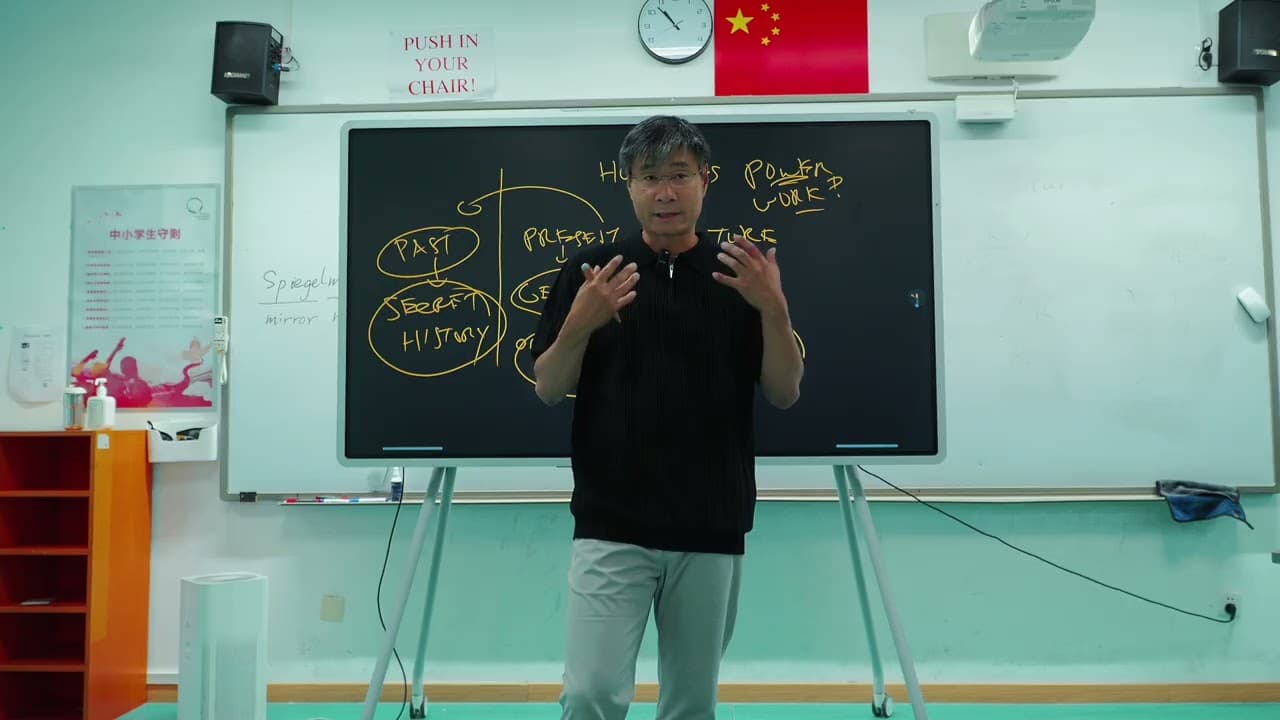
Money acts as a tool of power that lets those who control it fund activities, create more money through lending, and shape perceptions of reality. The course argues we can build analytical models to predict geopolitics, test them against reality, and uncover the hidden history of how wealth and influence shape global events.
Transcript
Good morning class. Welcome to our first class. And today what I want to do is provide the framework for how we will learn the semester. What are we learning? How are we learning? Why are we learning? All right. So this is a class of ideas. So, it's really important for you to pay attention and understand how these ideas connect with each other. If... Read More
Key Insights
- Power is analyzed as a framework to understand how wealth and influence interact, enabling manipulation or empowerment through structured thinking.
- The course emphasizes that learning focuses on thinking processes rather than dictating what to think, encouraging continuous questioning and clarification.
- Geopolitics is the present focus, with a method to build analytical models that predict future events and then test those predictions against reality.
- The speaker argues that the past, present, and future are examined to construct a more objective view of reality and reveal hidden patterns.
- Money is described as a modern form of alchemy, transforming debt into wealth through lending and interest that expands the economy.
- Fractional reserve banking is highlighted as a mechanism that creates money from nothing by lending more than is held in reserve.
- Historically, money emerged from merchant trade and evolved into a system where receipts and contracts enable broader commerce without physical gold.
- The ultimate aim is to uncover the secret history of humanity by understanding how power actually works through financial structures.
Install to Summarize YouTube Videos and Get Transcripts
Explore YouTube Video Summarizer or Get YouTube Transcript Extractor
Questions & Answers
Q: How does the lecture define the relationship between power and money?
Power is presented as something that can be analyzed and understood through financial systems, where money acts as a tool that enables those in control to fund ventures, pay employees, and expand influence. The talk uses a thought experiment about a bank to show how deposits can lead to loans that create more money, illustrating how financial mechanisms effectively turn power into practical capability. This framing suggests that understanding money reveals how power is exercised in the real world, shaping outcomes through financial leverage and systemic design.
Q: What is the role of geopolitics in the course framework?
Geopolitics serves as the present focus for developing analytical models that describe how global events unfold. By studying geopolitics, the course aims to create predictive models that can be tested against real-world outcomes. If predictions align with reality, the models are validated and then used to interpret past events to reveal deeper patterns. The ultimate goal is to understand how power operates within political, economic, and social systems to explain why wars and conflicts occur.
Q: What does the speaker mean by the idea that reality is imagined?
The speaker echoes Kant by suggesting that we do not access objective reality directly; rather, our senses shape perceptions into phenomena while there is a noumenal world beyond. This implies that our understanding of history and current events is filtered through perception and interpretation, making critical thinking and questioning essential. The course uses this premise to train students to augment their imagination and think more clearly about how power is perceived and constructed.
Q: How is money described as alchemy in the lecture?
Money is described as a form of alchemy because it enables the transformation of debt and promises into purchasing power and wealth. Through lending and the creation of money via receipts or contracts, banks can generate more money than the actual physical reserves, effectively turning imagined value into real economic capacity. This framing connects ancient alchemy ideas to modern financial systems, highlighting how monetary mechanisms convert social trust into measurable power.
Q: What historical origin of money does the lecture outline?
The origin described traces money back to merchants who needed to facilitate trade. They used gold and receipts as contracts to enable easier exchange across regions. Over time, banks provided receipts that could stand in for gold, allowing the creation of money through lending. This historical progression shows how monetary systems evolved from tangible gold to abstract promises that fuel broader economic activity and power.
Q: What is the significance of fractional reserve lending in the talk?
Fractional reserve lending is presented as a key mechanism that allows banks to lend more than the actual reserves, effectively expanding money supply. The discussion suggests this system underpins modern finance by enabling banks to create money through loans while maintaining a fraction of deposits as reserves. This process demonstrates how financial institutions contribute to wealth creation and control within the economy, shaping the power dynamics of global trade and policy.
Q: How does the course propose to validate its analytical models?
The course proposes to validate models by testing predictions against reality, similar to how one tests artificial intelligence systems. If the analytical framework produces accurate forecasts about geopolitical events and economic trends, its credibility increases. This iterative approach aims to refine understanding of past events, reveal hidden patterns, and strengthen claims about how power operates in shaping world history.
Q: What is the ultimate aim of studying the secret history of humanity in this context?
The ultimate aim is liberation and empowerment through understanding how power actually works. By uncovering the mechanisms of control, especially through money and financial systems, students can learn to recognize manipulation, anticipate developments, and make more informed choices about how to live. This perspective frames knowledge as a practical tool for freedom rather than mere academic interest.
Summary & Key Takeaways
-
A framework for studying how ideas connect, what we learn, and how we learn is outlined, emphasizing questions and critical thinking.
-
The lecture introduces geopolitics, past present and future analysis, and the goal of constructing an objective model to understand world events.
-
The central claim is that power operates like alchemy through money, enabling wealth creation and influence beyond surface appearances.
Read in Other Languages (beta)
Share This Summary 📚
Summarize YouTube Videos and Get Video Transcripts with 1-Click
Try YouTube Summary with ChatGPT & Claude or YouTube Transcript Generator
Explore More Summaries from Predictive History 📚
Summarize YouTube Videos and Get Video Transcripts with 1-Click
Try YouTube Summary with ChatGPT & Claude or YouTube Transcript Generator