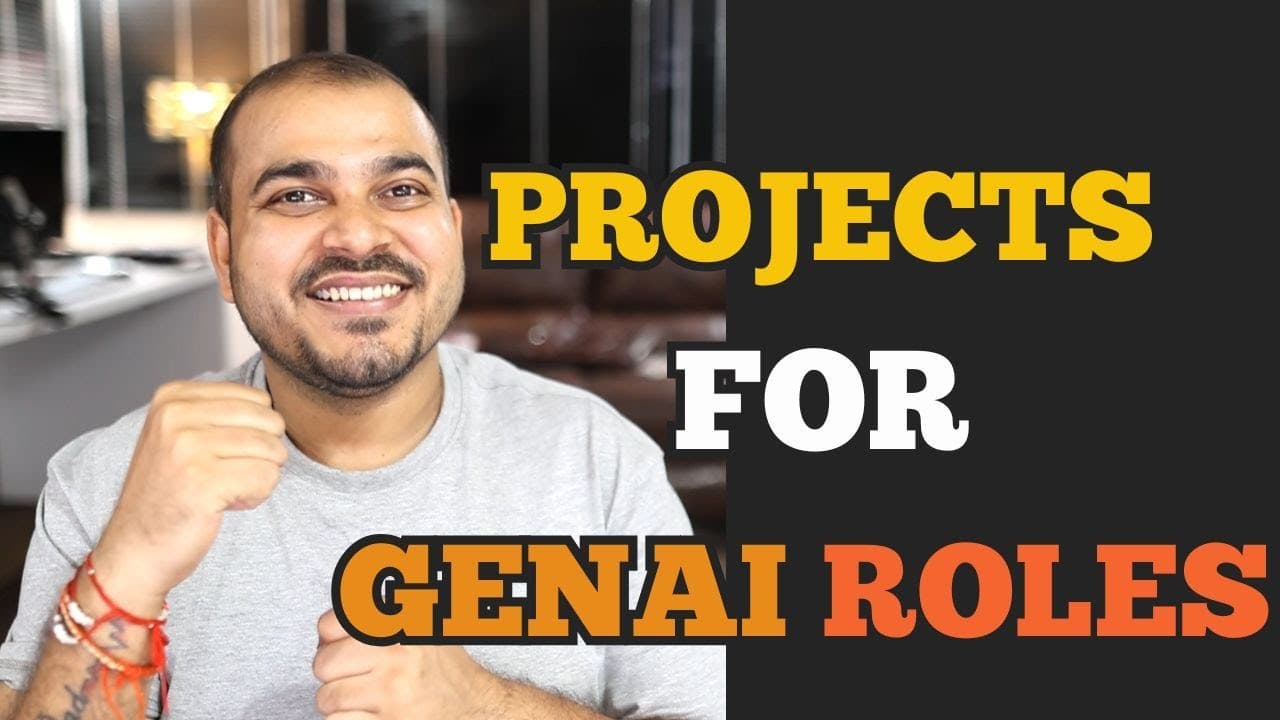
What Projects Should You Build for Gen AI Roles?
TL;DR
The two core project types to showcase are Agentic AI projects and RAG projects with vector databases. Emphasize data parsing, embeddings, memory management, and how you integrate external tools and MCP concepts. These projects help you stand out in interviews by proving practical end to end capabilities.
Transcript
Hello all, my name is Krishna and welcome to my YouTube channel. So guys, I hope everybody's following my langraph crash course. Already part one of the langraph crash course is uploaded where we covered various topics um wherein we need to understand about langraph fundamentals. We built a applications. We learned about MCP techniques, how to buil... Read More
Key Insights
- RAG projects with vector databases are a core expectation in Gen AI interviews and must be demonstrated in the resume.
- Agentic AI projects show how multiple AI agents coordinate to solve complex workflows, a highly valued capability in production environments.
- Data parsing and metadata enrichment are fundamental steps in building effective RAG pipelines for reliable retrieval.
- Text embeddings and choosing appropriate vector databases are critical for accurate and fast retrieval in RAG systems.
- Persisting cross session memory and different RAG variants, including adaptive and agentic RAG, are important topics for interviews.
- Knowledge of MCP techniques and debugging, monitoring, and evaluation metrics is increasingly expected for Gen AI roles.
- Integration with external tools and building end to end pipelines are key differentiators when presenting projects to potential employers.
- Understanding how to deploy LLM powered applications in an LLM OPS style context is a sought after skill set.
Install to Summarize YouTube Videos and Get Transcripts
Explore YouTube Video Summarizer or Get YouTube Transcript Extractor
Questions & Answers
Q: What are the two main project types you should include for Gen AI roles
The two main project types are Agentic AI projects and RAG projects with vector databases. Agentic AI projects demonstrate how multiple AI agents collaborate to complete complex tasks, mirroring real world workflows. RAG projects focus on retrieval augmented generation using vector stores to provide accurate, context aware responses. Together they cover end to end capabilities from data ingestion to response generation.
Q: Why are RAG projects with vector databases important for interviews
RAG projects with vector databases are important because they show you can parse data from multiple sources, generate meaningful embeddings, and store them in a vector database for efficient retrieval. Interviewers look for a complete data to answer loop, including how you handle metadata, how you select a vector store, and how you manage retrieval quality and latency.
Q: What skills should you highlight alongside RAG when interviewing
You should highlight data parsing, metadata handling, text embeddings, choice and use of vector databases, and memory management within RETRIEVAL augmented generation. Also discuss how you implement persistent memory across sessions, how you handle different RAG variants, and how you evaluate retrieval quality and system reliability.
Q: How do external tools factor into Gen AI projects
External tools are integrated to extend capabilities beyond the base LLM, enabling actions like querying data sources, performing computations, or controlling applications. A strong project will document how tools are bound, how failures are handled, and how tool responses are integrated into the final output for a coherent user experience.
Q: What is meant by agentic AI in this context
Agentic AI refers to creating multi agent systems where agents communicate and coordinate to fulfill a task or workflow. This approach divides complex problems into smaller steps, assigns them to different agents, and orchestrates their interactions to achieve a goal, often improving efficiency and reliability in production settings.
Q: What MCP techniques are emphasized for Gen AI projects
MCP techniques refer to memory, context handling, and feedback loops. Emphasizing these means you describe how memory is stored and retrieved across sessions, how you incorporate human feedback to improve models, and how you monitor accuracy and adapt strategies based on real user interactions.
Q: What interview topics should you be ready to discuss besides projects
Be ready to discuss MCP, debugging strategies, monitoring setups, LLM evaluation metrics, and how you would deploy Gen AI applications in an LLM OPS style environment. Interviewers expect knowledge on end to end lifecycle, performance considerations, and how to validate results with metrics.
Q: How should you present these projects on a resume
Present projects as end to end flow stories from data ingestion to final outputs, specify the tech stack, data formats, vector databases used, memory strategies, and how you evaluated results. Include clear outcomes like improved retrieval quality or faster response times to demonstrate impact.
Summary & Key Takeaways
-
Summary point 1: The video highlights two main project categories for Gen AI roles, Agentic AI and RAG with vector databases, as essential resume items to impress interviewers and demonstrate practical skills. This framing guides what to build first and how to present it.
-
Summary point 2: It stresses the importance of mastering base skills such as working with LLMs, external tools integration, memory management, and MCP techniques, which underpin successful end to end Gen AI applications and interview readiness.
-
Summary point 3: The content emphasizes showcasing RAG pipelines with data parsing, text embeddings, vector store usage, and advanced RAG variants like adaptive and agentic RAG to reflect current industry practices.
Read in Other Languages (beta)
Share This Summary 📚
Summarize YouTube Videos and Get Video Transcripts with 1-Click
Try YouTube Summary with ChatGPT & Claude or YouTube Transcript Generator
Explore More Summaries from Krish Naik 📚


Summarize YouTube Videos and Get Video Transcripts with 1-Click
Try YouTube Summary with ChatGPT & Claude or YouTube Transcript Generator