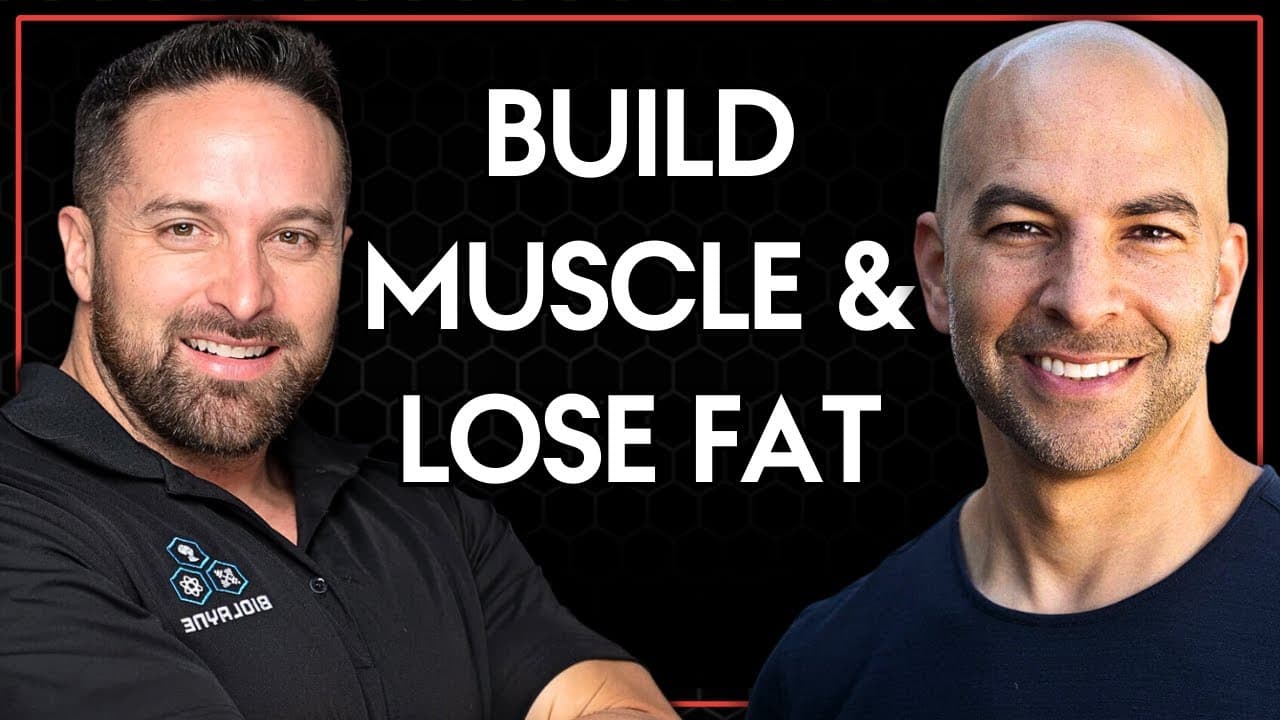
How to Build Muscle and Lose Fat with Resistance Training
TL;DR
Consistency drives strength gains more than natural talent or any specific program: if you train regularly, you will get stronger regardless of the exact routine. Progressive overload remains the core principle of weight training, and its measurable, black-and-white feedback (lifting 10% more in two months) makes progress objective rather than a matter of perception.
Transcript
hey everyone welcome to the drive podcast i'm your host peter etia hey lane awesome to uh be sitting down with you today at least virtually i've been looking forward to speaking with you for actually about two and a half years i know dom introduced us a long time ago we were trying to do this in person at some point and then one thing led to anothe... Read More
Key Insights
- Consistency is the primary driver of strength gains. As Layne Norton notes, if you are consistent you will get stronger regardless of what program you follow, which is why beginners progress even doing whatever the football team does.
- Progressive overload remains the foundation of weight training. Despite advances in understanding, the basics have stayed relatively similar, and this core principle still governs how lifters build strength over time.
- Weightlifting rewards work over talent. Norton was drawn to lifting because the investment-to-payoff ratio felt fairer than baseball, where being a five-foot-ten right-handed pitcher imposes hard physical limits.
- Weight training progress is objective and measurable. Unlike vague self-assessment, lifting 10% more than two months ago is a hard outcome that proves improvement without needing to guess whether you are getting better.
- Evidence-based coaching means questioning dogma. Norton's mentor Dr. Joe Klemczewski avoided common practices like water depletion, explaining the physiological reasons rather than following bodybuilding tradition.
- Being drug-free is a personal ethos, not a judgment. Norton competed only in drug-tested organizations because he personally wouldn't feel good otherwise, while stating no objection to those who use PEDs in untested competitions.
- Sheer volume of work can overcome ADHD-related challenges. Norton found that consistent effort helped him compensate in academics where focus was difficult, a pattern he applied to both study and lifting.
- Self-directed learning launched Norton's fitness career. Unable to afford bodybuilding magazine subscriptions, he walked to his local library and checked out books on weight training to teach himself the fundamentals.
Install to Summarize YouTube Videos and Get Transcripts
Explore YouTube Video Summarizer or Get YouTube Transcript Extractor
Questions & Answers
Q: How important is consistency for getting stronger in the gym?
Consistency is the single most important factor for building strength. Layne Norton emphasizes that if you are consistent, you will get stronger regardless of what program you are doing. He points out that even when his high school lifting class simply had students do whatever the football team was doing, he still got stronger. This shows that showing up regularly and putting in the work matters more than following any perfect or optimized routine, especially for beginners.
Q: What is progressive overload in weight training?
Progressive overload is the foundational principle of weight training that involves gradually increasing the demands on your muscles over time. Norton notes that while our understanding of weight training has advanced considerably, the basics like progressive overload remain relatively similar to what was taught decades ago. Even an early strength-training book he read from the library covered these fundamentals. It is the core mechanism through which lifters continue building strength consistently across weeks and months.
Q: Why did Layne Norton start lifting weights?
Layne Norton started lifting weights as a teenager primarily to stop being picked on and to get dates. He describes being a nerdy kid with ADHD who was talkative and goofy and was borderline emotionally abused by his peers growing up. Lifting weights did not accomplish either of his original goals, but he unexpectedly developed a genuine passion for weight training that eventually shaped his entire career in bodybuilding, powerlifting, and nutritional science.
Q: What makes weightlifting appealing compared to other sports?
Norton found weightlifting appealing because it felt fair and measurable. Compared to baseball, where being a five-foot-ten right-handed first baseman or pitcher imposes hard physical limits, lifting offered a lower threshold of natural talent needed relative to the work invested. He also valued that progress is objective and black-and-white: if you lift 10% more than you did two months ago, that is a hard outcome proving you improved, not a matter of guessing or perception.
Q: Who was Layne Norton's first bodybuilding coach?
Layne Norton's first coach was Dr. Joe Klemczewski, an evidence-based natural bodybuilding coach who happened to live in Norton's hometown and wrote for natural bodybuilding magazines. Klemczewski prepped Norton for his first drug-tested show, which Norton won in both the teenage and novice divisions. Klemczewski's evidence-based approach and willingness to question dogma, such as avoiding common water depletion practices, deeply influenced Norton and inspired him to pursue advanced academic study of the human body.
Q: How did Layne Norton learn about weight training without money or resources?
Growing up without much money in southern Indiana, which he describes as not a hotbed of fitness information, Norton could not afford subscriptions to bodybuilding magazines. So the first thing he did when he got into weightlifting was walk down to his local library and check out books on weight training. One book he recalls covered the basics of strength training including periodization, a concept then new to weightlifting. This self-directed learning guided his first few years in the sport.
Q: What is Layne Norton's stance on performance-enhancing drugs?
Norton has always been drug-free regarding anabolic steroids, growth hormones, and other performance-enhancing drugs. He stresses this is a personal ethos, not a judgment of others: he has no problem with anyone who uses PEDs as long as they compete in untested organizations. He chose drug-tested bodybuilding because he never felt called to be Mr. Olympia and knew he personally would not feel good about himself otherwise, while affirming that others who use them should feel good about themselves.
Q: How did Layne Norton overcome ADHD to succeed academically?
Norton found that through sheer volume of work he could overcome many of the focus challenges caused by his ADHD. School was difficult and staying focused was hard, but his parents were deeply committed to his education, instilling that he would go to college. By the time he reached college he had developed strong study habits. He was the first person in his extended family to attend college, and the effort-based approach he applied to academics mirrored how he approached lifting.
Summary & Key Takeaways
-
Layne Norton grew up in Evansville, southern Indiana, playing baseball from age five and running cross country. Picked on as a nerdy kid with ADHD, he started lifting weights hoping to stop the bullying and get dates. Neither happened, but he developed a lasting passion for weight training.
-
Norton was drawn to lifting because it felt fair: the work-to-payoff ratio required less natural talent than baseball, and progress was measurable and black-and-white. Progressive overload and consistency meant he got stronger regardless of program, teaching himself from library books before formal guidance existed.
-
At 19 Norton entered his first drug-tested bodybuilding competition and won the teenage and novice divisions. He was coached by Dr. Joe Klemczewski, an evidence-based natural bodybuilding coach whose focus on physiology over dogma inspired Norton to pursue academics and eventually earn a Ph.D. in nutritional sciences.
Read in Other Languages (beta)
Share This Summary 📚
Summarize YouTube Videos and Get Video Transcripts with 1-Click
Try YouTube Summary with ChatGPT & Claude or YouTube Transcript Generator
Explore More Summaries from Peter Attia MD 📚
Summarize YouTube Videos and Get Video Transcripts with 1-Click
Try YouTube Summary with ChatGPT & Claude or YouTube Transcript Generator