How AI Shifts from Scaling to Research: Insights from Ilya Sutskever
TL;DR
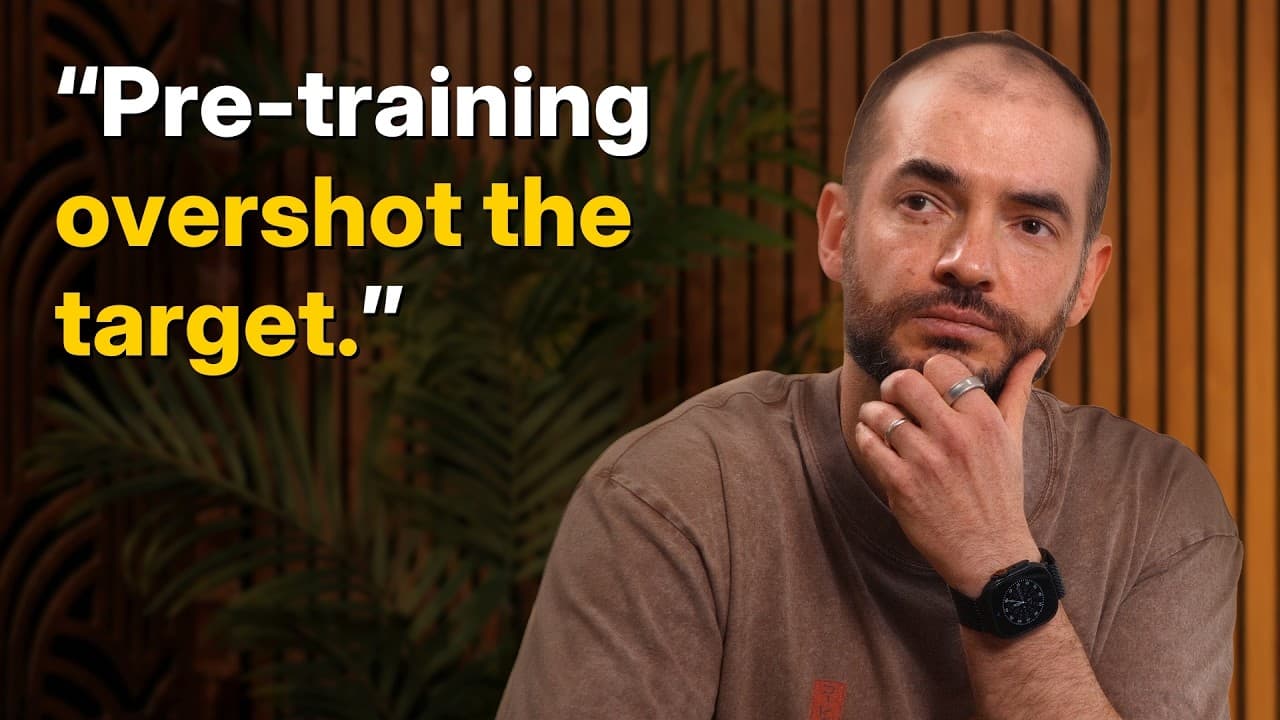
Ilya Sutskever argues that AI progress is shifting toward research because scaling alone does not explain why models excel on difficult evaluations yet remain unreliable in real-world work. Although AI investment has reached 1% of GDP, its effects still feel abstract, and reinforcement-learning environments may be encouraging narrow evaluation performance rather than broad generalization. Read on for his explanations of this gap and the research directions it suggests.
Transcript
You know what's crazy? That all of this is real. Meaning what? Don't you think so? All this AI stuff and all this Bay Area… that it's happening. Isn't it straight out of science fiction? Another thing that's crazy is how normal the slow takeoff feels. The idea that we'd be investing 1% of GDP in AI, I feel like it would have felt like a bigger... Read More
Key Insights
- AI's evolution is shifting from scaling to a research-focused approach.
- Current AI models excel in evaluations but lag in economic impact.
- Reinforcement learning (RL) training presents challenges in data selection.
- AI's generalization capabilities are less robust compared to human learning.
- Future AI development will require incremental deployment to ensure safety.
- Human emotions play a crucial role in decision-making, potentially analogous to AI value functions.
- Superintelligence development may benefit from focusing on alignment with sentient life.
- Future AI advancements will likely lead to significant economic growth.
Install to Summarize YouTube Videos and Get Transcripts
Explore YouTube Video Summarizer or Get YouTube Transcript Extractor
Questions & Answers
Q: Why does Ilya Sutskever say AI is moving from the age of scaling to the age of research?
Current models perform remarkably well on difficult evaluations, yet their real-world economic impact and reliability lag behind. Sutskever says this unexplained gap points to research problems involving reinforcement-learning environments and inadequate generalization.
Q: Why does AI’s economic impact seem weaker than its evaluation performance?
Sutskever observes that models appear much smarter on evaluations than their economic impact would imply. He suggests that reinforcement-learning training may be narrowly focused or influenced by evaluation tasks, allowing models to score well without performing consistently in real situations.
Q: How can an AI model perform well on evaluations but still fail at coding?
Sutskever describes a vibe-coding example in which a model fixes one bug by introducing another, then restores the first bug while correcting the second. This alternating failure suggests that strong evaluation results do not necessarily produce reliable judgment across an entire codebase.
Q: How might reinforcement learning make AI models too narrowly focused?
One possible explanation is that reinforcement-learning training makes models single-minded and insufficiently aware of the broader situation. Although that training can improve some capabilities, it may leave models unable to handle basic dependencies or consequences reliably.
Q: Why is selecting reinforcement-learning environments difficult?
Pre-training can use all available data, so researchers do not face the same degree of selection. Reinforcement learning requires teams to choose particular tasks and environments from a huge range of possibilities, creating many degrees of freedom in the training mix.
Q: Can focusing on evaluations distort AI training?
Yes, Sutskever suggests that teams may take inspiration from evaluations when creating reinforcement-learning environments because they want released models to score well. Combined with inadequate generalization, this could help explain the gap between evaluation performance and real-world performance.
Q: Should researchers simply add more diverse reinforcement-learning environments?
One proposal is to expand the environment suite beyond coding competitions to tasks such as building the best application for different purposes. Another is to develop an approach that lets a model learn in one environment and improve its performance somewhere else.
Q: What does the 10,000-hour versus 100-hour student example illustrate?
Sutskever compares a student who practices competitive programming for 10,000 hours with another who performs well after only 100 hours. The comparison raises the question of whether intensive domain-specific performance or faster learning better predicts broader future success.
Summary & Key Takeaways
-
AI's current progress is transitioning from an era of scaling to one of research, where understanding generalization and alignment are key challenges. Sutskever highlights that while models perform well in tests, their economic impact is not as pronounced, suggesting a disconnect between evaluation success and real-world application.
-
The discussion emphasizes the importance of reinforcement learning and the complexities involved in selecting appropriate training data. Sutskever suggests that AI's future lies in improving generalization to match human-like learning, which could lead to more robust and versatile AI systems.
-
Sutskever advocates for a gradual deployment of AI to better understand its societal impact and ensure safety. He proposes that AI should be aligned with the values of sentient life, which could provide a framework for developing superintelligence that benefits humanity.
Read in Other Languages (beta)
Share This Summary 📚
Summarize YouTube Videos and Get Video Transcripts with 1-Click
Try YouTube Summary with ChatGPT & Claude or YouTube Transcript Generator
Explore More Summaries from Dwarkesh Patel 📚





Summarize YouTube Videos and Get Video Transcripts with 1-Click
Try YouTube Summary with ChatGPT & Claude or YouTube Transcript Generator