How to Convert Hexadecimal Values to Decimal
TL;DR
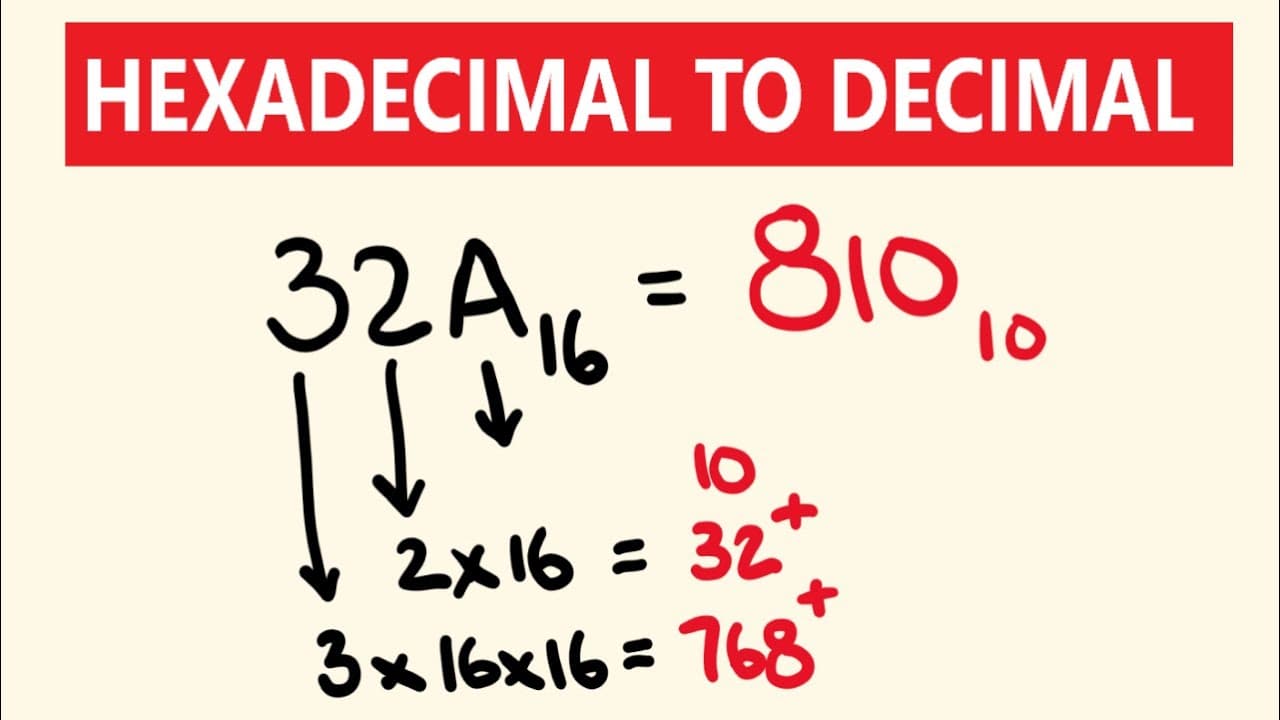
Hexadecimal numbers convert to decimal by multiplying each digit by increasing powers of 16, then summing the results. This process involves understanding the additional digits (A-F) used in hexadecimal, as well as handling decimal places through decreasing powers of 16. The video provides clear examples and step-by-step instructions.
Transcript
good day welcome to the tech math Channel I'm Josh today we're going to be looking at how to convert a heximal number into its decimal equivalent so we'll be looking at these examples here we're going to be converting increasingly larger heximal numbers as well as a decimal place hexadecimal number so that's going to be right through the video ther... Read More
Key Insights
- ⚾ Hexadecimal and decimal numbers are different base counting systems.
- #️⃣ Hexadecimal numbers have extra digits (A-F) compared to decimal numbers.
- ✊ Converting hexadecimal numbers to decimal involves multiplying each digit by increasing powers of 16.
- 🗯️ Decimal places in hexadecimal numbers are handled by multiplying the digits to the right of the decimal by decreasing powers of 16.
- ✖️ The conversion process involves simple multiplication and addition.
- ❓ The examples provided demonstrate the step-by-step process of converting hexadecimal to decimal.
- ❓ Patrons are acknowledged and support for the Tech Math Channel is encouraged.
Install to Summarize YouTube Videos and Get Transcripts
Explore YouTube Video Summarizer or Get YouTube Transcript Extractor
Questions & Answers
Q: What is the difference between hexadecimal and decimal numbers?
Hexadecimal and decimal numbers are different base counting systems. Decimal numbers use a base of 10 (0-9), while hexadecimal numbers use a base of 16 (0-9, A-F).
Q: How do you convert a hexadecimal number to its decimal equivalent?
To convert a hexadecimal number to decimal, each digit is multiplied by increasing powers of 16. The hexadecimal digit 'A' is equivalent to 10, 'B' is 11, 'C' is 12, 'D' is 13, 'E' is 14, and 'F' is 15.
Q: Can you provide an example of converting a hexadecimal number to decimal?
Sure! Let's convert the hexadecimal number 32A. The digit 'A' is equal to 10. So, 32A becomes (3 * 16^2) + (2 * 16^1) + (10 * 16^0), which equals 810 in decimal.
Q: What happens when there is a decimal place in a hexadecimal number?
When there is a decimal place, the digits to the left of the decimal are converted as usual. The digits to the right of the decimal are multiplied by decreasing powers of 16 (16^-1, 16^-2, etc.) to get the decimal equivalent.
Summary & Key Takeaways
-
The video explains the difference between hexadecimal and decimal numbers, which are different base counting systems.
-
Hexadecimal numbers have extra digits (A-F) compared to decimal numbers, which only have digits 0-9.
-
To convert a hexadecimal number to its decimal equivalent, each digit is multiplied by increasing powers of 16 and then added together.
Read in Other Languages (beta)
Share This Summary 📚
Summarize YouTube Videos and Get Video Transcripts with 1-Click
Try YouTube Summary with ChatGPT & Claude or YouTube Transcript Generator
Explore More Summaries from tecmath 📚


Summarize YouTube Videos and Get Video Transcripts with 1-Click
Try YouTube Summary with ChatGPT & Claude or YouTube Transcript Generator