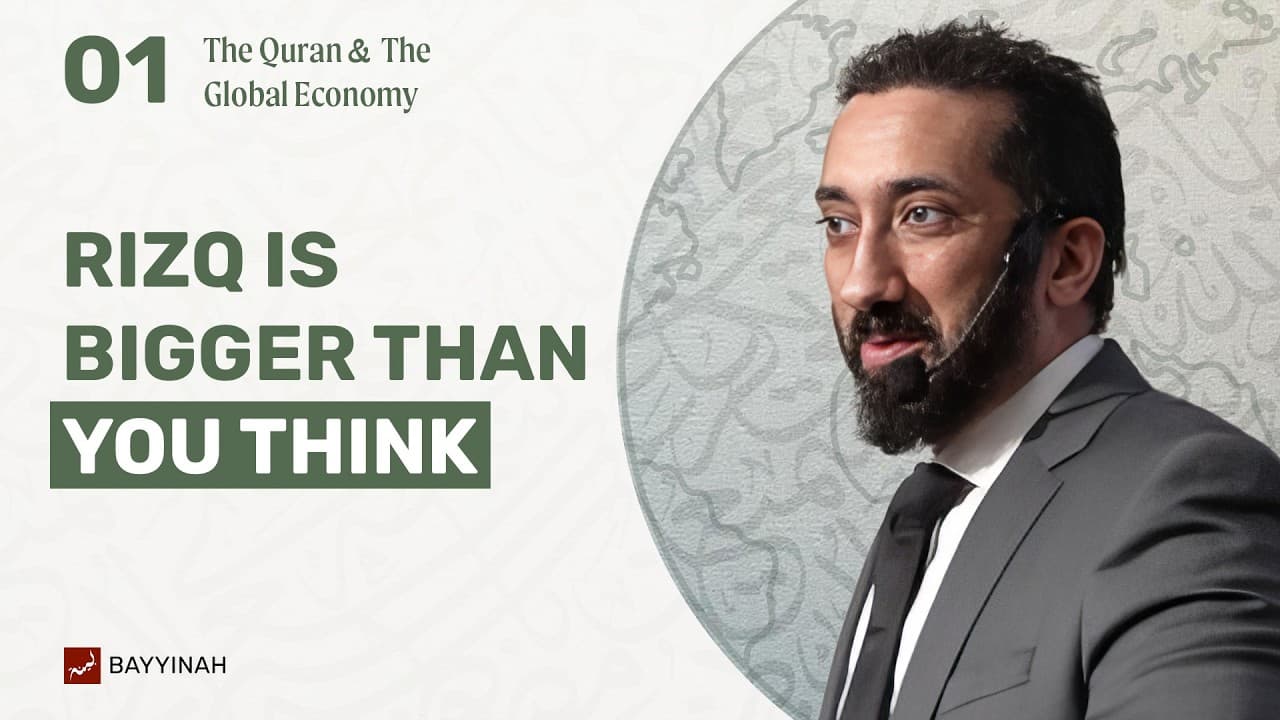
How Does the Quran Frame Money, Trade, and Business? | Quran & The Global Economy by Nouman Ali Khan
TL;DR
The Quran frames money, trade, work, and spending as parts of divine guidance rather than matters separate from spirituality. In part one of Nouman Ali Khan’s three-part Quran & The Global Economy series, provision and business are connected to worship, while inheritance and divorce illustrate why Quranic teachings must shape practical conduct. Read on to understand rizq, natural resources, agriculture, and the wider economic consequences of everyday choices.
Transcript
Coming up in today's episode, I usually don't get nervous when I give a lecture, but I'm nervous today. Allah says there's no harm on you when you enter homes that are not lived in, meaning commercial buildings in which there is mad for you. How is Allah talking about the pursuit of economic benefit? What if your risk, your work, and your spending ... Read More
Key Insights
- The Quran addresses material life as part of religious guidance, including wealth, trade, careers, inheritance, divorce, and national economic prosperity. Treating these matters as a separate worldly sphere produces an incomplete understanding of how Quranic teachings are meant to guide daily conduct.
- A narrow religious lens can produce serious contradictions between devotion and behavior. A person may recite, memorize, study Arabic, pray, and perform pilgrimage while disregarding Quranic inheritance shares or failing to show generosity and fairness during a divorce.
- Natural resources are presented as provisions intended for human and animal use. Rain enables the earth to produce grain, grapes, olives, palm trees, fruit, pasture, and crops, connecting divine provision directly with agriculture, consumption, livestock, and economic activity.
- Agricultural capacity gives nations a major economic advantage because food remains a fundamental human dependency. Technological development does not remove the need for bread, eggs, milk, fruit, meat, poultry, dairy products, and the natural systems that sustain their production.
- Food supply disruptions can affect far more than grocery prices. The lecture cites conflict involving Russia and Ukraine as an example in which interrupted wheat and food supplies raised prices and influenced commodities, business costs, and wider supply chains across many countries.
- Water and rainfall have major economic and political consequences. Rain supports produce and livelihoods, while access to water can become a source of conflict between nations. Quranic references to rain therefore invite reflection on systems that sustain communities and economies.
- Rizq is a foundational economic term in the Quran that includes material and spiritual provision. Food and produce are rizq, while guidance, teachers, parents, charitable opportunities, and good intentions can also be understood as forms of provision from Allah.
- Economic reflection is one lens for contemplating Quranic passages about creation. Examining the effects of rain, clouds, agriculture, rivers, ships, or commerce can reveal how brief references connect to food security, transportation, trade, prices, livelihoods, and global economic relationships.
Install to Summarize YouTube Videos and Get Transcripts
Explore YouTube Video Summarizer or Get YouTube Transcript Extractor
Questions & Answers
Q: How does the Quran frame money, trade, and business?
The Quran does not separate spiritual commitment from material conduct. How people earn, spend, build, pursue economic benefit, and conduct business all matter to Allah, so these activities can become acts of worship when guided by the Quran.
Q: What does Nouman Ali Khan cover in part one of Quran & The Global Economy?
Part one explains how provision and business form part of the Quran’s divine guidance. It also introduces an economic lens for reflecting on the earth, natural resources, work, spending, and the pursuit of economic benefit.
Q: What is rizq in the Quranic framework described in the lecture?
Rizq includes both material and spiritual provision from Allah. Food, fruit, and agricultural produce are material rizq, while guidance, teachers, parents, charitable opportunities, and good intentions can also be forms of provision.
Q: Why should the Quran not be reduced to spirituality and rituals?
Spirituality, rituals, theology, and legal rulings are important, but the Quran’s guidance is more inclusive than those lenses alone. It also addresses practical matters such as careers, banking, trade, inheritance, divorce, earning, and spending.
Q: How can a narrow relationship with the Quran create contradictions?
A person may recite the Quran, memorize it, study Arabic, pray, and perform pilgrimage while failing to apply its guidance elsewhere. The lecture gives examples of denying a sister her inheritance share and allowing a divorce to become ugly despite the Quran’s instruction not to forget favors between the parties.
Q: Why are rain and agriculture economically important in this Quranic discussion?
Rain enables the earth to produce grain, grapes, olives, palm trees, fruit, pasture, and crops for people and animals. These resources support food supplies, livestock, consumption, livelihoods, trade, and national production.
Q: Why does agricultural production give countries an economic advantage?
Countries with strong agricultural, meat, poultry, and dairy production can meet essential food needs and supply other regions through exports. Technological development does not remove dependence on bread, eggs, milk, fruit, meat, and the natural systems that sustain them.
Q: How can disruptions to food supplies affect the global economy?
The lecture cites the conflict involving Russia and Ukraine, explaining that disrupted wheat and food supplies raised prices across multiple countries. Those increases can affect other commodities, business costs, and wider supply chains, showing how one producing region can influence many economies.
Summary & Key Takeaways
-
The Quran should not be approached only through spiritual practices, rituals, theology, or legal rulings. Its guidance also applies to inheritance, divorce, careers, banking, trade, and economic development. A serious relationship with the Quran therefore requires translating its teachings into material decisions and everyday conduct, not merely reciting or studying its verses.
-
Rain, fertile land, grain, grapes, olives, palm trees, fruit, pasture, and animals are presented as resources provided for human use. These resources remain essential despite technological progress. Countries with strong agricultural, meat, poultry, and dairy production gain economic advantages because food supplies, exports, prices, and wider supply chains depend upon them.
-
Rizq is a foundational Quranic economic concept that includes both spiritual and material provision. Guidance, teachers, parents, charitable opportunities, and good intentions can be rizq, while food and agricultural produce are material forms. Recognizing both dimensions prevents believers from separating worship from earning, spending, commerce, and responsible use of the earth's resources.
Read in Other Languages (beta)
Share This Summary 📚
Summarize YouTube Videos and Get Video Transcripts with 1-Click
Try YouTube Summary with ChatGPT & Claude or YouTube Transcript Generator
Explore More Summaries from Nouman Ali Khan - Official - Bayyinah 📚
Summarize YouTube Videos and Get Video Transcripts with 1-Click
Try YouTube Summary with ChatGPT & Claude or YouTube Transcript Generator