Which DJI Osmo Pocket 3 Filters Are Worth It?
TL;DR
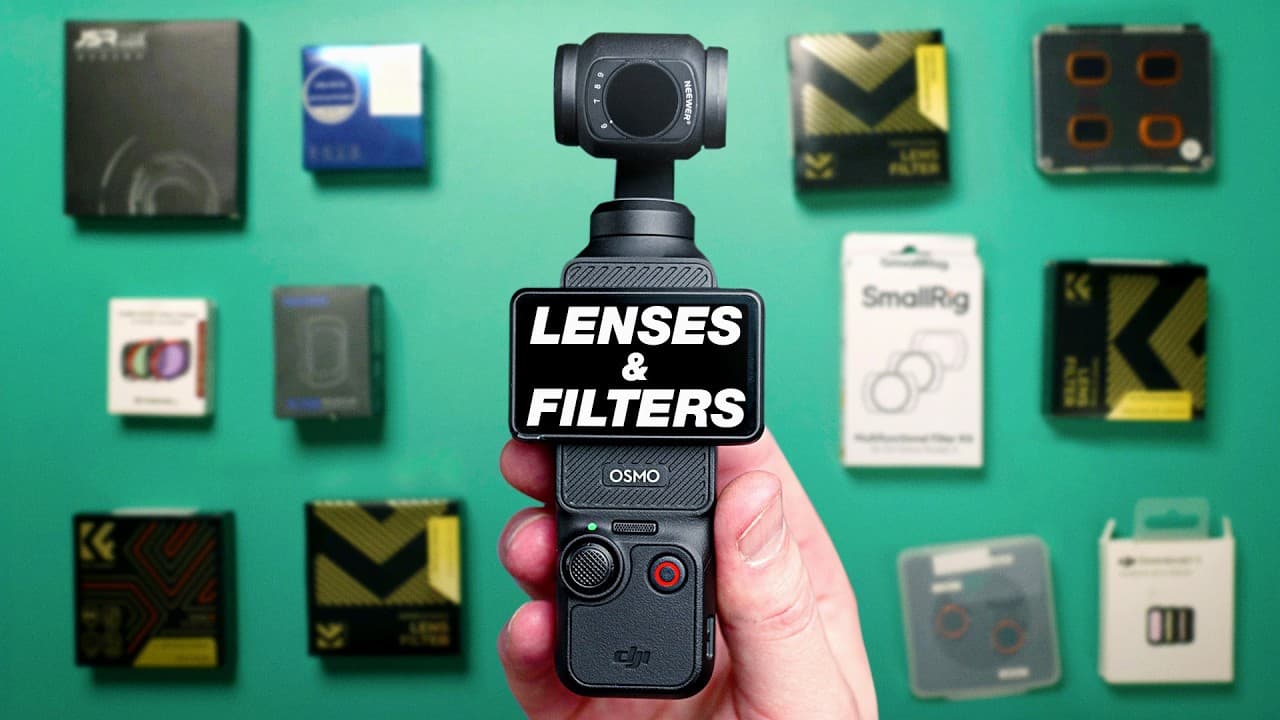
The MingVen set is the strongest budget choice because its three hard-stop ND filters and black mist filter cost about $30 while producing results similar to DJI’s pricier options. Freewell’s $70 variable ND pair offers better build quality, while the JSR and K&F wide-angle lenses provide the widest tested fields of view without major image-quality loss.
Transcript
So, I've tested more than 20 different filters and lenses for the Osmo Pocket 3 over the last few weeks to figure out if lenses and filters actually help the image quality of the Pocket 3 or hurt its overall performance. So, in this video, let's talk about what these different lenses and filters do, as well as compare the budget variations to their... Read More
Key Insights
- ND filters are primarily exposure-control tools that reduce the light reaching the Pocket 3 sensor. They are useful outdoors when a creator selects a slower shutter speed, such as 1/50 or 1/60 depending on frame rate, to control motion blur while filming with manual settings.
- Variable ND filters adjust light reduction through a rotating control, while hard-stop filters provide one fixed strength per filter. The reviewer preferred hard-stop filters on the Pocket 3 because rotating a tiny variable filter was awkward and could bend or move the camera’s small gimbal.
- The MingVen kit is the recommended value option at about $30 because it includes three ND filters and one black mist filter. Its ND image quality showed little meaningful difference from DJI’s magnetic three-pack, which costs about $60, making the less expensive set easier to justify.
- Freewell’s two-pack of variable ND filters is the recommended premium choice at $70. It had the best perceived build quality among the tested filters, produced good-looking images, and avoided substantial corner vignetting while the variable ND control was rotated through its available intensities.
- Black mist filters are designed to soften highlights, lights, skin tones, and some of the sharpness visible in an image. The diffusion filter included with the MingVen kit performed its intended function, while the more expensive standalone DJI option did not provide enough additional value to justify roughly $50 more.
- The JSR and K&F wide-angle lenses produced the widest tested fields of view. The JSR option was especially promising because it widened the shot without introducing substantial edge vignetting, while all tested wide-angle adapters remained fairly sharp and caused no major overall image-quality loss.
- Macro lenses enable close detail shots that the Pocket 3 cannot normally capture in the same way. Their practical limitation is the camera’s tiny screen, which can make precise framing and focus assessment difficult, although the effect can still benefit creators who want specialized, visually creative shots.
- The K&F Concept 1.2x anamorphic lens had good build quality but delivered only an adequate anamorphic result. The reviewer found little personal use for it and concluded that pairing the effect with the Pocket 3’s small sensor did not produce the full cinematic look or value expected.
Install to Summarize YouTube Videos and Get Transcripts
Explore YouTube Video Summarizer or Get YouTube Transcript Extractor
Questions & Answers
Q: Why use an ND filter on the DJI Osmo Pocket 3?
An ND filter reduces the amount of light reaching the Pocket 3 sensor, making it easier to achieve correct exposure while using manual camera settings outdoors. This becomes helpful when selecting a slower shutter speed, such as 1/50 or 1/60 depending on the frame rate, to control motion blur. The filter can work alongside a lower ISO to prevent an overly bright image.
Q: Are fixed or variable ND filters better for the Pocket 3?
Fixed, or hard-stop, ND filters may be easier to handle on the Pocket 3 because each filter supplies a preset level of light reduction. A variable ND offers adjustable intensity, but rotating its tiny dial can be awkward and may push or bend the gimbal during adjustment. The reviewer therefore preferred selecting the required hard-stop strength and attaching it directly to the camera.
Q: What is the best budget ND filter set for the Pocket 3?
The MingVen set is the reviewer’s preferred budget option because it costs about $30 and includes three hard-stop ND filters plus a black mist filter. Its image-quality performance appeared essentially similar to DJI’s magnetic ND three-pack, which costs about $60. The combination of useful filter strengths, acceptable results, and the included diffusion filter makes MingVen the stronger value in this comparison.
Q: Is the Freewell variable ND filter set worth buying?
The Freewell two-pack is worth considering when premium construction and variable light control matter more than the lowest price. It costs $70, felt like the best-built ND option tested, and produced good image quality. The filters also avoided substantial vignetting around the corners when rotated, addressing a potential weakness of variable ND filters while providing adjustable intensity across the pair.
Q: What does a black mist filter do on the Pocket 3?
A black mist or diffusion filter softens highlights and reduces some of the hard, sharp appearance in an image. It can take the edge off skin tones and make visible lights look softer. The MingVen kit’s included mist filter performed this job effectively, and the JSR mist filter also worked adequately. The reviewer could not justify paying roughly $50 more for DJI’s standalone variation.
Q: Which wide-angle lens gives the Pocket 3 the widest view?
The JSR and K&F wide-angle lenses produced the widest fields of view among the products tested. JSR’s lens was particularly notable because it delivered the widest tested view without substantial vignetting near the edges. Wide-angle products from Neewer and DJI were also fairly sharp, and none of the tested adapters caused a major reduction in image quality, but JSR and K&F offered greater width.
Q: Is a macro lens useful with the DJI Osmo Pocket 3?
A macro lens is useful for capturing close detail shots that are not normally possible with the Pocket 3’s standard lens. It can add specialized creative footage to a shot sequence, and the JSR kit includes this capability. However, macro shooting is somewhat difficult because the Pocket 3 screen is tiny, making it harder to inspect fine details and judge the shot precisely while recording.
Q: Is an anamorphic lens worth using on the Pocket 3?
An anamorphic lens can compress the recorded image so it can later be stretched into a wider, cinematic aspect ratio. The tested K&F Concept 1.2x model had good build quality, but its visual result was only adequate. The reviewer felt the Pocket 3’s small sensor did not deliver the full anamorphic appearance or practical value expected, so the lens is better treated as an experiment than an essential accessory.
Summary & Key Takeaways
-
Filters serve two main purposes on the DJI Osmo Pocket 3: controlling incoming light for correct exposure with manual settings and creating visual effects unavailable from the built-in lens. Available options include fixed and variable ND filters, diffusion filters, polarizers, blue streak filters, wide-angle adapters, macro lenses, and anamorphic lenses.
-
Among the tested ND and diffusion products, the roughly $30 MingVen kit offers the strongest value. It includes three fixed ND filters and a black mist filter, with image results comparable to more expensive DJI options. Freewell’s $70 variable ND pair is the premium alternative because of its construction and limited corner vignetting.
-
Wide-angle adapters generally retained sharp image quality, but the JSR and K&F options delivered the widest tested fields of view. JSR’s kit also includes diffusion, macro, and creative filters. Macro shooting can be difficult on the Pocket 3’s small screen, while K&F’s anamorphic lens offered good construction but only a modest visual result.
Read in Other Languages (beta)
Share This Summary 📚
Summarize YouTube Videos and Get Video Transcripts with 1-Click
Try YouTube Summary with ChatGPT & Claude or YouTube Transcript Generator
Explore More Summaries from Think Media 📚


Summarize YouTube Videos and Get Video Transcripts with 1-Click
Try YouTube Summary with ChatGPT & Claude or YouTube Transcript Generator