What Is the E2 Reaction Mechanism and Its Products?
TL;DR
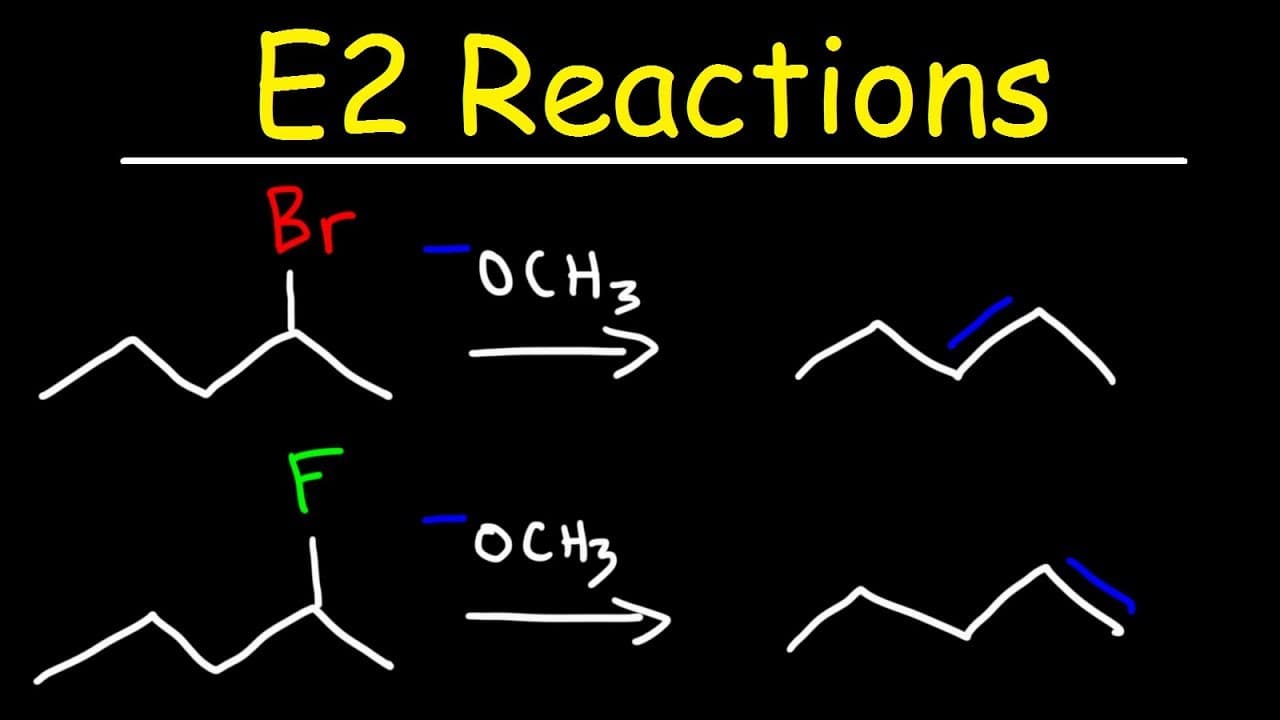
E2 reactions usually follow Zaitsev's rule, forming the most stable, more-substituted alkene when an unhindered strong base like methoxide or ethoxide abstracts the proton. Bulky bases such as tert-butoxide instead favor the less-substituted Hofmann product, and poor leaving groups like fluoride also push toward Hofmann. The mechanism is concerted and one-step with no carbocation rearrangements, and it is second-order overall. Read on for the rate law and worked examples.
Transcript
now in this video we're going to go over the e2 reaction mechanism so let's start with this example let's say we have two bromobutane and let's react with a strong base methoxide dissolve in methanol so what is the major product for this reaction now the strong base can either go for this hydrogen the primary blue hydrogen or it can go for the seco... Read More
Key Insights
- 💪 The E2 reaction mechanism involves a strong base abstracting a hydrogen atom, followed by the formation of a double bond and expulsion of the leaving group.
- 🫀 The major product in E2 reactions is determined by factors such as the accessibility of the hydrogen atom and the stability of the transition state.
- 🥺 Bulky bases can preferentially abstract a hydrogen atom that leads to the Hoffman product, while bases without steric hindrance favor the formation of the Zaitsev product.
- 💁 Alkyl fluorides tend to favor the Hoffman product as the major product, while alkyl bromides, chlorides, or iodides favor the formation of the Zaitsev product.
- 🥺 Conjugated dienes are more stable than isolated dienes, leading to the preferred formation of the double bond in the conjugated system.
- ❓ Steric hindrance can influence the preference for the Hoffman product in E2 reactions.
Install to Summarize YouTube Videos and Get Transcripts
Explore YouTube Video Summarizer or Get YouTube Transcript Extractor
Questions & Answers
Q: Does E2 follow Zaitsev's rule, or does it favor Hofmann?
E2 usually follows Zaitsev's rule when the base is a strong, unhindered base like methoxide or ethoxide, giving the most stable, more-substituted alkene as the major product. However, bulky (sterically hindered) bases favor the Hofmann product, and poor leaving groups such as fluoride also shift the outcome toward Hofmann. So the major product depends on both the base and the leaving group.
Q: What is the difference between the Zaitsev and Hofmann products?
The Zaitsev product has the double bond on the more substituted carbon and is the more stable alkene, while the Hofmann product places the double bond on the less substituted, more accessible carbon and is usually the minor product. A disubstituted alkene is more stable than a monosubstituted terminal alkene, which is why Zaitsev is normally favored. Steric hindrance and leaving-group ability decide which one dominates.
Q: Do bulky bases favor Zaitsev or Hofmann?
Bulky, sterically hindered bases such as tert-butoxide favor the Hofmann product. Because the base is large, it has a hard time reaching a proton crowded by nearby methyl groups, so it preferentially abstracts a more accessible hydrogen, often one on a primary carbon. That leads to the less substituted Hofmann alkene rather than the Zaitsev alkene.
Q: What is the E2 reaction mechanism?
In E2, a strong base grabs a hydrogen and breaks the carbon-hydrogen bond; those electrons form the pi (double) bond as the leaving group is expelled. It is a concerted reaction that happens in one step, so there are no carbocation rearrangements. When two adjacent hydrogens are available, you can get a mixture, such as both trans and cis isomers, with the more stable alkene as the major product.
Q: What is the rate law for the E2 reaction?
The E2 rate depends on the concentration of both the substrate and the base, making it first order in each and second order overall. For example, doubling the substrate and tripling the base increases the rate by a factor of six, and quadrupling the substrate while raising the base fivefold increases the rate by a factor of twenty.
Q: Why do alkyl fluorides give the Hofmann product while bromides give Zaitsev?
Fluoride is a poor leaving group, so it leaves slowly and the transition state resembles the starting material rather than the alkene, which favors the Hofmann product. Bromide is a good leaving group, so the transition state resembles an alkene, and the most stable alkene forms, giving the Zaitsev product. Leaving-group ability therefore controls which product dominates.
Q: Do strong bases favor E2 over E1?
Yes. Strong bases favor E2 reactions over E1, especially with secondary alkyl halides. Since E2 is concerted with no rearrangement, the double bond can only form on the carbons adjacent to the leaving group, and the more stable alkene is the major product.
Summary & Key Takeaways
-
The E2 reaction mechanism involves the abstraction of a hydrogen atom by a strong base, followed by the formation of a double bond and expulsion of the leaving group.
-
The major product in E2 reactions is determined by factors such as the accessibility of the hydrogen atom, stability of the transition state, and presence of substituents on the reacting molecules.
-
Sterically hindered bases can preferentially abstract a hydrogen atom that leads to the Hoffman product, while bases without steric hindrance favor the formation of the Zaitsev product.
Read in Other Languages (beta)
Share This Summary 📚
Summarize YouTube Videos and Get Video Transcripts with 1-Click
Try YouTube Summary with ChatGPT & Claude or YouTube Transcript Generator
Explore More Summaries from The Organic Chemistry Tutor 📚



Summarize YouTube Videos and Get Video Transcripts with 1-Click
Try YouTube Summary with ChatGPT & Claude or YouTube Transcript Generator