What Does the Computer Vision Bootcamp Cover?
TL;DR
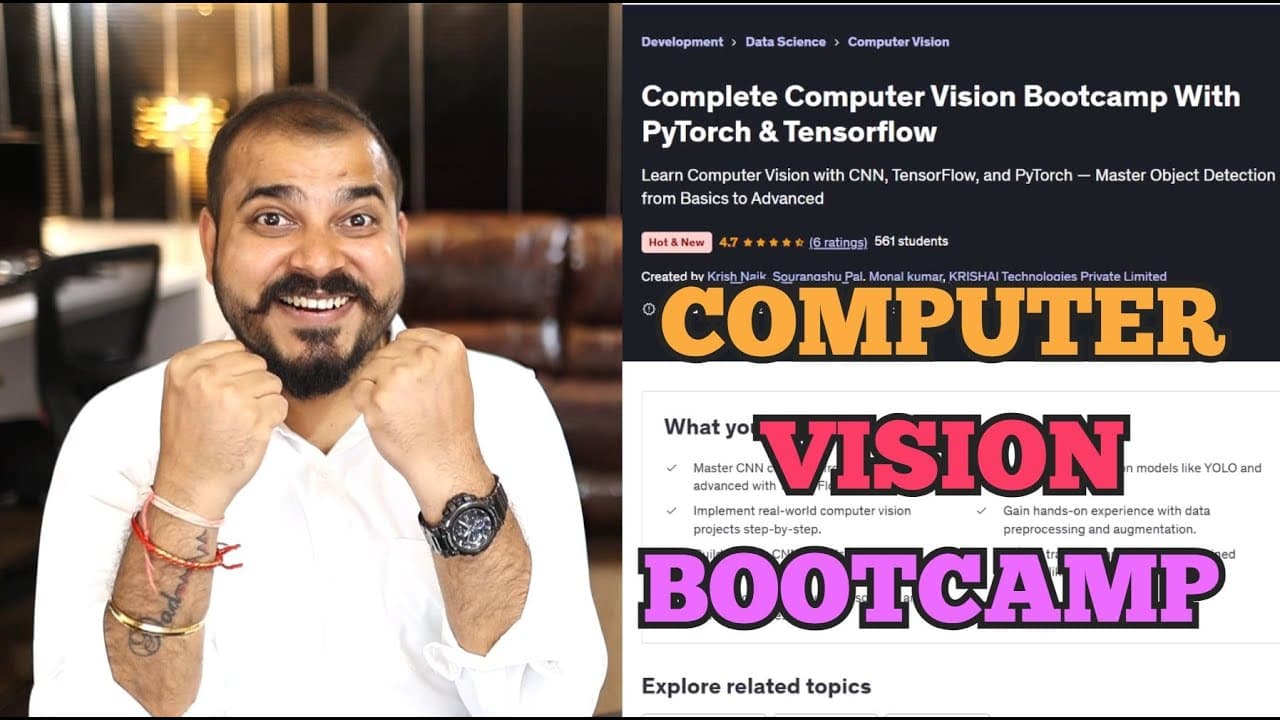
The bootcamp provides more than 54 hours of computer vision training, beginning with Python and deep learning fundamentals and progressing through OpenCV, CNNs, object detection, and image segmentation. It uses PyTorch and TensorFlow, includes end-to-end projects, and launched at 399 rupees with a 30-day money-back guarantee through Udemy.
Transcript
hello all my name is krishak and welcome to my YouTube channel so guys from past two to three months you know I've been getting this question a lot you know even in my YouTube videos chrish when is the complete computer vision boot camp coming up in Udi right so finally here you go guys uh the entire computer vision boot camp uh with pyos and tenso... Read More
Key Insights
- The bootcamp is a computer vision course built around PyTorch and TensorFlow, with material ranging from Python prerequisites to advanced model architectures. Its stated purpose is to provide the skills needed to build computer vision applications from scratch without omitting the foundational concepts.
- The initial release contains more than 54 hours of instruction, and the instructors plan to add roughly 30 additional hours. Their stated goal is to expand the course beyond 90 hours through weekly project uploads and other new lessons.
- The foundational curriculum includes Python, artificial neural networks, optimizers, loss functions, activation functions, backpropagation, gradient descent, and convolutional neural networks. These subjects establish the deep learning knowledge required before students approach specialized computer vision models.
- OpenCV is presented as an important component for practical computer vision work. The curriculum covers image structure, pixel values, channels, color spaces, image manipulation, and preprocessing so students can prepare and transform image data for later modeling tasks.
- The CNN curriculum covers convolution layers, pooling layers, fully connected layers, image classification, and architectures through ResNet. The description also identifies transfer learning with pretrained models such as ResNet, VGG, and EfficientN as part of the course content.
- The object detection section includes R-CNN, Fast R-CNN, Faster R-CNN, Detectron, custom object detection with Detectron 2, and YOLO V11. These topics follow the earlier Python, deep learning, OpenCV, and CNN modules.
- The image segmentation section covers downsampling, upsampling, fully convolutional networks, U-Net, custom U-Net training, and Mask R-CNN. This module extends the course beyond image classification and object detection into pixel-level image analysis methods.
- The course launched on Udemy at 399 rupees using the MARCH02 coupon code and includes Udemy's 30-day money-back guarantee. The transcript states that 561 students had enrolled before the formal announcement was made.
Install to Summarize YouTube Videos and Get Transcripts
Explore YouTube Video Summarizer or Get YouTube Transcript Extractor
Questions & Answers
Q: What topics does the computer vision bootcamp cover?
The bootcamp covers Python prerequisites, deep learning fundamentals, artificial neural networks, optimizers, loss functions, activation functions, convolutional neural networks, and OpenCV. It then progresses to visual CNNs, image classification, data augmentation, transfer learning, object detection, and image segmentation. Named architectures and tools include ResNet, Detectron 2, YOLO V11, U-Net, and Mask R-CNN.
Q: Does the bootcamp teach both PyTorch and TensorFlow?
Yes, the bootcamp is structured around both PyTorch and TensorFlow. The curriculum includes implementing convolutional neural network models with these frameworks and applies them to computer vision tasks. The course also provides a deeper exploration of PyTorch while covering the broader foundations, architectures, preprocessing methods, detection models, segmentation methods, and end-to-end projects needed for computer vision applications.
Q: How long is the computer vision bootcamp?
The launched course contains more than 54 hours of instructional content. The instructors say they are working to add roughly 30 more hours, including additional end-to-end projects and a computer vision transformer module. Their stated goal is to grow the complete curriculum to more than 90 hours, with new project material intended for weekly uploads.
Q: What object detection models are included in the course?
The object detection section includes R-CNN, Fast R-CNN, Faster R-CNN, Detectron, custom object detection using Detectron 2, and YOLO V11. These lessons appear after foundational instruction in Python, deep learning, OpenCV, convolutional neural networks, image classification, and data augmentation, giving students a progression from general concepts to specific detection architectures and implementations.
Q: What image segmentation methods does the bootcamp teach?
The image segmentation module introduces segmentation concepts alongside downsampling, upsampling, and fully convolutional networks. It also covers U-Net, custom U-Net training, and Mask R-CNN. This section follows the course's treatment of deep learning, CNN architectures, image classification, data augmentation, and object detection, extending the curriculum into methods that analyze and separate image regions.
Q: Does the course include OpenCV and image preprocessing?
Yes, OpenCV and image preprocessing are included as important parts of the curriculum. The course introduces image data and its structure, including pixel values, channels, and color spaces. It also covers OpenCV-based image manipulation and preprocessing, plus data augmentation techniques using imgaug, Albumentations, and the TensorFlow Data Pipeline to support model development and performance improvement.
Q: Who teaches the computer vision bootcamp?
The course is mentored by Krish, Paul, and Monal. Krish presents the course and describes Paul as an experienced professional who has worked specifically on computer vision projects. Monal has appeared on Krish's YouTube channel and in several of his courses. Together, they support a curriculum spanning foundations, model architectures, practical tools, and projects.
Q: What was the bootcamp price and enrollment offer?
The course launched on Udemy for 399 rupees, with the MARCH02 coupon code provided through the enrollment link in the description. The offer also included Udemy's 30-day money-back guarantee. According to the transcript, 561 students had already enrolled before the formal announcement, and prospective students were encouraged to explore the syllabus and provide ratings and feedback.
Summary & Key Takeaways
-
The course starts with Python prerequisites and foundational deep learning topics, including artificial neural networks, optimizers, loss functions, activation functions, and convolutional neural networks. It also introduces image data, pixel values, channels, color spaces, backpropagation, gradient descent, and OpenCV techniques for image manipulation and preprocessing.
-
The advanced curriculum covers CNN architectures through ResNet, data augmentation, image classification, transfer learning, and object detection. Named detection topics include R-CNN, Fast R-CNN, Faster R-CNN, Detectron, custom detection with Detectron 2, and YOLO V11, with implementations involving both PyTorch and TensorFlow.
-
Image segmentation lessons address downsampling, upsampling, fully convolutional networks, U-Net, custom U-Net training, and Mask R-CNN. Krish, Paul, and Monal mentor the course, while additional projects, a computer vision transformer module, and roughly 30 more hours of material are planned for future weekly uploads.
Read in Other Languages (beta)
Share This Summary 📚
Summarize YouTube Videos and Get Video Transcripts with 1-Click
Try YouTube Summary with ChatGPT & Claude or YouTube Transcript Generator
Explore More Summaries from Krish Naik 📚




Summarize YouTube Videos and Get Video Transcripts with 1-Click
Try YouTube Summary with ChatGPT & Claude or YouTube Transcript Generator