What Distinguishes CPUs from GPUs?
TL;DR
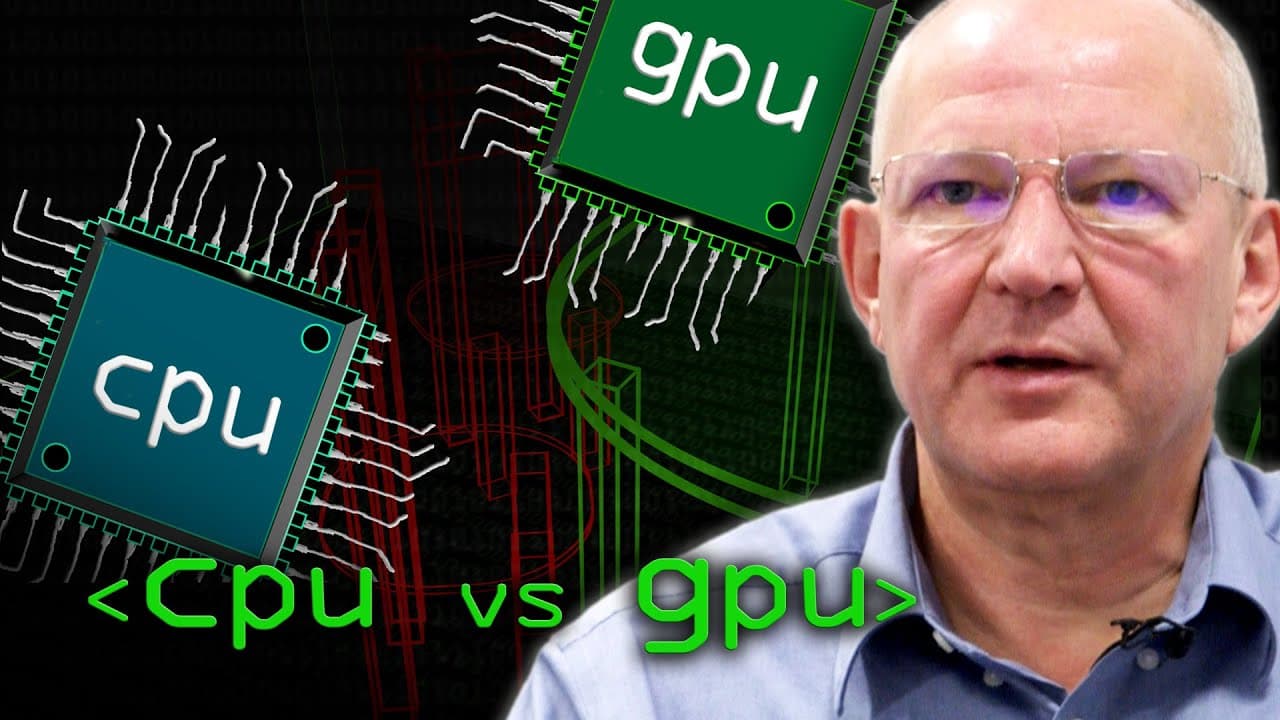
A CPU provides versatile processing for a wide range of tasks, while a GPU is specialised for efficiently rendering three-dimensional images through parallel processing. This design enables GPUs to excel in bulk calculations, making them particularly effective for specific computational tasks beyond graphics, like Bitcoin mining and image processing.
Transcript
And a graphics processor is a specialist processor that is designed to make processing of three-dimensional images more efficient than other forms of processor. It is a digital world. It's all 1s and 0s, adds and minuses. And if you do lots of adds, you can turn it into a multiply. But actually, a graphics processor takes a very specialist workload... Read More
Key Insights
- 🎨 Graphics processors (GPUs) are specialized processors designed for efficient three-dimensional image processing.
- 🙂 GPUs excel in rendering pixels on screens by working with geometry, colors, lights, and cameras.
- 💨 GPUs prioritize parallel processing and are optimized for bulk throughput, enabling faster processing for specific tasks.
- 🧡 CPUs, in contrast, are general-purpose processors that perform a wide range of tasks in a more versatile but slower manner.
- 🎭 GPUs extract parallelism from algorithms and can perform calculations in parallel, providing an advantage in certain computational tasks.
- 🚱 The distinction between GPUs and CPUs is becoming blurred, with the emergence of GPU computing for non-graphics tasks.
- 🏑 GPU computing has found applications in fields like Bitcoin mining and image processing, where parallel processing is beneficial.
Install to Summarize YouTube Videos and Get Transcripts
Explore YouTube Video Summarizer or Get YouTube Transcript Extractor
Questions & Answers
Q: How does a graphics processor differ from a central processing unit?
A key difference lies in their purpose. A GPU is specifically designed to render pixels on screens by processing three-dimensional models, geometry, colors, lights, and cameras efficiently. On the other hand, a CPU is a general-purpose processor that performs a wide range of tasks in a more versatile but slower manner.
Q: What are some calculations involved in three-dimensional image processing?
Three-dimensional matrix arithmetic, involving XYZ coordinates and floating-point numbers, is extensively used. Additionally, solving plane equations to determine visible parts of objects, like tables and floors, requires matrix solving. GPUs excel in performing these calculations in parallel and extracting parallelism from algorithms.
Q: Can a graphics processor be used for tasks other than graphics processing?
Yes, there is a concept of "GPU computing" where GPUs are used for non-graphics tasks that benefit from parallel processing. Tasks like Bitcoin mining and image processing, which involve intensive mathematical computations, can be executed more efficiently on GPUs compared to CPUs.
Q: How can GPUs improve image quality in modern devices?
GPUs are beneficial in image processing tasks where a poor lens or sensor needs to be compensated for. They perform extensive image cleanup and enhancements to produce high-quality images. These tasks can be executed more effectively on GPUs than CPUs.
Summary & Key Takeaways
-
A graphics processor (GPU) is designed to efficiently process three-dimensional images, while a central processing unit (CPU) is more versatile.
-
GPUs excel in executing commands to render pixels on screens by working with geometry, color, lights, and cameras.
-
GPUs prioritize parallel processing and are optimized for bulk throughput, which makes them faster for certain tasks compared to CPUs.
Read in Other Languages (beta)
Share This Summary 📚
Summarize YouTube Videos and Get Video Transcripts with 1-Click
Try YouTube Summary with ChatGPT & Claude or YouTube Transcript Generator
Explore More Summaries from Computerphile 📚






Summarize YouTube Videos and Get Video Transcripts with 1-Click
Try YouTube Summary with ChatGPT & Claude or YouTube Transcript Generator