What Is the Axiom of Choice in Math?
TL;DR
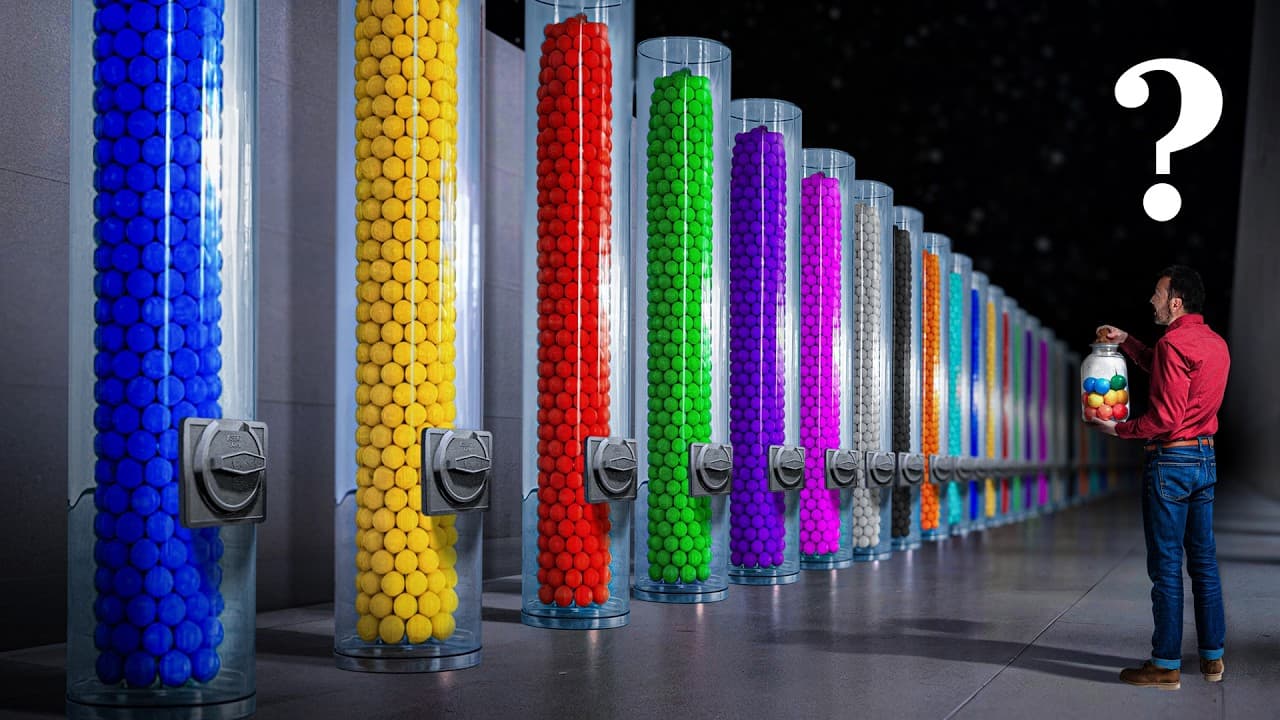
The axiom of choice is a controversial mathematical principle that allows for the selection of elements from infinite sets without a specific rule. It supports the well-ordering of real numbers and leads to paradoxes like the Banach-Tarski paradox, where a sphere can be split and reassembled into two identical spheres. Despite its counterintuitive implications, it is widely accepted for simplifying mathematical proofs.
Transcript
- There is a rule in mathematics that is so simple, you would think it obviously must be true, but if you accept it, you find there are now some line segments that have no length. A sphere without adding anything to it can be turned into two identical spheres. A hundred plus years of mathematics has been built on this axiom. It seems intuitive and ... Read More
Key Insights
- The axiom of choice allows for selecting elements from infinite sets without a specific rule.
- Cantor's Diagonalization Proof shows there are more real numbers between zero and one than natural numbers.
- The well-ordering theorem claims every set can be ordered, even uncountably infinite ones.
- Zermelo formalized the axiom of choice, enabling well-ordering of real numbers.
- The Banach-Tarski paradox shows a sphere can be split into parts and reassembled into two identical spheres.
- Non-measurable sets, like the Vitali set, challenge the concept of size and measurement.
- The axiom of choice cannot be proven or disproven from other axioms, similar to geometry's parallel postulate.
- Despite paradoxes, the axiom of choice is essential for simplifying and extending mathematical proofs.
Install to Summarize YouTube Videos and Get Transcripts
Explore YouTube Video Summarizer or Get YouTube Transcript Extractor
Questions & Answers
Q: What is the axiom of choice?
The axiom of choice is a principle in set theory that allows for the selection of elements from an infinite collection of non-empty sets without specifying a particular rule for making these selections. It is essential for certain mathematical proofs and leads to results like the well-ordering theorem and the Banach-Tarski paradox.
Q: Why is the axiom of choice controversial?
The axiom of choice is controversial because it leads to counterintuitive results, such as the Banach-Tarski paradox, where a sphere can be divided into parts and reassembled into two identical spheres, defying conventional understanding of volume and measurement. Additionally, it allows for the existence of non-measurable sets, challenging the idea that everything can be quantified.
Q: What is Cantor's Diagonalization Proof?
Cantor's Diagonalization Proof demonstrates that there are more real numbers between zero and one than there are natural numbers. By constructing a new real number that differs from each number in a list at a specific decimal place, Cantor showed that real numbers form an uncountable infinity, which is larger than the countable infinity of natural numbers.
Q: How does the Banach-Tarski paradox work?
The Banach-Tarski paradox shows that a solid sphere can be divided into a finite number of non-measurable pieces, which can then be reassembled into two identical spheres of the same size as the original. This paradox relies on the axiom of choice and challenges the conventional understanding of volume and measurement, as it seems to create matter from nothing.
Q: What are non-measurable sets?
Non-measurable sets are mathematical constructs that do not have a well-defined size, length, area, or probability. They arise from the axiom of choice and defy the traditional understanding that everything can be quantified. Examples include the Vitali set, which demonstrates the limitations of measuring subsets of real numbers.
Q: What is the well-ordering theorem?
The well-ordering theorem states that every set, including uncountably infinite sets like the real numbers, can be arranged in a well-defined order where every subset has a least element. This theorem relies on the axiom of choice and extends the concept of ordering beyond countable sets, allowing for a consistent way to compare elements in any set.
Q: How do different sizes of infinity exist?
Different sizes of infinity exist as demonstrated by Cantor's work. Countable infinities, like natural numbers, can be paired one-to-one with each other. However, uncountable infinities, such as the set of real numbers, cannot be matched with natural numbers, indicating a larger size. Cantor's Diagonalization Proof shows that real numbers form an uncountable infinity.
Q: What impact does the axiom of choice have on mathematics?
The axiom of choice significantly impacts mathematics by simplifying proofs and enabling the extension of results from finite to infinite cases. It is essential for many theorems, allowing for concise arguments and generalizations. Despite its controversial implications, it is widely accepted and used in modern mathematics to facilitate progress and understanding.
Summary & Key Takeaways
-
The axiom of choice allows mathematicians to select elements from infinite sets without a specific rule. This concept leads to paradoxical results, such as the Banach-Tarski paradox, where a sphere can be split into parts and reassembled into two identical spheres, challenging our understanding of size and measurement.
-
Cantor introduced the idea of different sizes of infinity, showing that some infinities, like the set of real numbers, are larger than others, such as natural numbers. Zermelo formalized the axiom of choice, enabling the well-ordering of real numbers and simplifying mathematical proofs.
-
The axiom of choice remains a topic of debate due to its counterintuitive implications, but it is widely accepted as a useful tool in mathematics. It cannot be proven or disproven from other axioms, similar to the parallel postulate in geometry, and is essential for many mathematical theorems.
Read in Other Languages (beta)
Share This Summary 📚
Summarize YouTube Videos and Get Video Transcripts with 1-Click
Try YouTube Summary with ChatGPT & Claude or YouTube Transcript Generator
Explore More Summaries from Veritasium 📚




Summarize YouTube Videos and Get Video Transcripts with 1-Click
Try YouTube Summary with ChatGPT & Claude or YouTube Transcript Generator