Vinod Khosla's 12 AI Predictions for 2035-2049
TL;DR
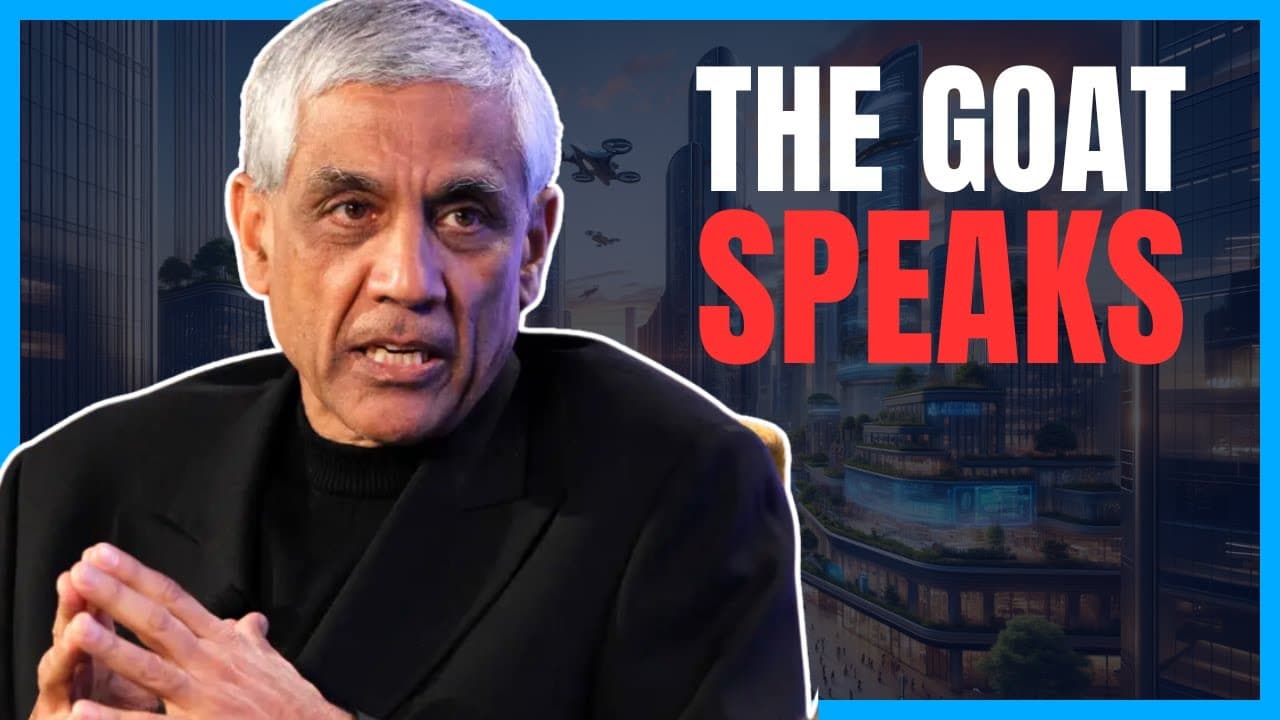
Vinod Khosla forecasts that between 2035 and 2049, expertise and labor will become near-free through AI doctors, AI tutors, and a billion bipedal robots. He also predicts a billion natural-language programmers, hyper-personalized AI entertainment, and internet access dominated by AI agents acting on behalf of consumers. The predictions span science, food, transport, and energy.
Transcript
vard kosla the founder of kosla Ventures the famed Venture Capital firm in Silicon Valley has put out 12 incredible predictions about the future and that's what we're going to be talking about today so first why should you listen to vard kosla who is he so let's just look at some of the Investments that kosla has made over the last 20 years we have... Read More
Key Insights
- Vinod Khosla is the founder of Khosla Ventures, whose early bets include Okta (valued at 27 billion), RingCentral (23 billion), GitLab, DoorDash, Impossible Foods, Instacart, Opendoor, Square, and Stripe, giving weight to his views on the future.
- Expertise will become near-free, with the prediction of near-free AI doctors for every person and AI tutors for every child available 24/7, positioned as the most likely of Khosla's forecasts.
- Essentially the entirety of human knowledge can be packaged into a file size of just a few gigabytes, meaning most knowledge work could be replaced or heavily complemented by large language models very soon.
- Thought workers who code or do creative work turned out to be more exposed to AI than blue-collar workers, reversing the earlier assumption that manual jobs would be automated first.
- Labor will become near-free through a predicted billion bipedal and other robots that free humans from undesirable jobs, though the video argues a billion robots within 10 years is unlikely.
- Simple physical tasks remain hard for robots; Elon Musk said he over-automated his factories because a task as easy as connecting two wires is extremely difficult for a robot but trivial for a human.
- Computer use will grow expansively with a billion-plus programmers writing in human language, but the video predicts the long-run end state is no programmers at all, with humans speaking natural language directly to AI.
- Internet access will be mostly by agents, with tens of billions of agents doing tasks and fending off marketers and bots; each person's AI acts as a personal filter against misinformation and scams.
Install to Summarize YouTube Videos and Get Transcripts
Explore YouTube Video Summarizer or Get YouTube Transcript Extractor
Questions & Answers
Q: Who is Vinod Khosla and why should you listen to his predictions?
Vinod Khosla is the founder of Khosla Ventures, a famed Silicon Valley venture capital firm. Over the last 20 years he has made early bets on massive companies including Okta (valued at 27 billion), RingCentral (23 billion), GitLab, Color Genomics, Academia.edu, DoorDash, Impossible Foods, Instacart, Opendoor, Square, and Stripe. His long track record of seeing the future better than most gives his 12 predictions credibility.
Q: What does Vinod Khosla mean by 'expertise will be near free'?
Khosla predicts we will be capable of having near-free AI doctors for every person and AI tutors for every child, available 24/7. The video argues this is his most likely prediction and that the scope is even larger than described, extending to software engineers, marketers, and creatives. Essentially the entirety of human knowledge can fit into a few gigabytes, so most knowledge work could soon be replaced or complemented by large language models.
Q: What is the prediction about labor becoming near free?
Khosla predicts a billion bipedal and other robots will free humans from the servitude of undesirable jobs within the next 10 to 25 years. The video is excited but skeptical that a billion robots will arrive within 10 years. Such a workforce willing to work for free 24 hours a day would skyrocket productivity, potentially helping solve major economic problems like growing US debt, but would also displace many workers who need to find new purpose.
Q: Why are simple tasks still difficult for robots?
Despite advances in AI and robotics, doing simple things remains really difficult for robots. The video cites Elon Musk, who said he went too far automating his factories because a task as easy as connecting two wires together, which is trivial for a human, is extremely difficult for a robot. Humans are vastly better and faster at learning such simple manual tasks, so robots are expected to struggle with them for the foreseeable future.
Q: How will computer use and programming change according to the predictions?
Khosla predicts a billion-plus programmers all programming in human language, dramatically increasing the scope of computers so that computers adapt to humans rather than humans to computers. The video agrees an influx of natural-language programmers will come over the next 5 to 8 years, but argues the long-run end state is no programmers at all, with humans speaking natural language directly to AI. AI may even invent a foreign, symbolic language more efficient than today's code.
Q: What role will AI play in entertainment and design?
Khosla predicts AI will play a large role in entertainment and design, making music and entertainment plentiful and personalized to your mood, while diversity of content and creativity increases and the celebrity-fan relationship stays unchanged. The video agrees content will be created dynamically for an audience of one, generated in the moment rather than pre-rendered, whether a video game, TV show, or movie. However, it questions whether the celebrity-fan relationship will truly remain unchanged when personalities themselves become AI.
Q: Why does Khosla predict internet access will mostly be by agents?
Khosla predicts most consumer internet access will be through AI agents acting for consumers, doing tasks and fending off marketers and bots, with tens of billions of agents online being normal. The video fully agrees and references Yann LeCun's interview with Lex Friedman, where LeCun said humans will protect themselves from misinformation, disinformation, and scams by having their own AI serve as a filter for all incoming information.
Q: What other predictions does Vinod Khosla make beyond AI and robots?
Beyond expertise, labor, programming, entertainment, and internet agents, Khosla's 12 predictions extend into several domains outlined in the video's chapters: AI in science and medicine, food alternatives, autonomous vehicles, flying being faster, energy transformation, natural resources becoming plentiful, and carbon emissions solutions. The thread also closes with a discussion of things that will slow progress, framing the forecasts as an optimistic vision for abundant, awesome technology from 2035 through 2049 if we allow it to happen.
Summary & Key Takeaways
-
Vinod Khosla, founder of Khosla Ventures and early backer of companies like Okta, DoorDash, Stripe, and Impossible Foods, released a thread of 12 optimistic predictions for abundant technology spanning 2035 through 2049, framed around entrepreneurs inventing the future they want.
-
The first predictions center on near-free expertise and labor: AI doctors and tutors for everyone 24/7, and a billion bipedal robots removing undesirable jobs. This raises questions about displaced experts and workers finding purpose, while robots still struggle with simple manual tasks.
-
Further predictions cover a billion natural-language programmers eventually giving way to no programmers, hyper-personalized AI entertainment created for an audience of one, and internet access dominated by tens of billions of AI agents acting for consumers and filtering out scams and misinformation.
Read in Other Languages (beta)
Share This Summary 📚
Summarize YouTube Videos and Get Video Transcripts with 1-Click
Try YouTube Summary with ChatGPT & Claude or YouTube Transcript Generator
Explore More Summaries from Matthew Berman 📚





Summarize YouTube Videos and Get Video Transcripts with 1-Click
Try YouTube Summary with ChatGPT & Claude or YouTube Transcript Generator