How Does the Box Rehabilitation Program Work?
TL;DR
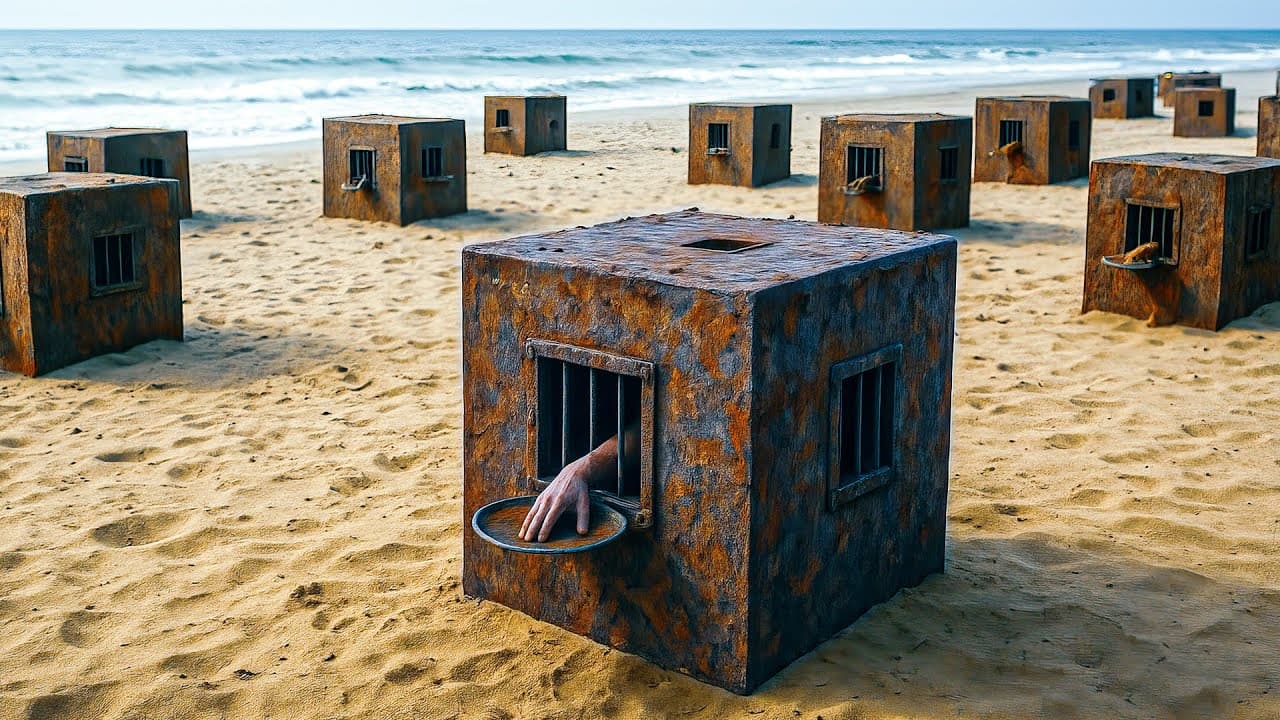
The box rehabilitation program confines prisoners in metal cells and lets citizens decide whether they receive food and water. Prisoner 13, sentenced to seven years for a political conviction she denies, survives isolation, starvation, surveillance, punishment, and exploitation while secretly finding hope in Romeo and Juliet and in a 16-year-old visitor who treats her with compassion.
Transcript
In the year 2053, after the last war, the crime rate has risen by over 800% and this has caused a crushing influx on the prison system. To solve this issue, the government has come up with the box rehabilitation program, which in the past would have been considered inhuman. This program makes prisoners choose between two options. They can volunteer... Read More
Key Insights
- The box rehabilitation program is a government response to an 800% rise in crime after the last war. It forces prisoners to choose between immediate extermination and serving their entire sentences in confined metal boxes under continuous surveillance.
- Citizens are responsible for deciding whether prisoners receive food and water. This arrangement turns basic survival into a public judgment, leaving confined people dependent on visitors who may offer compassion, ignore them, taunt them, or exploit their desperation.
- Prisoner 13 is serving a seven-year sentence for a political conviction that she denies. Her classification later excludes her from a general amnesty granted to other boxed prisoners, showing that political offenders receive different treatment under the program.
- Isolation is a central mechanism of punishment inside the boxes. Prisoner 13 scratches the walls for entertainment, clings to a rubber band ball, suffers breakdowns, attempts to end her life, and gradually struggles to distinguish reality from hallucination.
- The prison system enforces compliance through cameras, alarms, drones, electric shocks, and lethal machinery. One prisoner is crushed after interfering with a light panel, while Prisoner 13 receives a warning that another rule violation will result in her death.
- Books are forbidden inside Prisoner 13's box, despite the program being described as rehabilitation. A 16-year-old visitor secretly gives her Romeo and Juliet, and its language provides hope, mental stimulation, and a private connection to life outside confinement.
- Rule enforcement treats ordinary survival behavior as misconduct. The system classifies discarded washing water as waste, relocates Prisoner 13's box, and later imposes seven days of bright light and recurring alarms because she traded sexual access for food.
- Prisoner 13's physical condition worsens throughout confinement. She develops painful wounds, begins losing teeth, suffers a bullet injury, and later discovers she is pregnant after being sexually exploited by the man who offered her an apple.
Install to Summarize YouTube Videos and Get Transcripts
Explore YouTube Video Summarizer or Get YouTube Transcript Extractor
Questions & Answers
Q: What is the box rehabilitation program?
The box rehabilitation program is a prison system created after crime rose by over 800% following the last war. Prisoners may volunteer for immediate extermination or serve their complete sentences inside isolated metal boxes. Citizens decide whether to supply food and water, cameras monitor behavior, and attempted escape or repeated rule violations can lead to extermination.
Q: How do prisoners receive food and water in the boxes?
Prisoners receive food and water only when citizens choose to provide them through a small hatch. Prisoner 13 sometimes gets water and food pellets from a 16-year-old girl, but she also has to collect rainwater when nobody helps. The arrangement makes every prisoner dependent on the judgment, generosity, or cruelty of people outside.
Q: Why is Prisoner 13 denied amnesty?
Prisoner 13 is denied amnesty because she is politically convicted. During a New Year celebration, the prison voice announces that citizens have granted amnesty to all prisoners in boxes except those convicted for political reasons. Although Prisoner 13 repeatedly claims innocence, her seven-year political sentence keeps her confined while other prisoners are offered release.
Q: How does isolation affect Prisoner 13?
Isolation severely damages Prisoner 13's mental health. She screams, scratches the box for entertainment, plays repetitive games with a rubber band ball, and attempts to end her life with a rope. During forced insomnia, she hallucinates her former appearance telling her that release is imaginary. Human touch, reading, and brief conversations become crucial sources of comfort.
Q: What happens when prisoners break the rules?
Rule violations trigger automated and potentially lethal punishments. A prisoner who interferes with a light panel is warned of imminent extermination and crushed by descending metal rods. Prisoner 13 receives electric shocks while inspecting her box, is relocated for allegedly wasting water, and endures seven days without sleep after trading with a citizen for food.
Q: Why is Romeo and Juliet important to Prisoner 13?
Romeo and Juliet gives Prisoner 13 hope and mental stimulation in a place where reading is forbidden. A 16-year-old visitor first quotes the work and later hides a tiny copy among food seeds. Prisoner 13 secretly reads it while facing away from the camera, sometimes relying on moonlight, and eventually completes a quotation begun by the girl.
Q: What happens when a man offers Prisoner 13 an apple?
A man taunts the starving Prisoner 13 with an apple and demands sexual access in exchange for it. She agrees because she is desperate for food. A patrolling drone detects the prohibited encounter, kills the man, and wounds her leg. She retrieves the apple but discovers worms inside, becomes sick, and is punished for making the trade.
Q: How does the prison punish Prisoner 13 with insomnia?
The prison keeps Prisoner 13 awake for seven days by illuminating the box with a bright light and repeatedly sounding an alarm. Covering her eyes and ears does not help, and whenever the alarm briefly stops, it begins again as she tries to sleep. The deprivation causes extreme distress, mental deterioration, and a vivid hallucination of her former self.
Summary & Key Takeaways
-
After crime rises by over 800% following the last war, the government introduces the box rehabilitation program. Prisoners must accept immediate extermination or spend their sentences inside isolated metal boxes. Citizens control access to food and water, attempted escape brings death, and constant surveillance enforces rules through severe punishments.
-
Prisoner 13 begins a seven-year sentence while insisting she is innocent. She searches unsuccessfully for an escape, collects rainwater, struggles with starvation and isolation, and nearly takes her own life. A 16-year-old girl provides food, water, human contact, and a hidden copy of Romeo and Juliet.
-
Prisoner 13 is exploited by a man offering an apple, wounded when a drone kills him, and punished with seven days of forced insomnia for trading. Hallucinations follow, political prisoners are excluded from amnesty, and her health deteriorates. Later, she discovers she is pregnant, while the girl mentions a possible rescue.
Read in Other Languages (beta)
Share This Summary 📚
Summarize YouTube Videos and Get Video Transcripts with 1-Click
Try YouTube Summary with ChatGPT & Claude or YouTube Transcript Generator
Explore More Summaries from Movie Recaps 📚





Summarize YouTube Videos and Get Video Transcripts with 1-Click
Try YouTube Summary with ChatGPT & Claude or YouTube Transcript Generator