Linear motion with TB6600 and AccelStepper
TL;DR
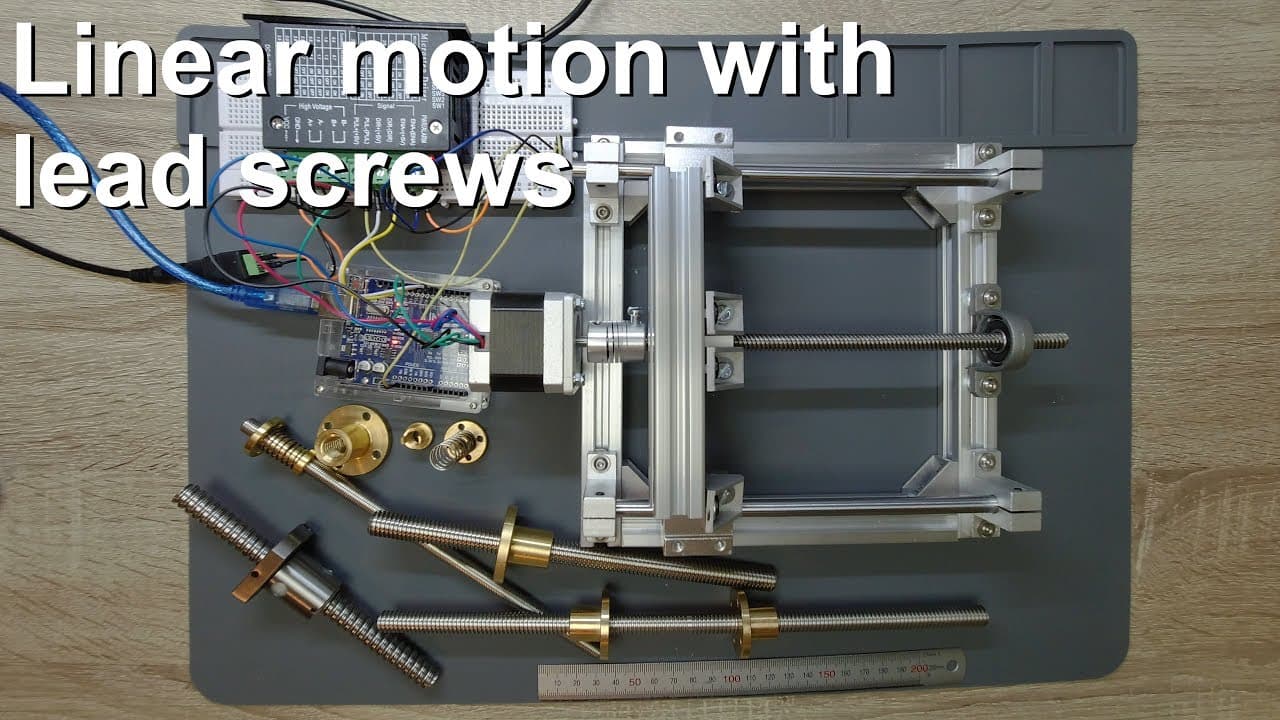
Learn how to transform stepper motor rotary motion into linear motion using lead screws for various applications.
Transcript
welcome everyone in this video I'm going to talk about stepper motors and lead screws so I would like to show you how to convert the rotary motion of stepper motors into linear motions so you can apply the stepper motors for different purposes or different applications so first of all I want to tell you a few examples why it is important to be able... Read More
Key Insights
- 🎮 Converting rotary motion to linear motion is essential in applications requiring movement control, such as robotics and machining.
- 🥺 Lead screws come in various types, each designed for specific load capacities, precision, and movement speeds, making them versatile tools in engineering.
- 🥺 Ball screws offer advantages in terms of smoothness and reduced friction, leading to higher efficiency and precision in motion.
- 🥺 Multi-start lead screws can greatly increase the linear distance traveled per rotation, providing faster movement options for various applications.
- 🥺 Calculating movement requires understanding the lead of the screw and the microstepping configuration to effectively translate distance into step commands.
- 😒 The use of anti-backlash nuts can significantly reduce errors in positioning, improving overall system accuracy in critical applications.
- 👻 Combining linear and rotary systems in setups allows for complex movement patterns, vital for applications like CNC machining and 3D printing.
Install to Summarize YouTube Videos and Get Transcripts
Explore YouTube Video Summarizer or Get YouTube Transcript Extractor
Questions & Answers
Q: Why is it important to convert rotary motion to linear motion in engineering applications?
Converting rotary motion to linear motion is crucial in many engineering applications because it provides the necessary precision and control for tasks such as lifting, positioning, and moving objects. For instance, in 3D printers and CNC machines, linear motion enables the accurate placement of tools or materials, making it essential for manufacturing and automation processes.
Q: What are the main types of lead screws mentioned in the video?
The video discusses four main types of lead screws: single start lead screws, which have one thread path; multi-start lead screws, which have multiple thread paths allowing for faster movement per rotation; anti-backlash lead screws, designed to minimize movement errors; and ball screws, which use balls for smoother motion and reduced friction, ideal for high-precision applications.
Q: How do you calculate the number of steps required for a desired movement distance?
To calculate the steps required for linear movement, you first determine the lead of your lead screw (distance traveled per rotation). For example, if a lead screw has a lead of 2mm and uses 400 microsteps per rotation, you would divide the desired distance by the lead to find the number of rotations needed and then multiply this by the number of steps per rotation to find the total step count.
Q: What is the role of the accessory components such as the Arduino and stepper driver in the setup?
The Arduino acts as the controller for the stepper motor, taking input commands to determine movement distance and speed. The stepper driver, like the TB6600, converts the control signals from the Arduino into precise step commands for the motor. Together, they enable a seamless transition from algorithmic instructions to physical movement in the setup.
Summary & Key Takeaways
-
The video introduces the importance of converting rotary motion from stepper motors into linear motion, especially valuable in applications like 3D printing and CNC machines.
-
Various types of lead screws are demonstrated, including single start, multi-start, anti-backlash, and ball screws, detailing their specific features and uses.
-
A practical demonstration illustrates how to calculate the number of steps needed for specific linear movements using a microstepping setup, showing successful precision in movement control.
Read in Other Languages (beta)
Share This Summary 📚
Summarize YouTube Videos and Get Video Transcripts with 1-Click
Try YouTube Summary with ChatGPT & Claude or YouTube Transcript Generator
Explore More Summaries from Curious Scientist 📚
![Building a Peltier cooler-based cooling box - First iteration, improvements [Part 2/6] thumbnail](/_next/image?url=https%3A%2F%2Fi.ytimg.com%2Fvi%2F0YlNw0EGnzI%2Fhqdefault.jpg&w=750&q=75)

Summarize YouTube Videos and Get Video Transcripts with 1-Click
Try YouTube Summary with ChatGPT & Claude or YouTube Transcript Generator