What Is Post-Labor Economics and Why It Matters
TL;DR
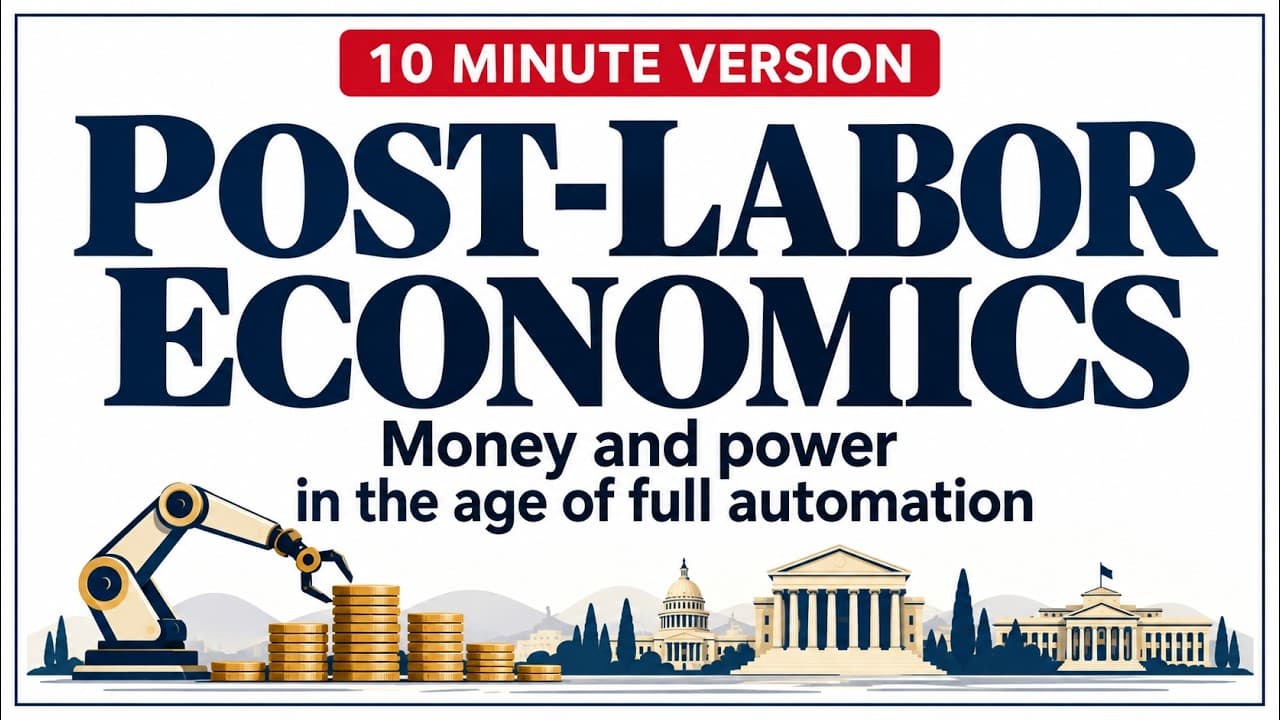
Post-labor economics describes a shift where machines perform more tasks, reducing the need for human labor. Automation takes tasks one by one rather than entire jobs, gradually eroding the premium humans can charge. The video argues that ownership and power are crucial alongside income to keep people resilient in this changing economy.
Transcript
For 200 years, the deal was simple. You traded your time for money. That deal is breaking down. Machines are learning to do the work. This is post-labor economics. Every task faces the same test. Better, faster, cheaper, safer. When a machine wins on all four, the human has to justify the premium. And that gets harder every year. Automation doesn't... Read More
Key Insights
- Automation wins when it is better, faster, cheaper, and safer, forcing humans to justify their premium.
- Automation does not erase jobs overnight; it replaces tasks gradually, which reshapes the labor market over time.
- Two demand types exist: derived demand for outcomes, and essential demand where a human presence is valued.
- Human labor boils down to four capacities: strength, dexterity, cognition, and empathy.
- Ownership is the remaining pillar to wealth when income from work declines.
- Power comes from the ability to say no and make it stick, not just from legal rights.
- The Gulf example shows a state relying on machines and wealth rather than taxes or labor, reducing accountability to people.
- A future economy requires leverage and ownership that do not solely depend on employment.
Install to Summarize YouTube Videos and Get Transcripts
Explore YouTube Video Summarizer or Get YouTube Transcript Extractor
Questions & Answers
Q: What is post-labor economics and why is it becoming relevant?
Post-labor economics refers to a shift where machines learn to perform more tasks traditionally done by humans, reducing the need for labor as a wage earner. It shows up as automation improving speed, cost, and safety, gradually eroding the value of human labor as technology takes over thinking and physical tasks. This concept explains why the classic time-for-money bargain is breaking down and why ownership and power become necessary for resilience.
Q: How do machines replace jobs according to the video?
Machines replace jobs not all at once but task by task. AI takes on thinking work while robots handle physical tasks, meaning that parts of many jobs become obsolete individually. The cumulative effect over time reduces the premium that humans can charge for work, prompting a gradual redefinition of employment and income as automation progresses.
Q: What are the two kinds of demand described, and why do they matter?
The two kinds of demand are derived demand and essential demand. Derived demand is for outcomes like a house, where the builder is a means to that end. Essential demand involves a person being part of what you are buying, where a human touch stays valued. These distinctions matter because essential demand sustains certain jobs even as automation advances.
Q: What does the video say about productivity and pay after the post-war era?
The video notes that after the war, productivity and pay rose together, but since 1979 productivity has grown about 94 percent while typical pay rose only about 33 percent. This shows a widening gap between output and wages, highlighting the need to rethink how wealth is generated and distributed beyond traditional salaries.
Q: Why is ownership important in the post-labor economy?
Ownership matters because income from work is not the sole path to wealth. The video argues that the pieces of wealth already exist, and the job is to put them in everyone’s hands. By distributing ownership, people can benefit from the productive system even if they are not employed in the traditional sense.
Q: What role does power play according to the transcript?
Power is the ability to influence outcomes and not just rights on paper. The video emphasizes that power must be able to impose a cost when demands are refused, otherwise it is not real power. This means building leverage that persists even when specific jobs disappear.
Q: What example is used to illustrate a state less dependent on labor, and what does it imply?
The Gulf example is used where oil pays the bills and the state can share wealth while asking for quiet in return, indicating a model where governance relies less on taxes or labor. It implies that when machines and wealth reduce the need for human input, policies and power structures shift, making ownership and non-labor wealth more central to prosperity.
Q: What does the video propose as a path to a stable post-labor future?
The video proposes building leverage that does not rely on a job and increasing ownership of productive assets so wealth can be shared more broadly. It emphasizes developing power that can insist on cooperation and asserting value even when traditional employment declines, to maintain autonomy and financial security in a changing economy.
Summary & Key Takeaways
-
Post-labor economics explains a historical shift where time worked for money is being replaced by machine driven task completion. The process happens gradually as AI handles thinking tasks and robots handle physical tasks. Ownership and power become essential as traditional pay and jobs shrink.
-
The video presents two kinds of demand for labor: derived demand for getting outcomes and essential demand where the person is part of what is bought. People want a human touch in many cases, even if the work is technically possible without them.
-
A central message is that after World War II productivity and pay rose together, but since 1979 productivity grew faster than typical pay. The remaining issue is balancing what people do, what they receive, and what they own in order to maintain wealth.
-
Ultimately the video calls for building leverage that does not depend on a job, and for creating ownership that can distribute wealth more broadly.
Read in Other Languages (beta)
Share This Summary 📚
Summarize YouTube Videos and Get Video Transcripts with 1-Click
Try YouTube Summary with ChatGPT & Claude or YouTube Transcript Generator
Explore More Summaries from David Shapiro 📚


Summarize YouTube Videos and Get Video Transcripts with 1-Click
Try YouTube Summary with ChatGPT & Claude or YouTube Transcript Generator