What Drives Figures Like Lenin and Stalin for Power?
TL;DR
Lenin and Stalin's motivations for seeking power stemmed from a mix of ideological beliefs and personal ambition. The post-revolution era marked a significant shift towards consolidating power, raising questions about the authenticity of leaders. Balancing skepticism about corruption is essential for understanding the dynamics of power in historical contexts.
Transcript
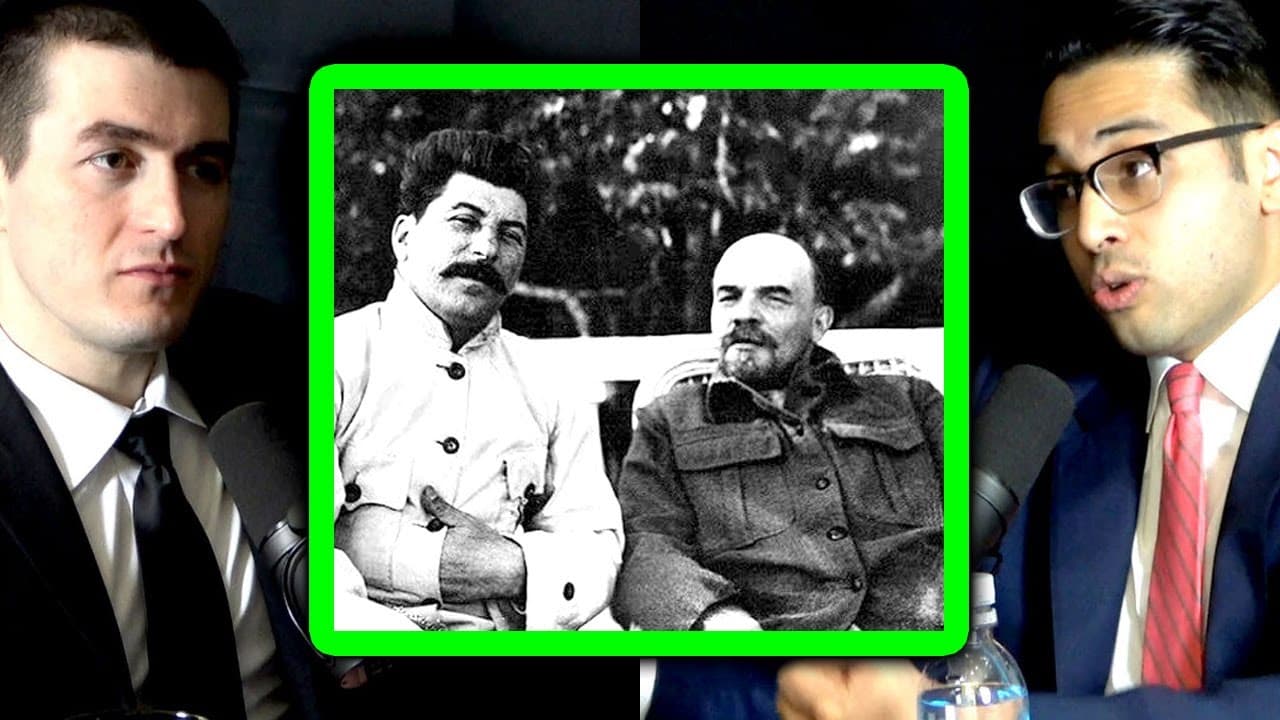
and i mean it makes me wonder what looking at some of the biggest leaders in human history to ask the question of what was the motivation what was the motivation for even just the revolutionaries like lennon trotsky and stalin what was the motivation because it sure as hell seems like the motivation was at least in part the driven by the idea by id... Read More
Key Insights
- ✊ Leaders like Lenin, Trotsky, and Stalin had different motivations, combining ideological beliefs and the pursuit of power.
- 🖐️ The post-revolution period involved a shift towards consolidation, with power playing a central role.
- ❓ Conspiracy theories can offer valuable skepticism but should be approached with caution to avoid overgeneralization.
- 👻 Striking a balanced perspective allows for critical reasoning and the creation of robust systems that can withstand corruption.
- 😈 Acknowledging the presence of evil in the world is essential for engineering effective solutions.
- 🤨 The video raises questions about the authenticity of deeply two-faced individuals on a large scale.
- ❓ Skepticism towards powerful individuals is warranted, but assuming everyone is corrupt can be unproductive.
- 🎙️ More videos with Saagar Enjeti:
Install to Summarize YouTube Videos and Get Transcripts
Explore YouTube Video Summarizer or Get YouTube Transcript Extractor
Questions & Answers
Q: What were the motivations of leaders like Lenin, Trotsky, and Stalin?
Lenin was a true believer in his ideology, combining narcissism with the belief that only he could bring about change. Trotsky leaned towards ideological motivations, while Stalin seemed to be primarily driven by the pursuit of power.
Q: Did these leaders genuinely believe in communism?
Lenin and Stalin genuinely believed in communism, but their actions suggest that power and control played significant roles in their motivations. Trotsky may have had a stronger ideological commitment to communism.
Q: Was consolidation after the revolution more about communism or power?
The video suggests that the consolidation phase was mainly driven by power dynamics rather than solely focusing on implementing communist ideals.
Q: How do conspiracy theories fit into this discussion?
The speaker acknowledges the existence of conspiracy theories and highlights the need for a balanced approach. While powerful individuals often abuse their positions, assuming everyone is deeply two-faced can be counterproductive.
Summary & Key Takeaways
-
The content explores the motivations of historical leaders, such as Lenin, Trotsky, and Stalin, questioning whether their actions were driven by personal power or ideological beliefs.
-
There is a discussion surrounding the post-revolution period and the shift towards consolidation, indicating that power dynamics played a significant role.
-
The speaker reflects on the difficulty of believing in deeply two-faced individuals, emphasizing the importance of skepticism while not disregarding the possibility of corruption and abuse of power.
Read in Other Languages (beta)
Share This Summary 📚
Summarize YouTube Videos and Get Video Transcripts with 1-Click
Try YouTube Summary with ChatGPT & Claude or YouTube Transcript Generator
Explore More Summaries from Lex Clips 📚
Summarize YouTube Videos and Get Video Transcripts with 1-Click
Try YouTube Summary with ChatGPT & Claude or YouTube Transcript Generator