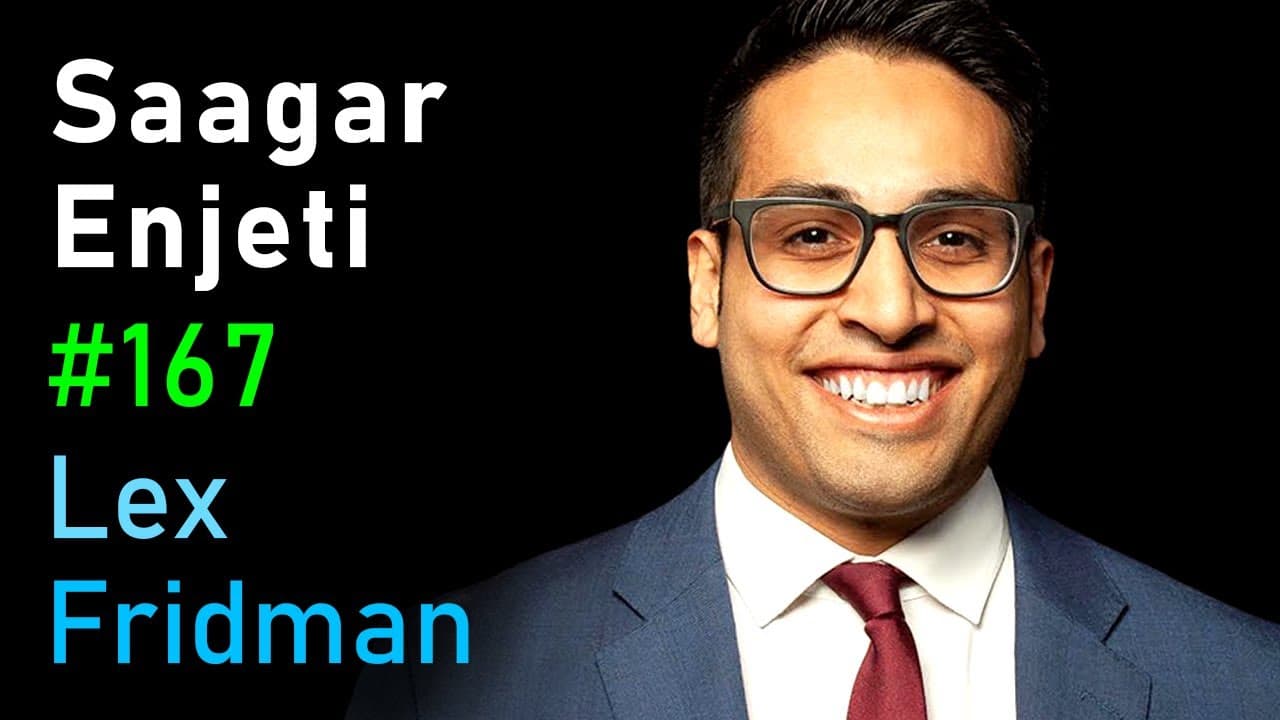
Saagar Enjeti: Politics, History, and Power | Lex Fridman Podcast #167
TL;DR
Understanding power dynamics is essential in politics, as individuals change with the influence of power. Sagar Anjeri shares his insights from interviewing Donald Trump, emphasizing that intentional decision-making and grasping the systems behind power are crucial for driving meaningful change.
Transcript
the following is a conversation with sagar anjeri he is a dc based political correspondent host of the rising with crystal ball and host of the realignment podcast with marshall kozlov he has interviewed donald trump four times and has interviewed a lot of major political figures and human beings who wield power he loves policy and loves history wh... Read More
Key Insights
- ✊ Power dynamics in politics are influenced by systems, intentional decision-making, and culture, which shape the behavior of individuals in positions of power.
- 😮 Understanding the context and historical factors that contribute to the rise of influential leaders can provide valuable insights into their actions and decision-making.
- 🤑 Distribution of money, cultural impact, and the nature of institutions contribute to the perception of corruption in politics.
- 🤔 Conspiracy theories should be approached with caution, as they often lack evidence and can contribute to further polarization and distrust in society. However, some conspiracy theories have been proven true, highlighting the need for critical thinking and examination of the facts.
- 🎙️ More videos with Saagar Enjeti:
Install to Summarize YouTube Videos and Get Transcripts
Explore YouTube Video Summarizer or Get YouTube Transcript Extractor
Questions & Answers
Q: How does Sagar Anjeri describe the power dynamics in politics?
Anjeri believes that understanding systems of power is crucial and that power can change individuals, making it important to analyze how power is wielded in politics.
Q: Is money a significant influence in politics?
Anjeri acknowledges that money plays a role in politics, but also emphasizes that the distribution of money and the cultural impact on politics are equally important factors to consider.
Q: What are some conspiracy theories that Anjeri finds interesting?
Anjeri expresses skepticism towards most conspiracy theories, but finds the Jeffrey Epstein case intriguing due to the complex network of powerful individuals and the implications of their involvement.
Q: Is there too much power in the presidency?
Anjeri believes that the presidency has become too powerful, leading to less democratic checks on the systems and bureaucracies that operate on autopilot.
Key Insights:
- Power dynamics in politics are influenced by systems, intentional decision-making, and culture, which shape the behavior of individuals in positions of power.
- Understanding the context and historical factors that contribute to the rise of influential leaders can provide valuable insights into their actions and decision-making.
- Distribution of money, cultural impact, and the nature of institutions contribute to the perception of corruption in politics.
- Conspiracy theories should be approached with caution, as they often lack evidence and can contribute to further polarization and distrust in society. However, some conspiracy theories have been proven true, highlighting the need for critical thinking and examination of the facts.
- The Epstein case reveals the potential for powerful individuals to manipulate and exploit others, and raises questions about the involvement of institutions and the responses of those in positions of authority.
Summary
In this conversation, Lex Friedman speaks with Sagar Anjeri, a DC-based political correspondent and host of several political shows. They discuss various topics, including their fascination with Hitler, the power dynamics of political leaders, and the complexities of the US political system. They also touch on the influence of the "deep state" and the need for intentional leadership.
Questions & Answers
Q: What is the book that Sagar Anjeri gifted to Lex Friedman about Hitler?
The book is the second volume of Ian Kershaw's biography on Hitler, which is considered one of the most definitive studies of Hitler. Sagar explains that he loves reading biographies as they provide a deeper understanding of the times and the context surrounding historical figures.
Q: Was Hitler's charisma something he was born with or something he developed strategically?
Sagar believes that Hitler's charisma was both innate and developed. He points to examples, such as Hitler's ability to convince people to follow him and his adeptness at reading coalitional politics. Sagar also shares his own observations from interviewing Donald Trump, where he observed the power of charisma in influencing others.
Q: Could a long-form podcast conversation with Trump reveal something more human or genuine about him?
Sagar does not believe that a long-form conversation with Trump would reveal a deeper or more genuine side of him. Based on his own experiences interviewing Trump and observing his interactions, Sagar believes that Trump is highly skilled at presenting a carefully crafted image and controlling the narrative.
Q: What lessons can be learned from the time of Hitler and World War II?
Sagar explains that understanding the system of power, the incentives within that system, and the disincentives are key to understanding historical events. He suggests that Hitler, Stalin, and Mao may be seen as the culmination of the monarchical system in Europe, and the atrocities committed may be seen as payments for the sins of that system. Sagar also emphasizes the importance of recognizing cultural norms and entrenched practices within bureaucracies and their impact on policy-making.
Q: Is there too much power in the US presidency, and is it corrupting to leaders?
Sagar acknowledges that there is definitely too much power in the presidency, which can be corrupting. He stresses the importance of focused intentionality and personnel selection to effectively exercise that power. Presidents who are not intentional in their decision-making and who do not hire the right people may find it difficult to steer the ship and produce meaningful change.
Q: How would Sagar describe the US political system to someone?
Sagar describes the US political system as one in which the people elect the lawmakers (congress), who create the laws. The executive branch, led by the president, is responsible for executing those laws, and the judicial branch, particularly the Supreme Court, interprets and determines the legality of those laws.
Q: Which branch of government is the most dysfunctional and which is Sagar's favorite?
Sagar finds the presidency to be the most dysfunctional and his favorite to study. He believes that power has become too concentrated in the executive branch, causing a lack of democratic checks and balances. Sagar also mentions that the Senate has undergone less change since pre-Civil War times, and its power has diminished compared to the executive branch.
Q: Are the deep state and bureaucracy the true sources of power?
Sagar clarifies that when referring to the deep state and bureaucracy, he does not believe in conspiracy theories or intentional collusion. Instead, he argues that a culture has developed within these institutions, where individuals perpetuate certain practices and ways of thinking, leading to a lack of meaningful change. He emphasizes the need for intentional leadership to disrupt these systems and implement effective policies.
Q: Can a president significantly change the course of policies and challenge the autopilot of bureaucracy?
Sagar explains that a president can make a significant difference, but it requires focused intentionality and personnel selection. Without a clear vision for change and the right team to execute that vision, a president may find it challenging to challenge the status quo and overcome the inertia of bureaucracy.
Q: How can the system of power in the US government be changed?
Sagar suggests that understanding the system, its incentives, and its disincentives is crucial to effecting change. He believes that the system, particularly the bureaucracy, has become comfortable and resistant to disruption. To address this, leaders need to be intentional in their decision-making, hire the right people, and challenge entrenched practices. Sagar also emphasizes the importance of democratic checks and balances to prevent the concentration of power.
Takeaways
In this conversation, Sagar Anjeri provides insights into the power dynamics of political leaders, the challenges of the US political system, and the need for intentional leadership. He reflects on his observations of both Hitler and Trump, highlighting the role of charisma and the impact of power on leaders. Additionally, Sagar discusses the dysfunction within the branches of government, the influence of the deep state, and the necessary steps to effect meaningful change. Overall, he emphasizes the importance of understanding systems, incentives, and the need for disruption in order to shape effective governance.
Summary & Key Takeaways
-
Sagar Anjeri discusses his fascination with political figures who wield power and how power can change individuals.
-
He shares his experiences interviewing Donald Trump and observing his charisma and ability to navigate conversations.
-
Anjeri highlights the need for intentional decision-making and the importance of understanding systems of power in order to effect change.
Read in Other Languages (beta)
Share This Summary 📚
Summarize YouTube Videos and Get Video Transcripts with 1-Click
Try YouTube Summary with ChatGPT & Claude or YouTube Transcript Generator
Explore More Summaries from Lex Fridman Podcast 📚





Summarize YouTube Videos and Get Video Transcripts with 1-Click
Try YouTube Summary with ChatGPT & Claude or YouTube Transcript Generator