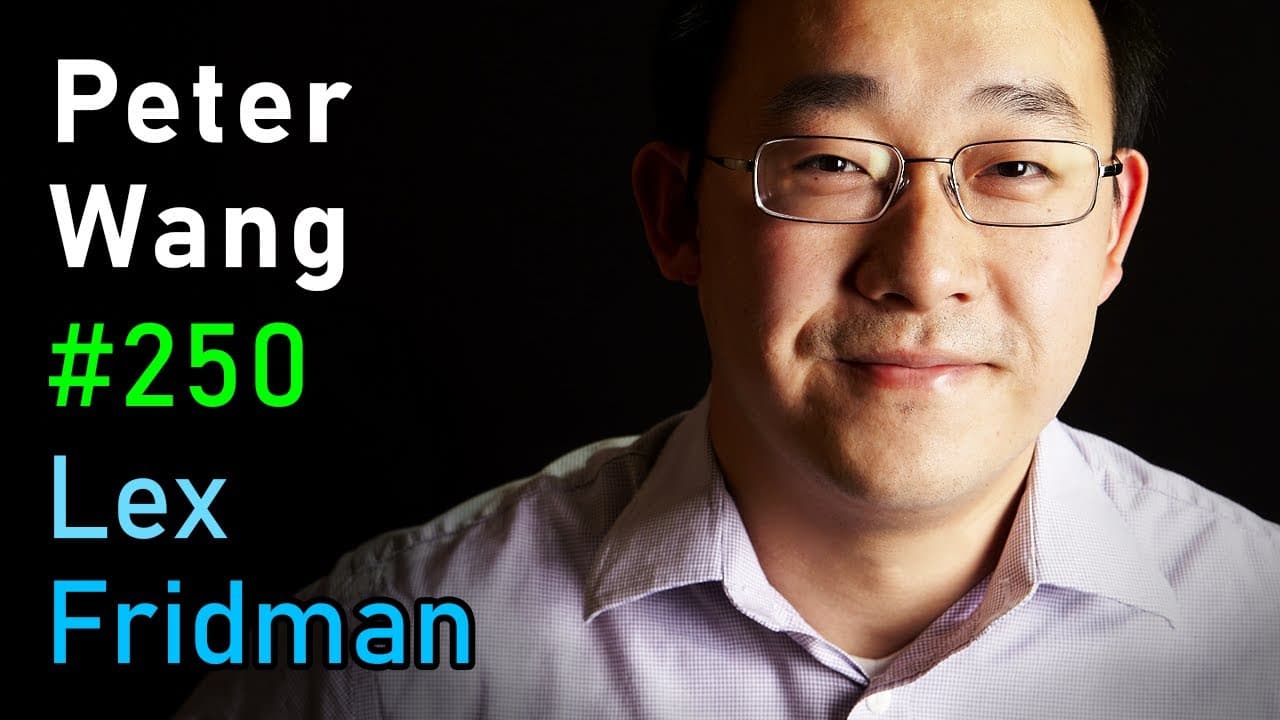
Peter Wang: Python and the Source Code of Humans, Computers, and Reality | Lex Fridman Podcast #250
TL;DR
Peter Wang shares his passion for Python, highlighting its expressive programming abilities and how it enables quick scripting. He emphasizes Python's fitting design for programmers and its foundational role in the growth of cybernetic systems, illustrating its importance in shaping technology and collaboration.
Transcript
the following is a conversation with peter wang one of the most impactful leaders and developers in the python community former physicist current philosopher and someone who many people told me about and praised as a truly special mind that i absolutely should talk to recommendations ranging from travis oliphant to eric weinstein so here we are thi... Read More
Key Insights
- 🥰 Peter Wang's love for Python programming stems from its support for expressive and abstract programming, making it enjoyable and productive.
- 🤯 The design motif of Python, which fits in the minds of programmers, contributes to its popularity and accessibility.
- ♿ The future of computing systems will likely involve compositional scripting and modular blocks to simplify complexity and increase accessibility.
- 🤨 The emergence of cybernetic systems raises questions about ethics, governance, and the impact of technology on society.
- ✖️ Understanding the multi-tiered nature of human beings, including physical, biological, social, and intellectual aspects, is crucial for comprehending human existence and collaboration.
- 🖐️ Collaboration has been essential to human survival and progress, and the threat of violence has played a role in fostering cooperation.
- 🤯 It is possible to create synthetic systems that rival human cognition, but there is still much to learn about the human mind and the unknown unknowns of nature.
Install to Summarize YouTube Videos and Get Transcripts
Explore YouTube Video Summarizer or Get YouTube Transcript Extractor
Questions & Answers
Q: What made Peter fall in love with Python programming?
Python's support for types and functions that enable expressive programming and quick scripting combined with its simplicity attracted Peter.
Q: How does Python fit in a programmer's mind according to Peter?
Python's design adheres to programmers' cognitive processes, allowing them to seamlessly work with the language, making it an accessible and efficient tool.
Q: Why does popularity lead to increased complexity in programming languages?
With popularity, the diverse opinions and needs of users make it challenging to satisfy everyone, resulting in multiple valid approaches and increased complexity.
Q: How does Peter envision the future of cybernetic systems?
Peter predicts that as we move into the cybernetic era, understanding the implications of automation and the need for ethics and governance in these systems will become crucial.
Key Insights:
- Peter Wang's love for Python programming stems from its support for expressive and abstract programming, making it enjoyable and productive.
- The design motif of Python, which fits in the minds of programmers, contributes to its popularity and accessibility.
- The future of computing systems will likely involve compositional scripting and modular blocks to simplify complexity and increase accessibility.
- The emergence of cybernetic systems raises questions about ethics, governance, and the impact of technology on society.
- Understanding the multi-tiered nature of human beings, including physical, biological, social, and intellectual aspects, is crucial for comprehending human existence and collaboration.
- Collaboration has been essential to human survival and progress, and the threat of violence has played a role in fostering cooperation.
- It is possible to create synthetic systems that rival human cognition, but there is still much to learn about the human mind and the unknown unknowns of nature.
- Maintaining biological humans, despite advancements in synthetic intelligence, is crucial for epistemic humility and being open to the surprises of nature.
Summary
In this conversation, Lex Friedman talks to Peter Wang, an influential leader and developer in the Python community, about programming and philosophy. They discuss what makes Python beautiful and expressive, the design process behind the language, the challenges of building a language that fits in the mind, the future of programming and its relationship with machine learning, the distinction between complexity and complication, the impact of software 2.0 and cybernetic systems, the balance between virtuality and reality, the layers of human experience, the role of social media platforms, and the potential for creating connection machines.
Questions & Answers
Q: What is the most beautiful feature of Python that made you fall in love and stay in love with it?
Peter Wang fell in love with Python because it provided first-class support for types and functions, making it incredibly expressive and allowing for abstract and higher-order programming. Additionally, Python's productivity as a scripting language was impressive, allowing him to easily create functional programs in a short amount of time.
Q: Is there a specific reason why Python became Peter's preferred language for scripting instead of Perl?
Peter doesn't attribute it to a specific reason, but rather to the taste and design motif of Python's creator and the core group of people who built the standard library. Python simply fit in his head and provided a more compact and coherent solution for his needs compared to Perl.
Q: What has been the most beautiful feature of Python that made Peter stay in love with it over the years?
Peter particularly enjoys the ability to play with meta-classes and express higher-order concepts when building new object models in Python. He also appreciates the elegance and power of NumPy's data structures, such as matrices and vectors, and the ability to slice through multi-dimensional data.
Q: How does one design a language that fits in the head of users?
Designing a language that fits in the user's mind requires understanding the needs and preferences of the user audience. The better-defined the user audience is, the easier it is to create a language that aligns with their mental model. However, as popularity grows, diverse user opinions can make it harder to design a language that fits everyone's needs.
Q: What are the challenges of using machine learning in programming and its impact on the future of programming?
Programming traditionally focused on functional correctness, but the advent of machine learning systems introduces value dependence on functional correctness. Machine learning systems require considering the values of inputs and their performance boundaries, leading to new challenges in defining correctness and ensuring system performance. This marks a shift towards more complex and cybernetic systems, which will pose challenges in ethics, governance, and correctness.
Q: How does virtuality affect human perception and the distinction between reality and virtuality?
Virtual experiences are a subjective phenomenon that engages with virtual sensation and perception while suspending or forgetting the context of reality. Virtual experiences can never fully replicate reality, and certain aspects of embodiment and participatory interaction are lost. Excessive engagement with virtual experiences can lead to an alienation from reality and a disconnection from other people and the environment.
Q: Can platforms be created that prioritize connection and bring out the best in human nature while still being financially successful?
While it is possible to create platforms that prioritize connection and personal growth, the current digital landscape focuses on exploiting human weaknesses and appealing to the limbic system for profit. Social media platforms, specifically, have become adept at grooming destructive inclinations and targeting vulnerabilities. Despite this, there is potential for future platforms to prioritize connection and bring out the best in human nature.
Q: Can humans resist the negative effects of virtual experiences and make conscious choices to seek platforms that make them better people?
Humans have the capacity for introspection and reflection on their experiences, which can lead to conscious choices to seek platforms that align with personal growth and well-being. However, societal and social pressures can influence people's behaviors, especially when the majority of social interactions occur within virtual spaces.
Q: What is a cybernetic system, and why is it different from traditional software systems?
A cybernetic system refers to a system where software closes the loop of observe, orient, decide, and act, without requiring human intervention. In traditional software systems, human decisions and instructions are executed by computers. Cybernetic systems mark the progression towards software 2.0 and involve the integration of autonomous intelligences and extended human experiences into the digital realm.
Q: What layers make up a human being, and how do they interact with one another?
Humans consist of multiple layers, including physical, biological, social, and intellectual layers. These layers interact and influence one another, shaping human experiences and behavior. Each layer contributes to the overall makeup of a person, and understanding these interactions is crucial for developing future philosophies and technologies that extend human capabilities into the digital realm.
Q: Is consciousness a quality that exists at each layer of a human being, or does it permeate all layers?
Consciousness is a complex phenomenon that permeates all layers of a human being. While each layer contributes to an individual's experience of consciousness, consciousness itself is not limited to a particular layer. Rather, it is a generalized principle that seeks order and manifests differently at multiple levels.
Summary & Key Takeaways
-
Peter Wang fell in love with Python due to its support for types and functions, which made programming more expressive and productive.
-
The ability to easily create meta classes and work with numpy's data structures are some of the most beautiful features of Python for Peter.
-
Python fits in the minds of programmers and provides a universal tool for scripting and creating various applications.
-
The design of a language that fits in one's head depends on understanding the audience and their needs, but popularity can lead to increased complexity.
Read in Other Languages (beta)
Share This Summary 📚
Summarize YouTube Videos and Get Video Transcripts with 1-Click
Try YouTube Summary with ChatGPT & Claude or YouTube Transcript Generator
Explore More Summaries from Lex Fridman Podcast 📚


Summarize YouTube Videos and Get Video Transcripts with 1-Click
Try YouTube Summary with ChatGPT & Claude or YouTube Transcript Generator