How Does Generative AI Create New Content?
TL;DR
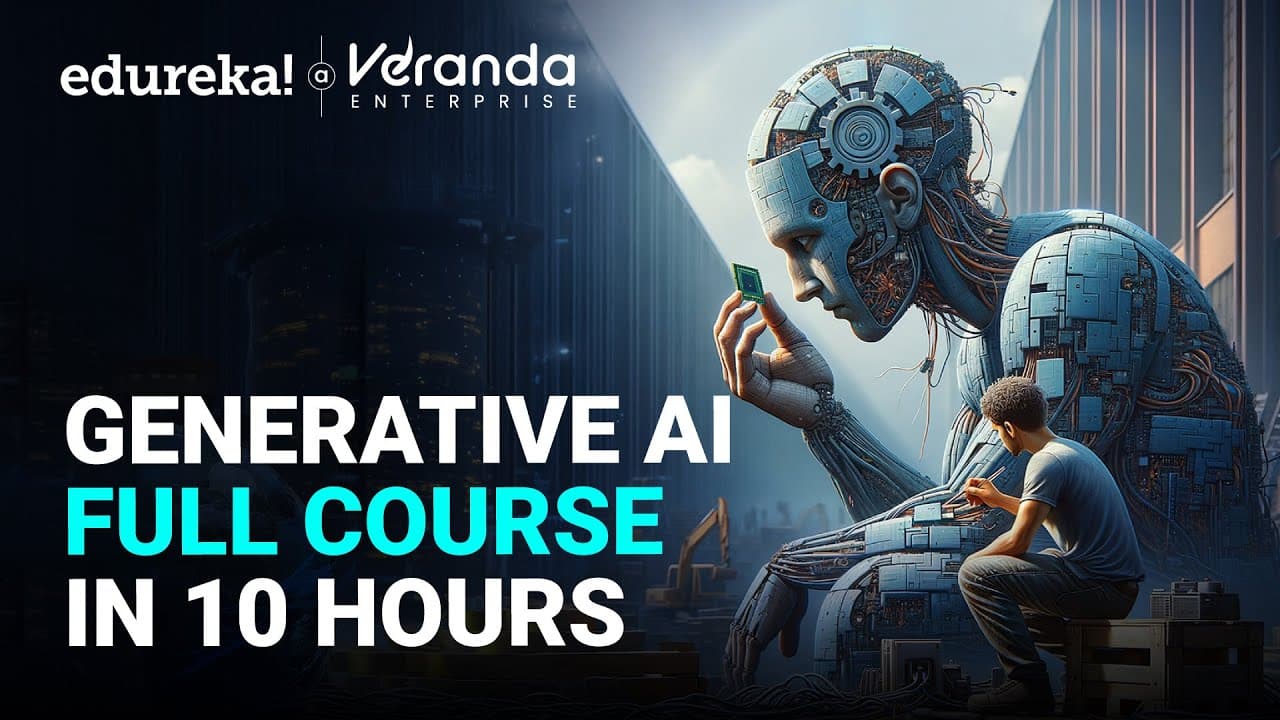
Generative AI creates new text, images, music, and code by learning patterns from large volumes of data through models such as transformers, GANs, and diffusion models. Building a useful system requires a clear objective, prepared data, an appropriate model, training, evaluation, validation, deployment, and ongoing refinement, while responsible development must address bias, misinformation, and ethical use.
Transcript
hello everyone and welcome to this generative AI full course generative AI is a Cutting Edge discipline of artificial intelligence that enables missions to create new content such as text images music or code in the same way that humans do generative AI learns from in numerous volumes of data to produce realistic and imaginative results using deep ... Read More
Key Insights
- Generative AI is a form of artificial intelligence that produces new content in formats including text, images, music, and code. It learns patterns from large volumes of data and uses deep learning models such as GANs, transformers, and diffusion models to generate realistic or imaginative outputs.
- The generative AI development cycle is an iterative process of defining an objective, preparing data, selecting a suitable model, training it, evaluating results, validating performance, deploying the system, and refining it with feedback and additional data. Continued iteration helps models remain useful and relevant.
- Generative AI applications are spread across content creation, image production, coding assistance, translation, healthcare, and marketing. The transcript cites GitHub Copilot for code suggestions, DALL-E 3 for image generation, GPT-4 for text generation, Grammarly for writing support, and H2O.ai for accessible machine learning models.
- Large language models are presented as a foundation for AI-driven text production. The course places LLMs alongside transformers, prompt engineering, LangChain, and retrieval-augmented generation, showing how these topics contribute to building applications that generate text and improve responses through external information sources.
- Retrieval-augmented generation is described as a method for improving AI answers with external data sources. Within the course sequence, RAG follows LangChain and is treated as a practical component for developing LLM applications whose responses need information beyond the model's existing learned patterns.
- A YouTube summarizer can be built by extracting a video's transcript, sending that transcript to an LLM for summarization, and presenting the result through a Streamlit interface. The demonstrated setup uses Python 3.10, YouTube Transcript API, Google Gemini access, environment variables, and supporting Python libraries.
- Generative AI adoption is affecting healthcare, education, marketing, technology, consulting, and other workplace settings. The transcript projects a healthcare generative AI market of $17.2 billion by 2032 and identifies marketing and technology as areas experiencing especially strong workplace impact.
- Responsible generative AI development requires attention to bias, misinformation, and ethical use. These risks accompany the technology's creative and productive capabilities, so the course treats ethics as part of the learning path alongside model architecture, application frameworks, career preparation, and practical implementation.
Install to Summarize YouTube Videos and Get Transcripts
Explore YouTube Video Summarizer or Get YouTube Transcript Extractor
Questions & Answers
Q: What is generative AI and what can it create?
Generative AI is a type of artificial intelligence that creates new content after learning patterns from large volumes of data. It can produce text, articles, summaries, images, artwork, music, code suggestions, translations, and automated responses. The course identifies GANs, transformers, and diffusion models as important deep learning approaches behind these capabilities and presents generative AI as useful across many industries.
Q: How does the generative AI development process work?
The process starts by defining a clear objective, such as generating text, creating images, or assisting with code. Relevant data is then gathered, cleaned, and structured before an appropriate model is selected or adapted. The model is trained, evaluated, refined, tested, and validated against the objective. After deployment, feedback and new data guide further improvements through an ongoing cycle.
Q: What are common real-world applications of generative AI?
Common applications include generating articles, summarizing material, creating images from text prompts, suggesting or completing code, translating languages with contextual awareness, and improving grammar, tone, and clarity. The transcript also describes uses in personalized healthcare, marketing optimization, business support, decision-making, music composition, architecture, virtual assistance, and making machine learning models accessible to people without deep technical expertise.
Q: Which generative AI tools are discussed in the course?
The course mentions GitHub Copilot as a coding assistant, DALL-E 3 for producing images from text prompts, GPT and GPT-4 for language generation, Grammarly for writing assistance, and H2O.ai for access to machine learning models. It also covers Midjourney, the OpenAI API with Python, Google Gemini API access, LangChain, Streamlit, and YouTube Transcript API in practical sections.
Q: What are LLMs, transformers, GANs, and diffusion models used for?
Large language models are introduced in connection with AI-driven text production, while transformers are examined for their role in the development of modern generative AI models. GANs are presented as important for AI-generated content, including a practical DC-GAN image-generation section. Diffusion models are also named among the deep learning approaches that enable generative systems to produce realistic and imaginative results.
Q: What are LangChain and RAG used for in generative AI?
LangChain is presented as a framework for developing AI-powered applications that use large language models. RAG, or retrieval-augmented generation, is introduced as a way to improve AI answers by incorporating external data sources. Together, these topics form part of the course's application-development pathway, following the foundations of LLMs, transformers, and prompt engineering and preceding later practical and career-oriented sections.
Q: How can you build a YouTube video summarizer with an LLM?
The demonstrated project extracts a YouTube video's transcript and uses an LLM to generate a summary, which is then displayed through a user-friendly Streamlit interface. Its setup includes a Python 3.10 Conda environment, an environment file for the Google API key, and a requirements file containing YouTube Transcript API, Streamlit, Google generative AI access, python-dotenv, and pathlib-related support.
Q: What risks and future impacts of generative AI does the course identify?
The course identifies bias, ethical concerns, and misinformation as major risks that require responsible AI development and use. It also anticipates broader AI-assisted creativity, personalized user experiences, real-time content generation, architectural design and material optimization, human and AI collaboration, and more advanced models. These developments are presented alongside changing workplace roles, industry adoption, career opportunities, and the need for ethical practices.
Summary & Key Takeaways
-
Generative AI produces original content across formats such as text, images, music, and code. Its applications include writing assistance, translation, coding support, healthcare personalization, marketing optimization, business insights, and creative production. Deep learning approaches such as GANs, transformers, and diffusion models provide the foundations for many of these capabilities.
-
A generative AI project begins by defining a specific objective and gathering suitable data. Developers then preprocess that data, choose or adapt a model, train it to recognize patterns, evaluate its performance, and refine weaknesses. Testing precedes deployment, while feedback and additional data support continuing iteration after release.
-
The course connects foundational AI topics with practical generative AI development. Its curriculum covers artificial intelligence types, deep learning, TensorFlow, neural networks, LLMs, GANs, transformers, prompt engineering, LangChain, RAG, image generation, APIs, marketing, agentic AI, careers, ethics, and a project for summarizing YouTube transcripts with Gemini and Streamlit.
Read in Other Languages (beta)
Share This Summary 📚
Summarize YouTube Videos and Get Video Transcripts with 1-Click
Try YouTube Summary with ChatGPT & Claude or YouTube Transcript Generator
Explore More Summaries from edureka! 📚


Summarize YouTube Videos and Get Video Transcripts with 1-Click
Try YouTube Summary with ChatGPT & Claude or YouTube Transcript Generator