How Did Kant and Hegel Explain Reality?
TL;DR
Kant argued that the mind actively shapes the reality people experience, while true reality, or things-in-themselves, remains unknowable. His attempt to reconcile rationalism, empiricism, and skepticism transformed epistemology but left questions about the source and consistency of interpretation, which Hegel addressed through the dialectic of the geist, influencing Marxism and the nation-state.
Transcript
Okay. So today we will do Emanuel Kant and Frederick Hegel. So um my main argument is that Kant is really taking the main thesis of Dante um which is the imagination is the animating force of the universe and love is the unifying force of the universe. And and what he will do is he will use his epistomology. Epismology just means theory of knowledg... Read More
Key Insights
- Kant's central epistemological claim is that human beings actively participate in making experienced reality. The mind does not merely receive the world passively, because its internal mechanisms interpret engagement with reality and produce the realm of appearances that Kant calls phenomena.
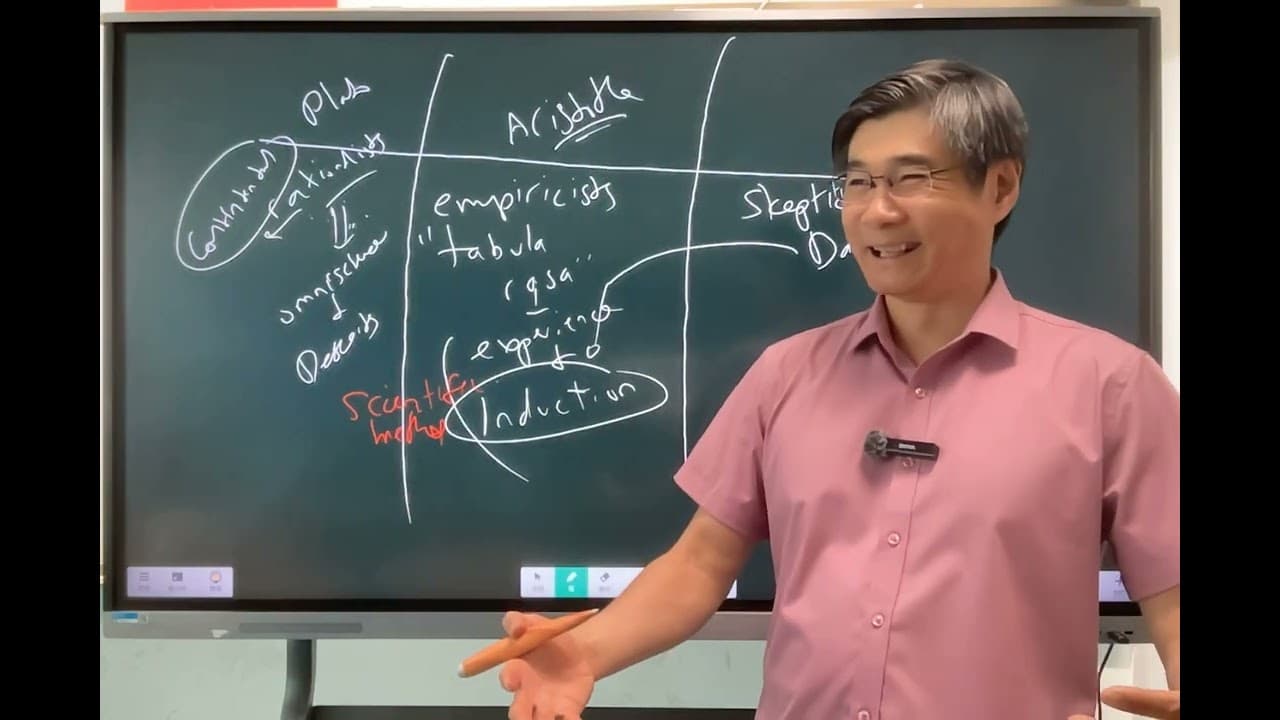
- Plato's worldview is dualistic because it gives significance to both ideas and matter. The form of the good produces ideals and forms, while ordinary experience belongs to a shadow world of imitations, making philosophy and mathematics paths toward what is true and real.
- Aristotle's worldview is materialistic because it focuses on the observable world, movement, cause and effect, and purpose. His concept of telos describes what something moves toward, and observation allows people to identify purposes, categorize things, and develop knowledge grounded in experience.
- Rationalism is the attempt to reason toward the mind of God through mathematics, logic, and first principles. Kant rejects its pursuit of omniscience because human reason has limits, making complete knowledge of God or reality impossible within the capacities of the human mind.
- Empiricism is the view that the mind begins as a blank slate and acquires knowledge through experience and induction. Kant argues that a completely empty mind could not engage with the world, because mechanisms of thought must already exist for experience to become intelligible.
- Hume's skepticism is based on the problem of induction. Observing many white swans cannot prove that every swan is white, because an unobserved exception may exist. Hume therefore treats much accepted knowledge as custom or consensus rather than as inherent truth.
- Kant's distinction between noumena and phenomena separates things-in-themselves from things as they appear to human beings. Noumena represent true reality, while phenomena constitute the interpreted world created when the mind's reasoning capacities engage with what exists.
- Hegel's dialectic of the geist responds to limitations left by Kant's epistemology. Kant did not identify the source of interpretive capacity or explain why interpretations would remain uniform across cultures and history, and Hegel's response later influenced Marxism and the nation-state.
- Related book: The Critique of Pure Reason
- Export your Kindle highlights to Glasp: How to Download Highlights and Notes from Kindle
Install to Summarize YouTube Videos and Get Transcripts
Explore YouTube Video Summarizer or Get YouTube Transcript Extractor
Questions & Answers
Q: How did Kant explain the mind's role in reality?
Kant argued that the mind is an active participant in producing the world people experience. When human reasoning engages reality, mental mechanisms interpret and organize that encounter, creating the realm of appearances called phenomena. This means people do not simply observe reality as passive recipients. However, the underlying things-in-themselves, which Kant calls noumena, remain distinct from the interpreted reality available to human experience.
Q: What is the difference between noumena and phenomena in Kant's philosophy?
Noumena are things-in-themselves, meaning the true and real world independently of how human beings perceive it. Phenomena are things for us, meaning the appearances produced when the mind engages and interprets reality. Kant's distinction establishes that experienced reality is shaped by mental mechanisms, but it also creates an ontological dilemma because people cannot directly know the reality that exists beyond those appearances.
Q: Why did Kant reject rationalism's pursuit of omniscience?
Kant rejected the rationalist pursuit of omniscience because he believed human reason has unavoidable limitations. Rationalists attempted to use mathematics, logic, and first principles to reason toward the mind of God. Kant maintained that complete knowledge of this kind is impossible. Reason remains important, but it cannot provide unlimited access to God, true reality, or every possible object of knowledge.
Q: Why did Kant reject the empiricist blank slate?
Kant rejected the claim that the mind begins as a completely blank slate because some mechanisms of thought must already be present for a person to engage with the world. Experience alone cannot account for knowledge if the mind has no prior capacity to interpret or organize experience. His position therefore preserves the importance of observation while denying that every element of thought originates solely from experience.
Q: How did David Hume challenge induction and philosophy?
David Hume argued that repeated observations cannot justify a universal conclusion. Seeing even a very large number of white swans does not prove that all swans are white, because a black swan may still exist. He therefore challenged induction and claimed that much human understanding rests on custom or consensus. This skepticism suggested that true knowledge and philosophical abstraction might be impossible.
Q: How do Plato and Aristotle differ on reality?
Plato presents a dualistic worldview in which both ideas and matter matter, although eternal ideals and forms constitute the true world while ordinary experience consists of imperfect imitations. Aristotle adopts a materialistic approach focused on the here and now. He studies observable movement, cause and effect, purpose, and categorization, providing an intellectual basis for experience-centered inquiry and the scientific method.
Q: What problems did Kant's epistemology leave unresolved?
Kant's epistemology left three major problems unresolved. It claimed that true reality, or things-in-themselves, could never be known, creating an ontological dilemma. It did not identify the source of the mind's capacity to interpret the world. It also failed to explain why interpretations would be sufficiently uniform across different cultures and historical periods, rather than varying without a common structure.
Q: How did Hegel respond to the limits of Kant's philosophy?
Hegel responded to the unresolved limitations in Kant's epistemology by developing the dialectic of the geist. This theory addressed questions about interpretation that Kant had not fully answered, including its source and its consistency across history and cultures. According to the description, Hegel's approach subsequently influenced the development of both Marxism and the nation-state, extending epistemological questions into historical and political thought.
Summary & Key Takeaways
-
Western philosophy was historically divided between Plato's dualism and Aristotle's materialism. Plato treated eternal ideals and forms as more real than their imitations, while Aristotle emphasized observable movement, purpose, categorization, and cause and effect. Their contrasting approaches later provided foundations for rationalist and empiricist schools of thought.
-
Rationalists sought knowledge through mathematics, logic, and reasoning from first principles, while empiricists argued that knowledge begins with experience and induction. David Hume challenged induction, arguing that repeated observations cannot establish universal truth. His skepticism reduced knowledge to experience and custom, placing the purpose of philosophy itself in doubt.
-
Kant responded by rejecting rationalist omniscience, the empiricist blank slate, and Hume's denial of inherent knowledge. He argued that minds contain mechanisms that actively organize experience, producing phenomena while leaving noumena unknowable. Hegel later addressed unresolved problems through the dialectic of the geist, influencing Marxism and the nation-state.
Read in Other Languages (beta)
Share This Summary 📚
Summarize YouTube Videos and Get Video Transcripts with 1-Click
Try YouTube Summary with ChatGPT & Claude or YouTube Transcript Generator
Explore More Summaries from Predictive History 📚

Summarize YouTube Videos and Get Video Transcripts with 1-Click
Try YouTube Summary with ChatGPT & Claude or YouTube Transcript Generator