What Are the Impacts of DeepSeek AI on Global Tech?
TL;DR
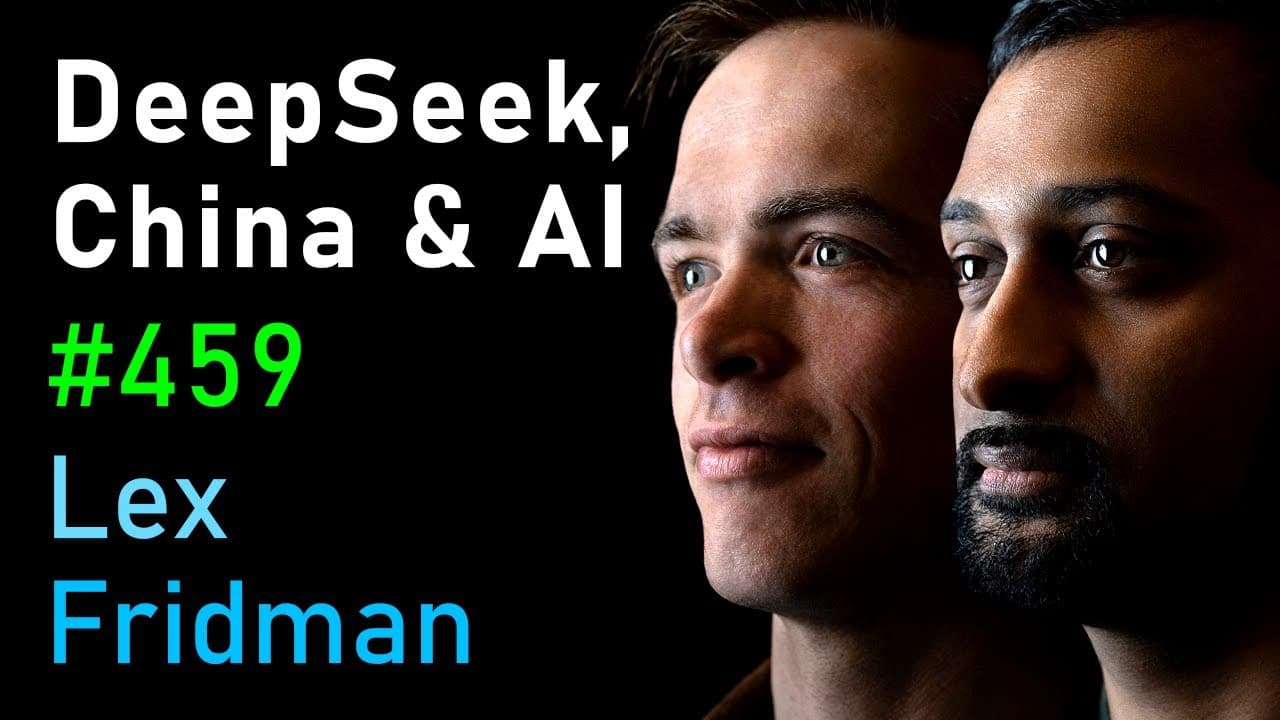
DeepSeek, a China-based AI lab, shook the AI world with two open-weight models: DeepSeek V3, a mixture-of-experts Transformer released around December 26, and DeepSeek R1, a reasoning model released January 20. In this Lex Fridman conversation, SemiAnalysis's Dylan Patel and the Allen Institute's Nathan Lambert explain how R1 matches OpenAI's o3-mini on benchmarks while staying cheaper and revealing its full chain-of-thought reasoning. Read on for how open weights, export controls, and geopolitics are reshaping the AI race.
Transcript
- The following is a conversation with Dylan Patel and Nathan Lambert. Dylan runs SemiAnalysis, a well-respected research and analysis company that specializes in semiconductors, GPUs, CPUs, and AI hardware in general. Nathan is a research scientist at the Allen Institute for AI and is the author of the amazing blog on AI called Interconnects. They... Read More
Key Insights
- 📭 Open-source models like DeepSeek's R1 are changing the competitive landscape of AI by lowering entry barriers for innovation.
- 🪛 Geopolitical tensions, particularly between the US and China, are driving advancements in AI hardware and shaping market dynamics.
- ❓ The distinction between reasoning and traditional AI models is becoming increasingly important for the future trajectory of AI development.
- 🈸 Agents have the potential to transform AI applications by enabling autonomous decision-making, though reliability remains a challenge.
- 👻 Training AI through reinforcement learning is fostering better performance in complex tasks by allowing systems to adapt based on trial and error.
- 🤨 The rising cost of GPU resources raises questions about the sustainability and scalability of AI technology in businesses.
- 👶 AI technology is poised to disrupt multiple sectors, necessitating new ethical frameworks and regulations.
Install to Summarize YouTube Videos and Get Transcripts
Explore YouTube Video Summarizer or Get YouTube Transcript Extractor
Questions & Answers
Q: Who are the guests on Lex Fridman Podcast #459 about DeepSeek?
The guests are Dylan Patel and Nathan Lambert. Dylan runs SemiAnalysis, a research and analysis company that specializes in semiconductors, GPUs, CPUs, and AI hardware in general. Nathan Lambert is a research scientist at the Allen Institute for AI and the author of an AI blog called interconnects. Lex used the DeepSeek moment as an opportunity to sit down with them.
Q: What are DeepSeek V3 and DeepSeek R1?
DeepSeek V3 is a mixture-of-experts Transformer language model from DeepSeek, a company based in China. It is an open-weight instruction model, like the kind used in chat applications, and was released around December 26. DeepSeek R1, released weeks later on January 20, is a reasoning model that shares many overlapping training steps with V3.
Q: How does DeepSeek R1 compare to OpenAI's o3-mini?
In the conversation, R1 is described as having similar performance to o3-mini on benchmarks while still being cheaper. R1 also reveals its full chain-of-thought reasoning, whereas o3-mini only shows a summary of its reasoning. R1 is open weight and o3-mini is not, though Lex notes that in his personal vibe check he still found o3-mini high better in some cases.
Q: What does it mean for a model to be "open weight"?
Open weight means a language model's weights are available on the internet for people to download. Those weights can come with different licenses, which are the terms by which you can use the model. Popular open-weight models such as Llama, DeepSeek, Qwen, and Mistral each have some of their own licenses.
Q: Is "open weight" the same as "open source"?
No. The transcript stresses that although "open weight" sounds close to "open source," they are not the same thing, and the definition and soul of open-source AI are still being debated. Open-source software has a rich history around freedoms to modify and redistribute, and what those freedoms mean for AI is still being defined.
Q: What is the difference between a base model, a chat model, and a reasoning model?
The transcript explains that DeepSeek releases a base model, which is the model before post-training techniques are applied. Additional steps turn that base model into a chat or instruction model, and separately, different techniques are applied to produce a reasoning model. Most applications today are served by instruction models rather than base models.
Q: Why is the "DeepSeek moment" considered significant?
The guests describe DeepSeek as a moment that shook the AI world. Lex predicts it will still be remembered five years from now as a pivotal event in tech history, due in part to its geopolitical implications and for other reasons discussed in detail throughout the conversation.
Q: Which companies and geopolitical issues does the conversation cover?
The discussion ranges across DeepSeek, OpenAI, Google, xAI, Meta, and Anthropic to Nvidia and TSMC, as well as US-China and China-Taiwan relations. Dylan Patel's expertise in semiconductors and AI hardware anchors the discussion of how chips and geopolitics shape the cutting edge of AI.
Summary & Key Takeaways
-
The conversation explores the rapid advancements in AI hardware, particularly focusing on companies like DeepSeek and Nvidia, and their implications on the industry.
-
It discusses the distinctions between reasoning models and traditional AI, emphasizing open-source developments and the increasing importance of ethical considerations in AI deployment.
-
Key themes include the challenges of building powerful AI systems, the impact of geopolitical dynamics on technology, and the future prospects of AI-driven innovation.
Read in Other Languages (beta)
Share This Summary 📚
Summarize YouTube Videos and Get Video Transcripts with 1-Click
Try YouTube Summary with ChatGPT & Claude or YouTube Transcript Generator
Explore More Summaries from Lex Fridman 📚

Summarize YouTube Videos and Get Video Transcripts with 1-Click
Try YouTube Summary with ChatGPT & Claude or YouTube Transcript Generator