TensorFlow Tutorial (Sherry Moore, Google Brain)
TL;DR
This comprehensive analysis explores a tutorial on TensorFlow, covering its definition, features, and applications in machine learning. The content also includes practical exercises to build models for linear regression and handwritten digit recognition.
Transcript
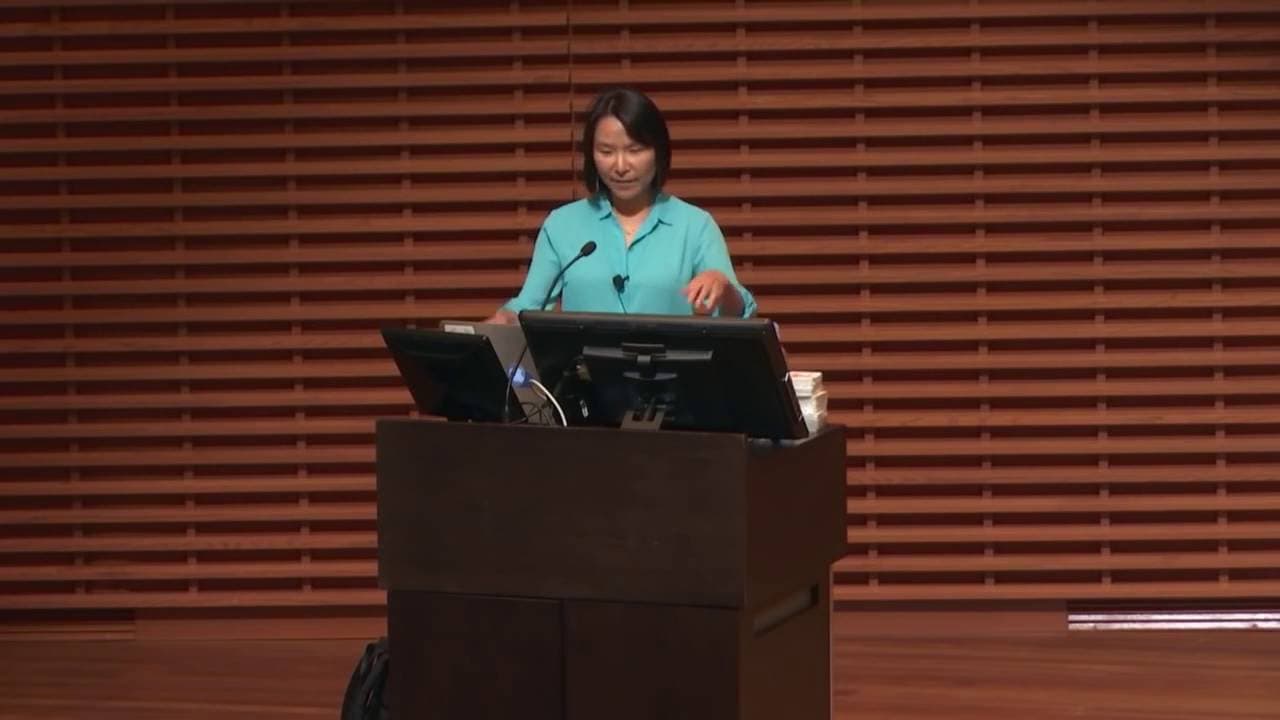
so I'm going to take a picture so I remember how many of you are here smile like Sammy says my name is sherry Moore I work in a Google brain team so today I'll be giving a tutorial on tensor flow first I'll talk up a little bit about what tends to flow is and how it works how we use it at Google and then the important part is that I'm going to work... Read More
Key Insights
- 🧡 TensorFlow is a popular machine learning library developed by Google, known for its flexible dataflow infrastructure and wide range of applications.
- 👨🔬 The library was designed to support researchers and provide a seamless transition from research to prototyping to production.
- 😒 TensorFlow uses tensors to hold data and constructs a graph of computation nodes for processing the data.
- 🏛️ TensorFlow can be used to build neural networks and supports various primitives and operations for efficient machine learning.
- 📱 The library is designed to be portable and can run on different devices, including CPUs, GPUs, mobile phones, and specialized hardware like TPUs.
- 🤩 TensorFlow has gained popularity and recognition in the machine learning community, with a large number of stars, forks, and contributions on GitHub.
- 📚 Google has provided various models and libraries built on top of TensorFlow, and also encourages users to contribute their own models and libraries.
Install to Summarize YouTube Videos and Get Transcripts
Explore YouTube Video Summarizer or Get YouTube Transcript Extractor
Questions & Answers
Q: What is TensorFlow and why is it popular?
TensorFlow is a machine learning library developed by Google that supports various applications and provides a flexible dataflow infrastructure. It is popular due to its wide range of functionalities and ease of use for researchers.
Q: Can TensorFlow be used to build neural networks?
Yes, TensorFlow can be used to build neural networks. It provides all the necessary primitives, such as neurons and operations like convolution and matrix multiplication, to construct neural networks.
Q: How does TensorFlow handle data in a network?
TensorFlow holds all the data in tensors, which are multi-dimensional arrays. The data flows through a graph of computation nodes, with each node performing specific operations on the data.
Q: Can TensorFlow be used on different devices, such as CPUs, GPUs, and mobile phones?
Yes, TensorFlow is designed to be portable and can run on various devices. It supports CPUs, GPUs, mobile phones, and even specialized hardware like TPUs (Tensor Processing Units) for efficient machine learning processing.
Summary
In this video, Sherry Moore from the Google Brain team gives a tutorial on TensorFlow. She explains what TensorFlow is, how it works, and how it is used at Google. She then demonstrates how to build and train models using TensorFlow to solve classic machine learning problems such as linear regression and classification.
Questions & Answers
Q: What is TensorFlow?
TensorFlow is a machine learning library developed at Google that was open-sourced in November. It is a popular library known for its flexible dataflow infrastructure, making it suitable for a wide range of applications.
Q: How does TensorFlow work?
TensorFlow works by using computation nodes to process data. These nodes, represented as circles and rectangles in a graph, are connected to each other and perform specific functions such as matrix multiplication or convolution. Data is held in tensors, which are multi-dimensional arrays. The flow of tensors through the network is what powers TensorFlow.
Q: How is TensorFlow used at Google?
TensorFlow is used extensively at Google for various tasks such as image recognition, voice search, playing games, and even creating art. Google has published models and libraries to support these applications and encourages contributions from developers.
Q: What is needed to build a neural network with TensorFlow?
To build a neural network in TensorFlow, you need neurons, which process data, and tensors, which hold the data. Neurons operate on the data, performing operations such as convolution or matrix multiplication.
Q: What are variables in TensorFlow?
Variables in TensorFlow are used to hold all the weights and biases associated with the network. They are stateful operations and allow the network to learn and update its parameters during training.
Q: How does one visualize the TensorFlow graph?
The TensorFlow graph can be visualized using TensorBoard, which is a tool that allows you to load and visualize the graph produced by TensorFlow. It provides a visual representation of the network, making it easier to validate and debug.
Q: What are the critical components needed when building a neural network in TensorFlow?
The critical components when building a neural network in TensorFlow are the input data, the inference graph, the training operations, and the running of the graph. These components need to be defined and connected properly to create a functioning network.
Q: How can one find what optimizers are available in TensorFlow?
To find the optimizers available in TensorFlow, one can refer to the TensorFlow API documentation or check the GitHub repository. These resources provide information on the available optimizers and their usage.
Q: How can checkpoints be saved and loaded in TensorFlow?
Checkpoints in TensorFlow can be saved and loaded using the Saver object. The Saver is used to save and restore the states of the network, allowing you to continue training from a previous checkpoint or evaluate the network at a later time.
Q: How can placeholders be used in TensorFlow?
Placeholders in TensorFlow allow you to feed data into the network during training, inference, or evaluation. They are placeholders for tensors and are useful for flexible training where you can feed any data you want.
Q: How can evaluation be done using a TensorFlow checkpoint?
Evaluation using a TensorFlow checkpoint can be done by loading the saved checkpoint and feeding in the evaluation data. The network will then make predictions based on the loaded parameters and the provided data.
Takeaways
TensorFlow is a powerful machine learning library developed by Google. It has a flexible dataflow infrastructure that makes it suitable for a wide range of applications. TensorFlow is used extensively at Google for tasks such as image recognition, voice search, playing games, and creating art. Checkpoints can be saved and loaded in TensorFlow using the Saver object, allowing for easy continuation of training or evaluation at a later time. Placeholders can be used to feed data into the network during training, and evaluation can be done by loading a checkpoint and providing evaluation data. TensorFlow provides a comprehensive set of tools and resources for building and training neural networks.
Summary & Key Takeaways
-
TensorFlow is a machine learning library developed by Google, open-sourced in November. It has become the most popular machine learning library due to its flexible dataflow infrastructure.
-
TensorFlow is designed for researchers and supports a variety of applications, including image recognition, voice search, game playing, and art generation.
-
The content provides a tutorial on how to build machine learning models with TensorFlow, covering the basics of linear regression and handwritten digit recognition.
Read in Other Languages (beta)
Share This Summary 📚
Summarize YouTube Videos and Get Video Transcripts with 1-Click
Try YouTube Summary with ChatGPT & Claude or YouTube Transcript Generator
Explore More Summaries from Lex Fridman 📚

Summarize YouTube Videos and Get Video Transcripts with 1-Click
Try YouTube Summary with ChatGPT & Claude or YouTube Transcript Generator