What 6 Skills Won’t Be Replaced by AI Until 2030+?
TL;DR
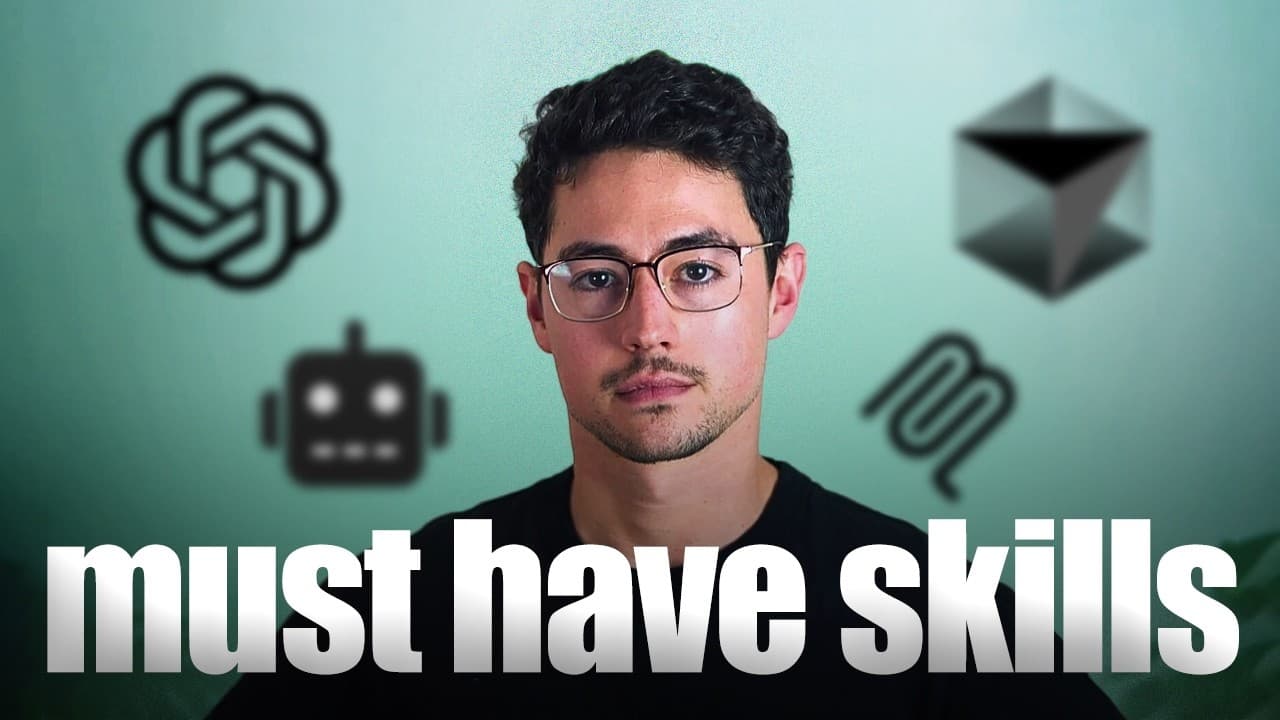
The six durable capabilities highlighted for remaining economically viable through 2030 are agency under uncertainty, interpersonal coordination, empathy, leadership, learning agility, and effective AI use. The practical strategy is to act at reasonable confidence, even around 70%, test minimum viable solutions with real market feedback, build authentic human trust, learn through focused feedback loops, and combine AI tools into controlled systems. Read on for specific ways to develop these advantages.
Transcript
I think a lot of people are rightfully worried about how to futureproof themselves against developments in AI technology. So, in this video, I wanted to cover six skills that I don't believe are going to be replaced by AI by 2030. And I'm saying 2030 here because I do think that eventually models are just going to outperform humans at most economic... Read More
Key Insights
- Agency under uncertainty is the ability to act consistently without an external trigger, complete certainty, or permission. People with high agency treat difficult problems as solvable through persistence, create their own opportunities, and move forward when they are reasonably confident that their effort can produce results.
- The value of waiting for perfect knowledge decreases as systems become more complex and knowledge itself becomes less economically valuable. Success therefore favors people who reach sufficient confidence quickly, make a decision, execute repeatedly, and adjust when evidence reveals that their original direction needs improvement.
- A minimum viable solution is a practical way to turn ambiguity into competitive advantage. Instead of building an entire business solution before testing demand, a high-agency operator creates the smallest workable version, exposes it to actual market feedback, and uses the response to determine the next action.
- Human interpersonal ability gains value when AI manages more customer interactions and business processes. Empathy, leadership, active listening, emotional intelligence, and authentic communication can distinguish a person or company in markets where competitors have automated nearly every operational and customer-facing activity.
- Human-to-human selling depends on signals that extend beyond written prompts. Facial expressions, body language, unspoken concerns, and personal imperfections can help establish trust, particularly when someone acknowledges flaws honestly and converts a complicated technical solution into value that customers perceive as centered on people.
- Learning how to learn is more durable than relying only on crystallized knowledge. Rapid learners can reach adequate understanding of a new subject, build with recently developed tools, and remain useful as business opportunities emerge and established industries disappear within increasingly short periods.
- AI-assisted learning works by creating personalized paths, dividing complex skills into manageable components, and supplying quizzes or feedback loops after learning modules. Combining these capabilities with uninterrupted focus can help a person understand unfamiliar concepts faster while still checking supporting references when necessary.
- Effective AI use is the ability to turn model capabilities into controlled, useful output. Valuable practitioners can connect multiple tools through automation or no-code builders, develop prompting approaches, minimize operating costs, maintain output quality, and synthesize available knowledge into systems that accomplish practical goals.
Install to Summarize YouTube Videos and Get Transcripts
Explore YouTube Video Summarizer or Get YouTube Transcript Extractor
Questions & Answers
Q: What 6 skills are unlikely to be replaced by AI until 2030+?
The six highlighted capabilities are agency under uncertainty, interpersonal coordination, empathy, leadership, learning agility, and effective AI use. They help people act amid rapid change, create human trust, acquire unfamiliar knowledge quickly, and turn AI capabilities into useful systems.
Q: How can I develop agency under uncertainty?
Practice acting consistently without waiting for permission, perfect conditions, or 100% certainty. Move forward when you are reasonably confident, illustrated as around 70%, and treat difficult problems as solvable through persistence and effort.
Q: Why is waiting for complete certainty a disadvantage in the AI era?
The transcript argues that systems are becoming more complex while stored knowledge is losing economic value. Waiting to understand everything can therefore delay action, while reaching adequate confidence, executing, and adapting favors speed over perfection.
Q: How should businesses test ideas in an uncertain AI market?
Build an extraordinarily minimal viable solution rather than completing the entire system first. Test it with actual market feedback, then use that evidence to determine the roadmap and turn ambiguity into a competitive advantage.
Q: Why may interpersonal coordination, empathy, and leadership become more valuable?
These abilities may gain a premium as AI handles more customer interactions and business management. People who understand what others are experiencing, help them authentically, and coordinate action can preserve meaningful human contact and strengthen their ability to sell.
Q: What human abilities support selling in an AI-driven economy?
Useful abilities include active listening, emotional intelligence, empathy, authenticity, and reading facial expressions, body language, and unspoken concerns. A seller can build trust by acknowledging imperfections and translating a complicated technical system into business value centered on human needs.
Q: How can AI help someone learn a new skill faster?
AI can create a personalized learning path, divide a complex skill into manageable components, and provide quizzes or feedback after each module. Combining those tools with uninterrupted focus, discussion of difficult concepts, and reference checking can accelerate understanding.
Q: What makes effective AI use economically valuable?
Effective AI use means converting model capabilities into controlled, practical output rather than merely generating information. Valuable practitioners can connect multiple tools through automation or no-code builders, improve prompts, manage operating costs and output quality, and synthesize knowledge into systems that accomplish useful goals.
Summary & Key Takeaways
-
Agency under uncertainty means acting consistently without waiting for permission, perfect conditions, or complete confidence. As knowledge becomes less valuable and systems become more complex, waiting for certainty becomes counterproductive. A practical response is to make reasonably confident decisions, build minimal solutions, test them with real market feedback, and adapt through decisive execution.
-
Interpersonal coordination, empathy, leadership, and selling may become more valuable as AI handles more customer interactions and business management. Human advantages include reading facial expressions and body language, listening actively, demonstrating emotional intelligence, acknowledging imperfections, and building authentic trust. Even highly automated companies can differentiate themselves by deliberately preserving meaningful human contact.
-
Learning agility and effective AI use help people navigate industries that can appear or disappear rapidly. Uninterrupted focus, personalized learning paths, manageable skill components, quizzes, and feedback loops can accelerate understanding. Competitive practitioners also connect multiple AI tools, control pipeline costs and output quality, and translate generated knowledge into practical systems and business value.
Read in Other Languages (beta)
Share This Summary 📚
Summarize YouTube Videos and Get Video Transcripts with 1-Click
Try YouTube Summary with ChatGPT & Claude or YouTube Transcript Generator
Explore More Summaries from Nick Saraev 📚




Summarize YouTube Videos and Get Video Transcripts with 1-Click
Try YouTube Summary with ChatGPT & Claude or YouTube Transcript Generator