Master Unit Conversions with Ease
TL;DR
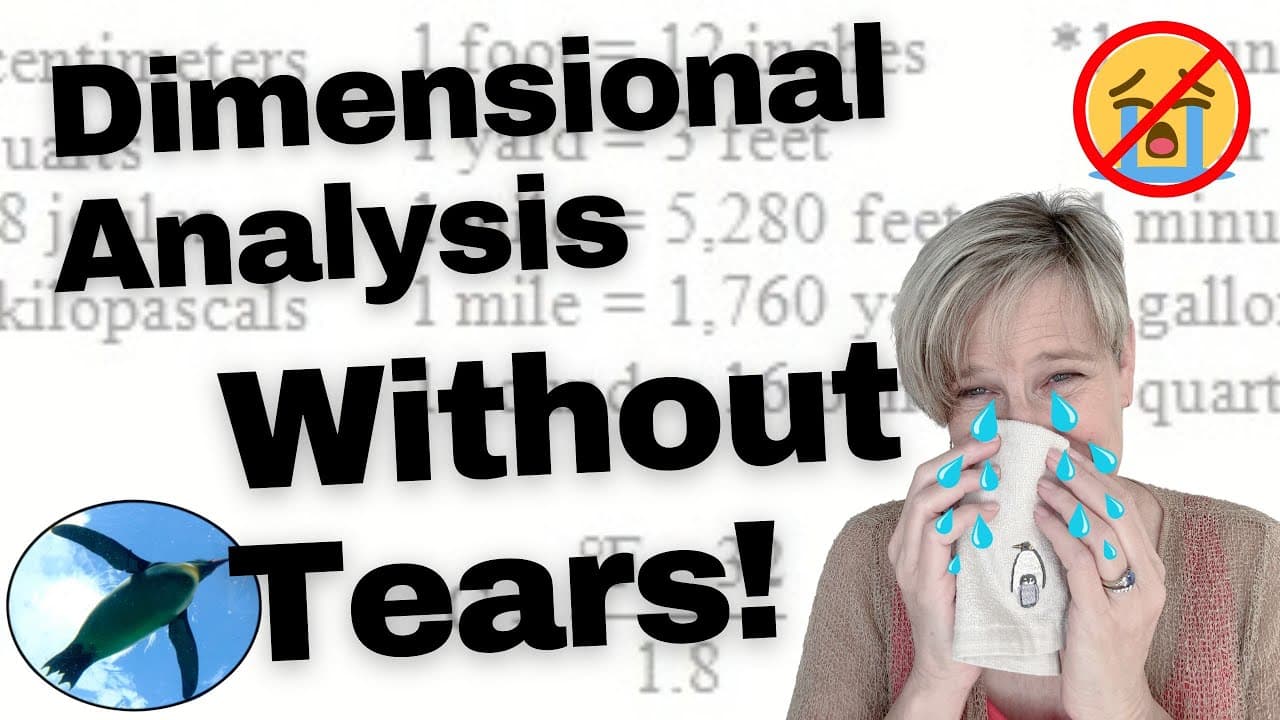
Effortlessly convert units by transforming equalities into fractions, ensuring you multiply by one to maintain value. Keep an eye on unit sizes and offsets, especially for conversions between Celsius and Fahrenheit, which require both multiplication and addition.
Transcript
Hello, and welcome to the Penguin prof Channel! Today, I want to talk about unit conversions without tears. I want to show you a strategy that just always works. How to convert equalities into fractions, how to get the units you want using the power of the number one and how to derive even weird conversions like Celsius to Fahrenheit so you don't h... Read More
Key Insights
- ❓ Conversions can be simplified by transforming equalities into fractions.
- 👻 Conversion factors allow for the cancellation of unwanted units.
- 🇦🇪 Consider the size and offset of units when converting between systems.
- ✖️ Celsius to Fahrenheit conversion requires both multiplication and addition.
- 👣 Keeping track of units is crucial to avoid errors in calculations.
- 🥶 Understanding the freezing and boiling points of water aids in temperature conversions.
- 0️⃣ Different units may have different sizes and zero values.
Install to Summarize YouTube Videos and Get Transcripts
Explore YouTube Video Summarizer or Get YouTube Transcript Extractor
Questions & Answers
Q: How can equalities be transformed into fractions for unit conversions?
Equalities can be written as fractions, such as one hour over 60 minutes, or flipped, like 60 minutes over one hour. These fractions represent equalities and can be used to convert units by multiplying them by one.
Q: How can conversion factors be used to cancel out unwanted units?
To convert units, start with the desired unit and set it equal to the given information. Multiply by appropriate conversion factors that will cancel out the unwanted units, leaving the desired units in the answer.
Q: What should be considered when converting between different unit systems?
The size of the unit and the offset between zero values should be considered. If the size is different, multiplication is required. If the zero values do not coincide, addition is needed for the conversion.
Q: How can Celsius be converted to Fahrenheit?
To convert Celsius to Fahrenheit, multiply by 9/5 (or 1.8) and add 32, which accounts for the difference in the freezing and boiling points of water between the two scales.
Summary & Key Takeaways
-
Converting equalities into fractions allows for easy unit conversions, as multiplying anything by one does not change its value.
-
Conversion factors can be used to cancel out unwanted units and obtain the desired units.
-
Consider the size and offset of units when converting between different systems.
Read in Other Languages (beta)
Share This Summary 📚
Summarize YouTube Videos and Get Video Transcripts with 1-Click
Try YouTube Summary with ChatGPT & Claude or YouTube Transcript Generator
Explore More Summaries from ThePenguinProf 📚




Summarize YouTube Videos and Get Video Transcripts with 1-Click
Try YouTube Summary with ChatGPT & Claude or YouTube Transcript Generator