What Is the Oldest Unsolved Problem in Math?
TL;DR
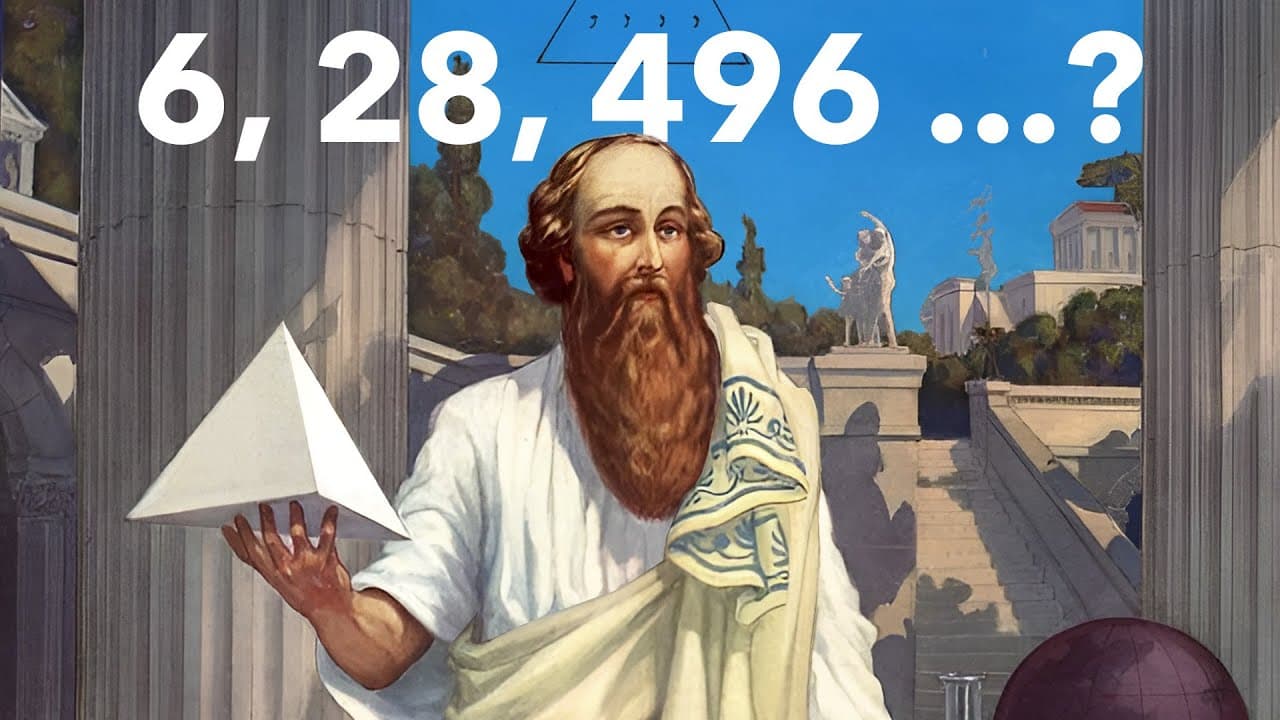
The oldest unsolved problem in mathematics is whether any odd perfect numbers exist. Despite extensive research spanning over 2000 years, no examples have been found, and modern heuristic arguments suggest they are unlikely to exist. However, proving their existence or non-existence remains a significant mathematical challenge.
Transcript
- This is a video about the oldest unsolved problem in math that dates back 2000 years. Some of the brightest mathematicians of all time have tried to crack it, but all of them failed. In the year 2000 the Italian mathematician, Piergiorgio Odifreddi, listed it among four of the most pressing open problems at the time. Solving this problem could be... Read More
Key Insights
- #️⃣ Perfect numbers are numbers whose proper divisors add up to the number itself.
- 💯 Only 51 perfect numbers are known, and all of them are even.
- 💯 The problem of odd perfect numbers has been studied for over 2000 years without a solution.
- #️⃣ Modern techniques, such as computer algorithms and the study of spoof numbers, have been used in the search for odd perfect numbers.
- 💯 Heuristic arguments suggest that odd perfect numbers are unlikely to exist, but a proof has not been found yet.
- 💯 The problem of odd perfect numbers continues to inspire mathematicians and offers an opportunity for individual exploration and discovery.
- 🙈 Mathematical research, even on seemingly abstract problems, can have surprising real-world applications, as seen with cryptography.
Install to Summarize YouTube Videos and Get Transcripts
Explore YouTube Video Summarizer or Get YouTube Transcript Extractor
Questions & Answers
Q: What is a perfect number?
A perfect number is a positive integer that is equal to the sum of its proper divisors. For example, 6 is a perfect number because its proper divisors (1, 2, and 3) sum up to 6.
Q: How many perfect numbers are known?
There are only 51 known perfect numbers, all of which are even. No odd perfect numbers have been discovered yet.
Q: Why are mathematicians interested in solving the problem of odd perfect numbers?
The problem of odd perfect numbers is one of the oldest unsolved problems in math. Solving it would provide valuable insights into number theory and could have potential applications in cryptography.
Q: How do mathematicians search for odd perfect numbers?
Mathematicians use computer algorithms and techniques such as factor chains to search for odd perfect numbers. They have also developed conditions and properties of "spoof" numbers, which are close to being odd perfect numbers, to guide their search.
Summary & Key Takeaways
-
The problem of odd perfect numbers dates back 2000 years and has stumped mathematicians throughout history.
-
Perfect numbers are numbers whose proper divisors add up to the number itself.
-
The search for odd perfect numbers has been conducted using computers and algorithms, but no solution has been found so far.
Read in Other Languages (beta)
Share This Summary 📚
Summarize YouTube Videos and Get Video Transcripts with 1-Click
Try YouTube Summary with ChatGPT & Claude or YouTube Transcript Generator
Explore More Summaries from Veritasium 📚



Summarize YouTube Videos and Get Video Transcripts with 1-Click
Try YouTube Summary with ChatGPT & Claude or YouTube Transcript Generator