Is RingConn Gen 2 Accurate for Sleep and Heart Rate?
TL;DR
RingConn Gen 2 produced poor initial heart rate and sleep-stage results despite its thin design and subscription-free model. Exercise readings differed substantially from a Polar H10 reference, while six nights of comparison with a Zmax headband showed about 60% agreement for deep and light sleep but only 18% agreement for RAM sleep.
Transcript
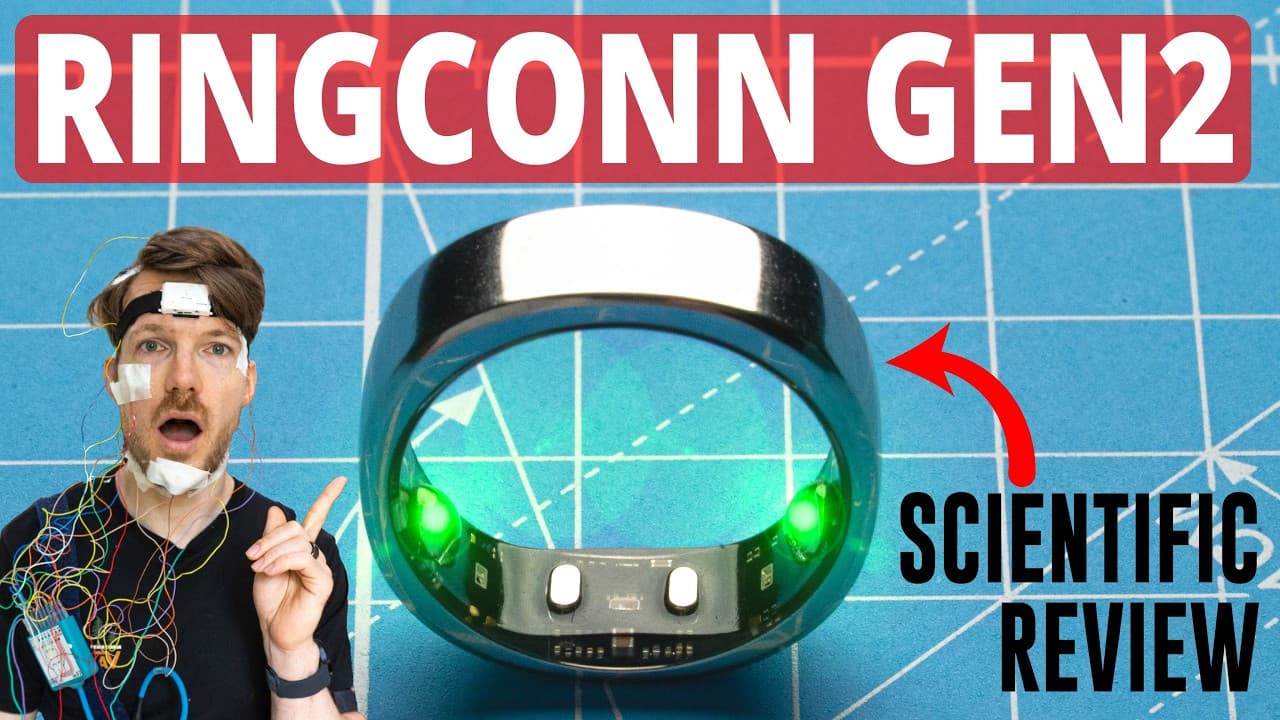
For the last few weeks, I've been wearing the Ringcon generation 2. Now, many of you have been asking me to review this smart ring, and today we'll take an initial look at the Ringcon generation 2. I've been enjoying wearing this ring. It looks quite good, honestly. It's relatively thin, especially if we compare it to an Aura ring, for instance. It... Read More
Key Insights
- RingConn Gen 2 is the thinnest of the three displayed rings, compared with the Oura Ring and Ultrahuman Ring Air. The reviewer enjoyed its appearance and feel, although he observed that most current smart rings look broadly similar.
- RingConn Gen 2 requires no subscription fee, making it more attractive than the Oura Ring's monthly subscription model. However, the Ultrahuman Ring Air example demonstrates that eliminating a subscription does not necessarily produce data quality comparable with Oura.
- RingConn's built-in export function provides daily summaries for activity, sleep, and vital information rather than detailed time-series measurements. These summaries were insufficient for evaluating heart rate tracking or reconstructing the timing of individual sleep stages.
- Apple Health receives RingConn heart rate data only at intervals of roughly 10 minutes, according to the reviewer's inspection. That sampling frequency prevented a detailed numerical comparison with the reference device and forced the initial assessment to rely on side-by-side visual inspection.
- The Polar H10 ECG chest strap served as the heart rate reference because it measures the heart's electrical activity. During indoor cycling, RingConn's recorded pattern differed substantially from the reference, even though cycling is generally considered one of the easier exercises for wearable tracking.
- RingConn Gen 2 reported an exercise maximum of about 148 BPM, while the Polar H10 reference reached closer to 165 BPM. The ring also failed to reproduce the heart rate patterns created by the workout's different intervals, indicating poor initial exercise tracking.
- RingConn Gen 2 achieved about 60% agreement with the Zmax headband for both deep sleep and light sleep across six nights. The reviewer described those results as acceptable only in a limited sense and clearly below strong sleep-stage performance.
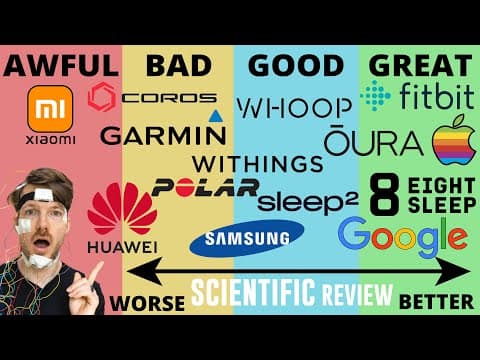
- RingConn Gen 2 achieved only 18% agreement for RAM sleep, while more than two-thirds of reference RAM sleep was classified as light sleep. This weak stage was chiefly responsible for placing the ring near the bottom of the reviewer's device comparison chart.
Install to Summarize YouTube Videos and Get Transcripts
Explore YouTube Video Summarizer or Get YouTube Transcript Extractor
Questions & Answers
Q: How accurate is RingConn Gen 2 for exercise heart rate tracking?
RingConn Gen 2 showed poor initial exercise heart rate accuracy in a side-by-side comparison with a Polar H10 ECG chest strap. During indoor cycling, the ring's interval patterns differed substantially from the reference. Its displayed maximum was about 148 BPM, while the reference maximum was closer to 165 BPM. The reviewer therefore considered the first exercise results unfavorable, while noting that raw data was unavailable for a fuller analysis.
Q: How accurate is RingConn Gen 2 for sleep-stage tracking?
RingConn Gen 2 performed poorly in an initial six-night comparison with a Zmax EG headband. Agreement was about 60% for both deep sleep and light sleep, but only 18% for RAM sleep. More than two-thirds of the periods identified as RAM sleep by the reference were classified as light sleep by the ring. The reviewer consequently did not recommend it for sleep-stage tracking based on these initial results.
Q: Why was RingConn Gen 2 heart rate accuracy difficult to analyze?
Heart rate analysis was limited because the ring did not provide accessible high-resolution data through the tested methods. The app's export function contained only daily summaries, which could not support detailed comparisons. Apple Health showed readings at intervals of roughly 10 minutes, and Strava connectivity was unavailable. As a result, the reviewer could only compare screenshots from RingConn's app with data from the Polar H10 reference.
Q: What reference devices were used to test RingConn Gen 2?
The reviewer used two reference devices for different measurements. A Polar H10 ECG chest strap served as the exercise heart rate reference because it measures the heart's electrical activity. A Zmax EG headband served as the sleep-stage reference because it is a scientific device specifically designed for sleep-stage tracking. RingConn results were compared with these references rather than assessed only through the ring's own app.
Q: Does RingConn Gen 2 require a subscription?
RingConn Gen 2 does not require a subscription fee, which the reviewer identified as an advantage over the Oura Ring's monthly subscription. The Ultrahuman Ring Air also has no subscription, but its earlier testing showed that a subscription-free product can still provide lower-quality data than Oura. The review therefore treats pricing structure and measurement quality as separate considerations rather than assuming one determines the other.
Q: How does RingConn Gen 2 compare with other smart rings in design?
RingConn Gen 2 was the thinnest among the three rings displayed, which included examples from Oura and Ultrahuman. The reviewer liked its appearance, feel, and relatively thin profile. At the same time, he observed that the three products looked broadly similar and that most smart rings are not dramatically different in appearance. The design assessment was positive, but it did not offset the initial measurement concerns.
Q: What did the six-night RingConn sleep comparison find?
Across six nights, about 60% of deep sleep identified by the Zmax reference was also labeled deep sleep by RingConn Gen 2. Light sleep produced a similar agreement of about 60%. RAM sleep agreement fell to only 18%, and more than two-thirds of reference RAM sleep was labeled light sleep. Awake-time comparisons were intentionally ignored because the Zmax scoring algorithm can identify awake moments that are not genuinely awake.
Q: Will RingConn Gen 2 receive a more complete scientific review?
The reviewer plans a more complete assessment after roughly two or three months. The initial sleep analysis covered only six nights, while the later review is expected to include at least 15 and possibly 30 nights. He also intends to investigate raw-data access, ask RingConn about better export options, and compare two rings for consistency if the company sends the additional device it mentioned.
Summary & Key Takeaways
-
RingConn Gen 2 is thinner than the Oura Ring and Ultrahuman Ring Air examples shown, feels comfortable, and requires no subscription. Its subscription-free model is attractive, but the reviewer emphasizes that convenience and appearance do not establish measurement quality, which must be evaluated independently through comparisons with appropriate reference devices.
-
The available export options severely restricted heart rate analysis. RingConn's app exported only daily summaries, while Apple Health supplied readings at roughly 10-minute intervals. A visual comparison against the Polar H10 during indoor cycling showed different interval patterns and a maximum near 148 BPM instead of the reference maximum near 165 BPM.
-
Across six nights, RingConn Gen 2 matched about 60% of reference deep sleep and light sleep, but only 18% of reference RAM sleep. More than two-thirds of reference RAM sleep was labeled light sleep. These initial results placed the ring among the reviewer's worst-performing devices for sleep-stage agreement, although longer testing remains planned.
Read in Other Languages (beta)
Share This Summary 📚
Summarize YouTube Videos and Get Video Transcripts with 1-Click
Try YouTube Summary with ChatGPT & Claude or YouTube Transcript Generator
Explore More Summaries from The Quantified Scientist 📚
Summarize YouTube Videos and Get Video Transcripts with 1-Click
Try YouTube Summary with ChatGPT & Claude or YouTube Transcript Generator