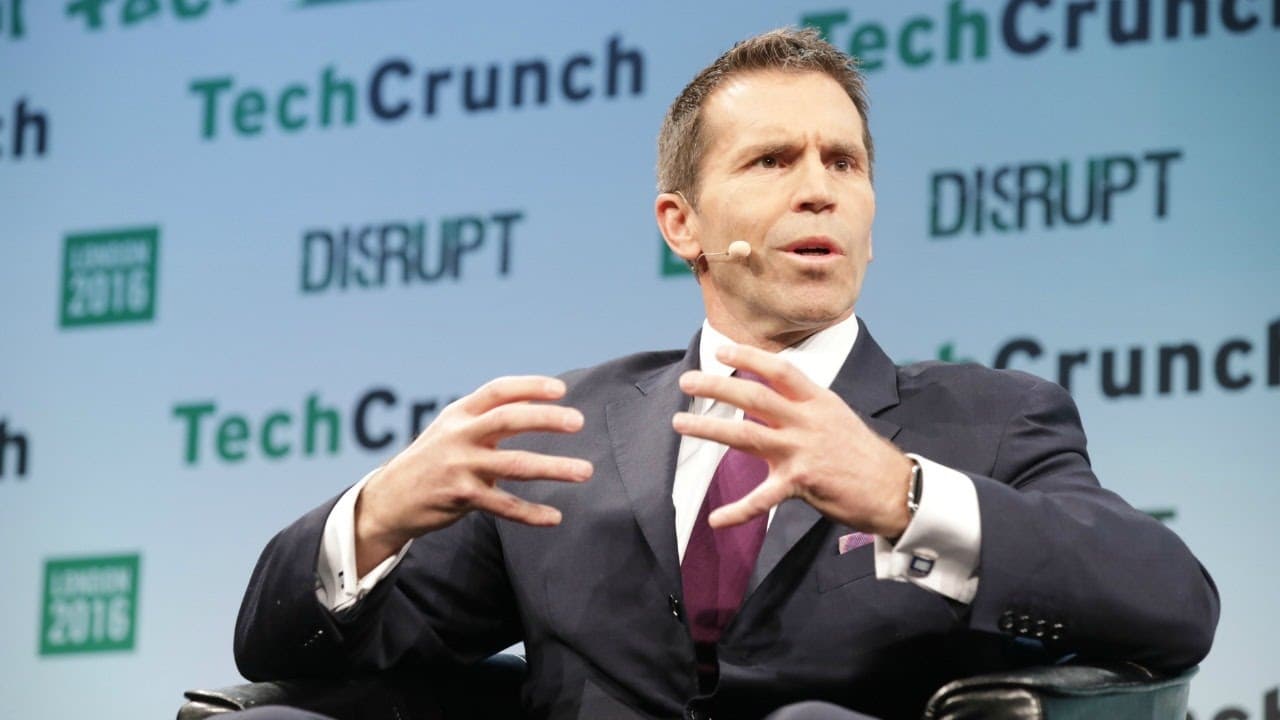
David Rutter of R3 Talks Blockchain
TL;DR
Banks are turning to blockchain to replace decades of siloed, incompatible legacy systems and cut the roughly $3.6 trillion McKinsey estimates global payments cost large institutions yearly. R3 built Corda, a distributed ledger designed specifically for financial institutions with over 70 member banks, letting trades create tamper-resistant cloud records instead of relying on manual reconciliation.
Transcript
well it's tough to get enough of that sweet Southern draw from John sheber so we're going to bring him back up with our next panelist please welcome to the stage David Rudder from R3 and again John sheber I get a feeling of deja vu from this scenario um I'm the the interviewer is so nice they're having me twice uh from robotics we're moving on into... Read More
Key Insights
- R3 is a blockchain company founded and led by David Rutter, who previously spent 10 years at ICAP running its electronic trading business, including BrokerTec and EBS, the largest fixed income and FX electronic exchanges in the world.
- Banks are drawn to blockchain because they are among the most highly regulated organizations in the world, and the cost of supporting compliance and existing infrastructure is enormous, creating a once-in-a-generation opportunity to rethink transactions.
- McKinsey estimates that supporting transactions and global payments among large global financial institutions costs about $3.6 trillion a year, representing the scale of the opportunity R3 and others are targeting.
- The core problem blockchain solves is fragmentation: institutions built their own technologies over 30 to 40 years, many systems are 20 to 30 years old, and they communicate poorly through a spaghetti of APIs even internally.
- Distributed ledgers let two parties push a trade to the cloud as a tamper-resistant record immediately, replacing third-party reconciliation done by humans and using an oracle to import reference rates like LIBOR to determine payments.
- Corda is R3's own distributed ledger, open sourced the week before the interview, designed from the ground up for financial institutions in collaboration with over 70 member banks, distinct from Bitcoin and Ethereum.
- R3 open sourced Corda, on CTO Richard Gendal Brown's conviction, to get more eyeballs on foundational infrastructure meant to last 20 to 30 years, and because banks fear vendor lock-in from proprietary trade processing systems.
- Goldman Sachs and Santander left the consortium during a funding round reportedly seeking $150 million; Rutter said Goldman preferred a smaller management group, while a larger network yields public-company-style governance.
Install to Summarize YouTube Videos and Get Transcripts
Explore YouTube Video Summarizer or Get YouTube Transcript Extractor
Questions & Answers
Q: Why are banks adopting blockchain technology?
Banks are among the most highly regulated organizations in the world, and the cost of doing business to support compliance and secure operations is enormous. According to David Rutter, new cryptographic tools, blockchains, and distributed ledgers create a once-in-a-generation opportunity to reconsider how financial transactions are made, confirmed, and how payments move globally in a far more efficient way. McKinsey estimates global payments cost large institutions about $3.6 trillion a year.
Q: What is R3 and who is David Rutter?
R3 is a blockchain company building distributed ledger technology for financial institutions, working in collaboration with over 70 member banks. David Rutter is its founder and CEO. Before R3, he spent 10 years at ICAP, where he ran the electronic trading business, including BrokerTec and EBS, which are the two largest fixed income and FX electronic exchanges in the world. He led their electronic execution business.
Q: How is blockchain different from the secure technologies banks already have?
Rutter acknowledges banks already have an array of technologies, but that is part of the problem: institutions built their own systems over the last 30 to 40 years, many 20 to 30 years old, and they communicate poorly, relying on APIs even internally, creating a spaghetti of technologies each bank pays to support alone. New cryptographic tools and distributed ledgers allow a shared, secure financial infrastructure in the cloud, letting banks move data safely out from behind their firewalls.
Q: What is Corda and why did R3 open source it?
Corda is R3's own distributed ledger, distinct from Bitcoin and Ethereum, designed from the ground up for financial institutions in collaboration with over 70 member banks. R3 open sourced it the week before the interview. CTO Richard Gendal Brown, formerly of IBM, felt strongly there is an advantage to getting more eyeballs on such a crucial piece of future market infrastructure, which R3 views as foundational technology for the next 20 to 30 years and wants others to build applications on.
Q: How does blockchain reduce trade manipulation and reconciliation costs?
When two parties enter a transaction, instead of one recording it privately and depending on a third party to reconcile it, they push the transaction to the cloud where a tamper-resistant record is created immediately. Software can then perform reconciliation services currently done by humans at individual institutions. An oracle imports rates like LIBOR to determine payments. This makes shenanigans such as hiding a ticket or manipulating a trade a thing of the past, bringing additional security to financial markets.
Q: Does blockchain eliminate the need for LIBOR and interbank exchanges?
No. Rutter says from a regulatory perspective LIBOR as a reference rate is still absolutely crucial. What changes is the mechanics: when two parties enter a transaction, a tamper-resistant record is created immediately in the cloud, and an oracle imports the LIBOR rate to determine the payment transferred between them. This is a panacea for regulators because it removes the current reliance on paper tickets and manual entry that enabled manipulation.
Q: Why did Goldman Sachs and Santander leave the R3 consortium?
Rutter explained that R3 began a funding round, which always gets interesting, and with a large crowd it is tough to meet everybody's criteria. In Goldman's case, he said they preferred to see a smaller group from a management perspective. He noted the consortium is more like a network of members, and that a larger group can actually produce a governance structure resembling a public company because there are so many shareholders.
Q: Why does R3 need such a large network of member banks?
R3 has a little over 70 member banks and adds more weekly, with over 1,100 people at member banks contributing to white papers or code. Rutter admits it sometimes feels like too many, but replacing systems like global payments and trade finance requires scale. You cannot reshape global payments with just three or four banks in the eastern United States; a globally dispersed group is needed to build consensus across technologies and drive big change.
Summary
In this video, David Rutter, the CEO of r3, explains the significance of blockchain technology for banks and why they are adopting it. He discusses the high cost of compliance for banks and the opportunity blockchain presents to create a more efficient and secure financial infrastructure. Rutter also touches on the unique aspects of blockchain technology and its potential to revolutionize the way financial transactions are made and confirmed. He addresses concerns about existing security and cloud technologies, highlighting the benefits of blockchain in terms of transparency, efficiency, and data security. Rutter also explains the decision to open source r3's distributed ledger, Corda, and the advantages of getting more stakeholders involved in its development. He further discusses the role of member banks in the consortium and the challenges and benefits of working with a large network of institutions. Rutter provides insights into the progress of r3's funding round and the expected timeline for substantial adoption of blockchain technology in the financial industry. Finally, he discusses the projects r3 is working on with governments, particularly in the area of interbank payments.
Questions & Answers
Q: Why are banks interested in adopting blockchain technology?
Banks are highly regulated organizations and the cost of compliance is significant. Blockchain offers an opportunity to create a more secure and efficient financial infrastructure, which can save banks significant costs. These new technologies allow for reconsideration of how financial transactions and payments are made, which is appealing to banks that want to ensure the security of their customers' funds.
Q: What is unique about blockchain that makes it attractive to banks?
Blockchain offers features such as transparency, data security, and decentralization that traditional technologies lack. It provides a tamper-resistant record of transactions, eliminating the need for third-party reconciliation. By moving transactions to the cloud and utilizing cryptographic tools, banks can create a more secure financial infrastructure and reduce the reliance on outdated technologies.
Q: Is blockchain just hype? Why not use existing secure and cloud technologies?
While existing technologies can serve certain purposes, they often do not communicate well and require complex API integrations. Blockchain offers a unique opportunity to create a more holistic and efficient financial infrastructure. It allows for the seamless transfer of data and assets between banks, streamlining processes and reducing costs. Blockchain technology is not just about hype, but rather a genuine innovation that can improve the financial industry.
Q: How does blockchain address the issue of trust in financial transactions?
Blockchain creates a tamper-resistant record of transactions, ensuring transparency and trust. It eliminates the need for manual reconciliation and reduces the risks of fraud and manipulation. For example, with blockchain, there would be a tamper-resistant record of a transaction immediately created in the cloud, making it easier to determine payment obligations and preventing ticket hiding or manipulative trades.
Q: How does r3's blockchain technology differ from other companies like Chain or Circle?
r3's approach is more holistic, aiming to build a comprehensive financial infrastructure that can serve multiple purposes. They work closely with member banks and focus on interoperability between different solutions, such as payment systems, trade finance, and derivatives. Companies like Chain or Circle may focus on delivering specific solutions in a more targeted manner.
Q: How do government projects fit into r3's roadmap?
r3 is working on government projects that involve tokenization of fiat currencies for interbank payments. These projects aim to enable faster, more efficient, and cost-effective payment transactions between banks. The involvement of governments demonstrates the recognition of blockchain's potential to improve life for citizens and enhance financial systems.
Q: When will r3's blockchain technology be widely adopted?
R3's blockchain technology is expected to be substantially adopted in the next three to five years. This timeline accounts for the need to build out the necessary infrastructure and gain regulatory and industry acceptance. However, r3 expects to have products in the market by the end of the next year.
Q: What are some of the potential applications of r3's blockchain technology?
R3 is working on various applications, including trade finance, payment systems, and collateral movement. These applications aim to improve the efficiency and security of processes such as asset registries, interbank payments, and securities ownership transfers. The goal is to simplify and expedite financial transactions while adhering to regulatory requirements.
Q: Why did r3 decide to open source their distributed ledger, Corda?
R3 believes that opening their technology up to more scrutiny and allowing others to build applications on it will result in a more robust and widely adopted solution. By open sourcing Corda, r3 aims to foster innovation and collaboration within the industry. Additionally, the privacy and security features of Corda make it suitable for applications beyond the scope of r3's focus.
Q: Is there concern about having too many member banks in the consortium?
While having a large number of member banks seems overwhelming at times, it also provides the advantage of a more diverse and globally dispersed network. Building consensus among various stakeholders is crucial to drive meaningful change in the financial industry. Additionally, having a larger network of member banks helps create a governance structure similar to that of a public company.
Takeaways
In summary, blockchain technology presents an opportunity for banks to create a more efficient and secure financial infrastructure. The high cost of compliance and the need for improved transaction processes are driving banks to adopt blockchain. R3's approach focuses on building a comprehensive financial infrastructure that facilitates interoperability between different solutions. Their distributed ledger, Corda, has been open sourced to encourage innovation and collaboration. Projects with governments highlight the application of blockchain to improve payment systems. While substantial adoption of blockchain technology may take a few years, progress is being made, and the market can expect the deployment of blockchain products by the end of next year. The ultimate goal is to create a more transparent, efficient, and inclusive financial system that benefits individuals and institutions alike.
Summary & Key Takeaways
-
David Rutter, founder and CEO of R3 and a 10-year ICAP veteran who ran BrokerTec and EBS, explains why banks are gravitating to blockchain. As the most heavily regulated organizations, banks face enormous compliance and infrastructure costs, and new cryptographic tools create a rare chance to rebuild how financial transactions are made, confirmed, and settled globally.
-
The key advantage is not speed alone but eliminating fragmentation. Institutions run incompatible systems 20 to 30 years old that barely communicate. Distributed ledgers let two parties record a trade as a tamper-resistant cloud entry instantly, using an oracle to import rates like LIBOR, removing manual reconciliation and making ticket-hiding or trade manipulation a thing of the past.
-
R3 built Corda, open sourced the prior week, as a ledger designed specifically for finance with over 70 member banks and input from more than 1,100 contributors. A large global network is needed to reshape payments and trade finance. Goldman Sachs and Santander left during a reportedly $150 million funding round that had not yet closed.
Read in Other Languages (beta)
Share This Summary 📚
Summarize YouTube Videos and Get Video Transcripts with 1-Click
Try YouTube Summary with ChatGPT & Claude or YouTube Transcript Generator
Explore More Summaries from TechCrunch 📚

Summarize YouTube Videos and Get Video Transcripts with 1-Click
Try YouTube Summary with ChatGPT & Claude or YouTube Transcript Generator