How Does (Formerly Augean) Burro Help Field Workers Harvest Fruit?
TL;DR
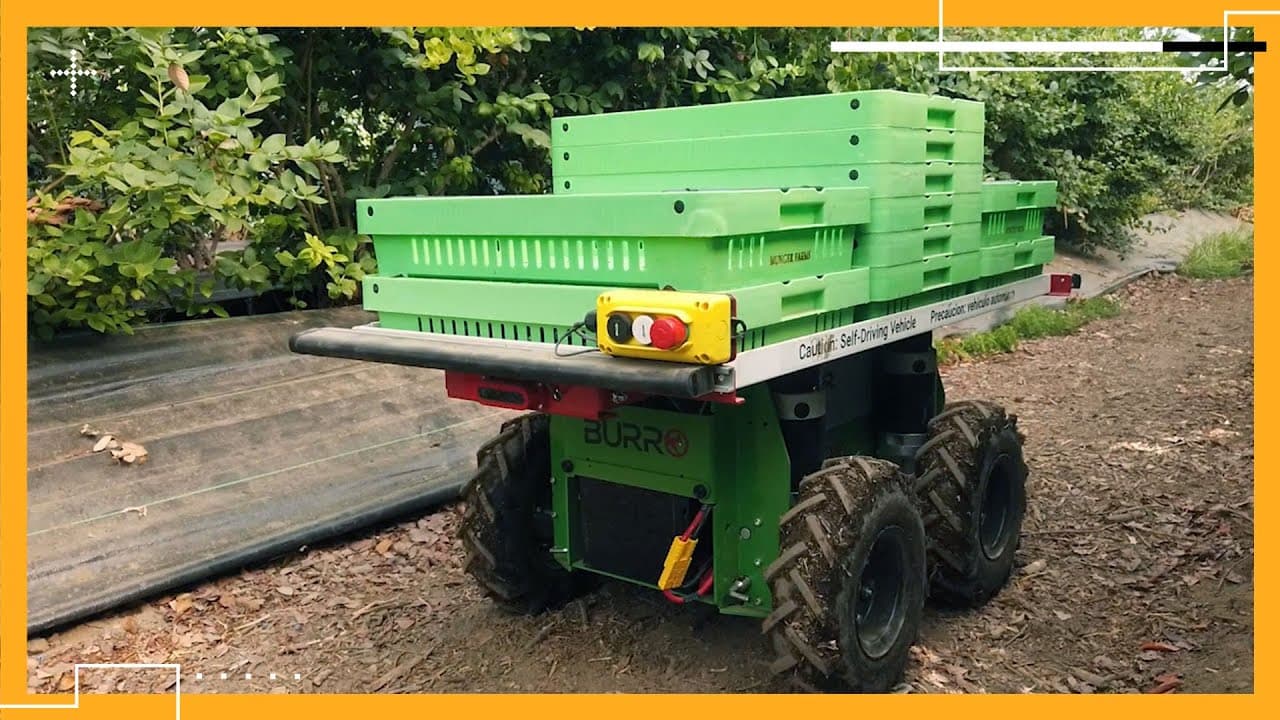
Burro helps field workers by autonomously carrying harvested fruit between crop rows and packing tables, allowing people to avoid moving two- or three-hundred-pound wheelbarrows in high heat. Workers briefly teach the collaborative robot a route, after which it retraces the path, handles obstacles, and shuttles loads throughout the day. Read on to understand its “pop-up autonomy,” field trials, and initial commercial use.
Transcript
we have found within agriculture you know we all know in 20 years things will be heavily automated but what people disagree on is how things actually begin and so we believe that they start with collaborative robots that help people work more productively and over time you more and more things autonomously as well which is what burrow is it's what ... Read More
Key Insights
- 🤖 Collaborative robots like Burrow are expected to play a crucial role in automating agriculture gradually.
- 🍵 Burrow's autonomous capabilities and obstacle handling enable it to navigate complex terrains in agricultural fields.
- 🤖 The concept of "pop-up autonomy" offers a unique approach to training robots for dynamic environments compared to static warehouse settings.
- 🤗 Table grapes are the initial target for Burrow, with plans to expand its usage to other hand-harvested fruits.
- 🧑⚕️ Burrow's deployment can significantly reduce physical strain on agricultural workers, improving their health and well-being.
- 🌥️ Burrow's partnership with the California Table Grape Commission demonstrates its potential to revolutionize large-scale agriculture.
- 🥳 The robot's ability to autonomously shuttle back and forth throughout the day increases overall productivity and efficiency in the field.
Install to Summarize YouTube Videos and Get Transcripts
Explore YouTube Video Summarizer or Get YouTube Transcript Extractor
Questions & Answers
Q: How does Burro help field workers harvest fruit?
Burro acts like an autonomous wheeled donkey that carries harvested fruit back and forth between crop rows and packing tables. This lets workers remain in place instead of running around with two- or three-hundred-pound wheelbarrows in high heat.
Q: What kinds of crops is Burro designed to support?
Burro is intended for hand-harvested fruit operations. The transcript specifically mentions table grapes, blueberries, and other hand-harvested fruits.
Q: How does Burro learn and follow a route?
The robot first follows a person to learn a route from the packing tables to the beginning of a crop row. It can then retrace that path autonomously while performing obstacle handling and path planning.
Q: What does “pop-up autonomy” mean for Burro?
“Pop-up autonomy” is the approach of training Burro on relatively short routes and combining them into larger autonomous progressions. The route is specific to that day, so the robot starts over and relearns it the next day.
Q: Why is autonomous operation difficult in agricultural fields?
Fields are highly variable environments where people move around, lighting changes, dust is present, and terrain conditions shift. Unlike a static, consistently lit warehouse with installed infrastructure, a field requires robots to respond dynamically to the terrain and situation.
Q: How quickly can workers set up Burro for daily operation?
The transcript says workers can set up the robot in perhaps twenty or thirty seconds at the beginning of the day. Afterward, it can autonomously shuttle back and forth throughout the day.
Q: How was Burro tested with growers?
Ten generation-five units completed about 3,000 autonomous hours in paid trials with 15 large growers. Burro also worked with the California Table Grape Commission to refine its autonomy to a commercial grade.
Q: What was Burro’s initial commercial rollout?
Seven of the largest table grape growers in the US each purchased six-packs of Burro robots for delivery that year. Together, those growers hire 19,000 people to pick fruit every day, forming Burro’s initial core customer base.
Summary & Key Takeaways
-
Burrow is a collaborative robot that helps agricultural workers by carrying heavy loads and autonomously following routes in the field.
-
The robot's solution, called Burrow, aims to alleviate the physical strain on workers who currently have to manually transport heavy loads in high-heat conditions.
-
Using the concept of "pop-up autonomy," Burrow trains on short routes and gradually progresses to longer ones, adapting to the dynamic conditions of the field.
Read in Other Languages (beta)
Share This Summary 📚
Summarize YouTube Videos and Get Video Transcripts with 1-Click
Try YouTube Summary with ChatGPT & Claude or YouTube Transcript Generator
Explore More Summaries from TechCrunch 📚






Summarize YouTube Videos and Get Video Transcripts with 1-Click
Try YouTube Summary with ChatGPT & Claude or YouTube Transcript Generator